Psych Final
Consciousness
What is consciousness?
¨ People can be conscious even when they don’t appear to be
¨ All conscious experience is associated with brain activity
¨ Variations in consciousness occur naturally
¨ Consciousness can be manipulated
¨ Conscious experience varies from person to
person
Consciousness: one’s subjective experience of the world, resulting from brain activity
- The brain and mind are inseparable.
- Each of us experiences consciousness personally.
- We cannot know if two people experience the world similarly.
The global workspace model
- consciousness arises as a function of which brain circuits are active.
§ In some cases, brain-injured patients are unaware of their deficits (hemineglect)
- Most importantly, the global workspace model presents no single area of the brain as responsible for general “awareness.”
Traumatic Brain Injury (TBI): impairments in mental functioning caused by a blow to or very sharp movement of the head
– TBIs can range from mild to severe.
– CTE: Chronic Traumatic Encephalopathy
Coma
Conditions of impaired consciousness provide valuable points of contrast to “normal” (fully functioning) consciousness.
– minimally conscious state
• Deliberate movement and communication are possible.
– unresponsive wakefulness syndrome
• complete coma that lasts more than a month
• formerly known as a persistent vegetative state
• Terri Schiavo
Brain Death: The irreversible loss of brain function.
o Terri Schiavo had a severe brain injury, but there was still activity in her brain stem (cannot survive without it)
o Jahi McMath suffered brain death after a routine tonsil surgery.
Locked-In Syndrome: Compared to being buried alive. You see all the sights around you and hear every noise, but you cannot respond physically to these sights and noises.
• Christine Waddell
-Automatic vs. controlled processing
-the cocktail party phenomenon
Selective Attention
· Donald Broadbent developed filter theory to explain the selective nature of attention.
– In this model, attention is like a gate that opens for important information and closes for irrelevant details.
• Some stimuli demand attention and virtually shut off the ability to attend to anything else.
• Decisions about what to attend to are made early in the perceptual process.
Change Blindness: a failure to notice large changes in one’s environment
A Freudian slip occurs when an unconscious thought is suddenly expressed at an inappropriate time or in an inappropriate social context. ( When you say things
Subliminal Perception: the processing of information by sensory systems without conscious awareness.
Circadian rhythms: biological patterns that occur at regular intervals as a function of time of day
– Circadian roughly translates to “about a day.”
Sleeping Brain
· The average person sleeps around 8 hrs per night (but this can vary).
· Bright light suppresses the production of melatonin, whereas darkness triggers its release.
· Information about light detected by the eyes is sent to a small hypothalamus region called the suprachiasmatic nucleus.
– sends signals to a tiny structure called the pineal gland.
· The pineal gland then secretes melatonin
· EEG reveals the brain is active in sleep.
– Beta waves: The EEG shows this activity as short, frequent, irregular brain signals.
Alpha waves: When people focus their attention on something or close their eyes and relax, brain activity slows and becomes more regular.
Stages of Sleep
· Stage 1: The EEG shows theta waves
· Stage 2: The EEG continues to show theta waves. It also indicates occasional bursts of activity called sleep spindles & large waves called K-complexes
· Stages 3 & 4
o Nowadays, they are typically seen as one stage because their brain activity is nearly identical.
– This period is marked by large, regular brain patterns called delta waves, often called slow-wave sleep.
– People in slow-wave sleep are very hard to wake up and are often very disoriented when they wake up.
REM sleep: The stage of sleep marked by rapid eye movement, paralysis of motor systems, and dreaming.
o The sleep cycle reverses after about 90 min, returning to stage 1
o Most dreaming occurs in REM sleep
o About 80% of the time, when people are awakened during REM sleep, they report dreaming.
o Cycle through REM five times per night
Sleep Disorders
· Insomnia: a disorder characterized by an inability to sleep that cause significant problems in daily living.
o An estimated 12 percent to 20 percent of adults have insomnia; it is more common in women than in men and older adults than in younger adults.
o Obstructive sleep apnea: a person, while asleep, stops breathing because his or her throat closes.
§ It’s most common among middle-aged men and is often associated with obesity.
o Narcolepsy: a sleep disorder in which people experience excessive sleepiness during normal waking hours, sometimes going limp and collapsing
§ During an episode of narcolepsy, a person may experience muscle paralysis accompanied with REM sleep, causing him or her to go limp and collapse.
o REM behavior disorder: Sufferers act out their dreams while sleeping, often striking their sleeping partners (mostly seen in elderly males)
o Somnambulism: sleepwalking
§ Most common in children
· We cannot override the desire to sleep indefinitely. Eventually, our bodies shut down, and we sleep whether we want to or not.
– Research suggests sleep is adaptive for three functions:
• restoration
• following of circadian rhythms
• facilitation of learning
– sleep deprivation:
• problems in mood and cognitive performance
• problems with the immune system
· Circadian rhythm theory:
o Many creatures are quiet and inactive at night because the darkness makes them more vulnerable to attack.
– reduced risk of exposure to predators
– Humans are adapted to sleeping at night because our early ancestors were more at risk in the dark.
· Dreams: products of an altered state of consciousness in which images and fantasies are confused with reality
– everyone dreams unless a particular kind of brain
injury or a particular kind of medication interferes.
· REM Dreams & Non-REM Dreams
o REM Dreams: more likely to to be bizarre
o Non-REM dreams: relatively dull
§ Non- REM dreams: general deactivation of many brain regions
§ REM dreams: brain structures associated w/ motivation, emotion, reward, & vision are active; the prefrontal cortex is not.
· Freud: Dreams contain hidden content that represents unconscious conflicts.
o Manifest contest: the plot of the dream
o Latent content: what a dream symbolizes
§ There is no scientific evidence of this
· Activation-synthesis theory: the brain tries to make sense of random brain activity that occurs during sleep by synthesizing the activity with stored memories
· Hypnosis: a person, responding to suggestions, experiences changes in memory, perception, and/or voluntary action
o Works primarily for suggestible people (who are open that it will work)
· Meditation: a mental procedure that focuses attention on an external object or on a sense of awareness
o Concentrative meditation: focusing attention on one thing, such as your breathing pattern, a mental image, or a specific phrase (sometimes called a mantra)
o Mindfulness meditation: letting your thoughts flow freely, paying attention to them but trying not to react to them
o Popular in Hinduism, Buddhism, & Sikhism
o Methods include Zen, Yoga, transcendental meditation
· Ex. Of Escapist behaviors:
o Drug & alcohol use
o Excessive tv viewing
o Surfing the web
o Texting
o Video games
· Purposes of escapist behavior:
o Distracts people from problems
o Avoids feeling shameful for themselves
How do Drugs affect consciousness?
· Drugs have been used throughout history to create altered states.
o Around 317 million people use illicit drugs each year (United Nations Office on Drugs and Crime,2013b).
o Other widely used drugs include alcohol, prescription medications, caffeine, and nicotine.
o Addiction: drug use that remains compulsive despite its negative consequences
· Why do people become addicted?
o Physiological:
§ Activation of brain dopamine systems which play a role in the pleasurable experience that drugs create and regions (the insula) that govern cravings
§ Hereditary Alcoholism
o Psychological:
§ high in the sensation-seeking personality trait
§ social learning (modeling drug use by others)
Why do people become addicted?
• Physiological:
– Activation of brain dopamine systems
– Heredity may play a role (e.g., alcoholism).
• Psychological:
– high in the sensation-seeking personality trait
– social learning (e.g., modeling of drug use by significant others)
Social Psychology
How Does Group Membership Affect People?
Throughout human evolution, being kicked out of the group would have had dire consequences.
– The social brain hypothesis places such challenges in the
context of brain size.
Good group member requires:
· The capacity to understand complex & subtle social rules
· Recognize when actions might offend others
· Control desires to engage in behaviors that might violate group norms.
Over the course of human evolution, groups needed to identify other groups as friends(suppliers) or foes(competitors).
2 conditions appear to be critical for group formation.
Reciprocity: if you scratch my back, I will scratch
yours
Transitivity: people generally share their friends’ opinions of other people.
Outgroup homogeneity effect: the tendency to view outgroup members as less varied than ingroup members
Ingroup favoritism: the tendency for people to evaluate favorably and privilege members of the ingroup more than members of the outgroup
Zimbardo and Haney showed how quickly apparently normal students could be transformed into the social roles they were playing.
· Within days, the “guards” became brutal and sadistic.
· The prisoners became helpless to resist.
Deindividuation: a state of reduced individuality, reduced self-awareness, and reduced attention to personal standards. This phenomenon may occur when people are part of a group.
· Self-awareness typically causes people to act according to their values and beliefs
· People are likely to become deindividuated when they are aroused & anonymous and when responsibility is diffused.
Groupthink is a group's tendency to make bad decisions when the group is under pressure, facing external threats, and is biased.
Preventing groupthink:
o Leaders refrain from expressing their opinions too strongly
o Group considers alternative ideas
o Pros and cons
Social loafing: the tendency for people to not work as hard in a group
Conformity: the alteration of one’s behaviors and opinions to match those of other people or to match other people’s expectations.
Social Norms: expected standards of conduct, which influence behavior
Compliance: the tendency to agree to do requested by others.
Obedience: When a person follows the orders of a person of authority
Aggression: any behavior that involves the intention to harm another
Prosocial behavior: actions that tend to benefit others, such as doing favors
Altruism: Helping someone when need without anticipation of reward
Bystander intervention effect: the failure to offer help by those who observe someone in need when other people are present
Stereotypes: cognitive schemas that help us organize info about people on the basis of their membership in certain groups.
Prejudice: negative feelings, opinions, and beliefs associated with a stereotype
Discrimination: inappropriate and unjustified treatment of people as a result of prejudice
Passionate love: a state of longing and sexual desire
Companionate love: a strong commitment to care for and support a partner
Ch 10: Emotion & Motivation
Emotion: An immediate, specific negative or positive response to environmental events or internal thoughts
§ For psychologists, emotion (sometimes called affect) has three components:
o A physiological process (e.g., heart beating fast,
sweating)
o a behavioral response (e.g., eyes and mouth opening
wide)
o a feeling based on cognitive appraisal of the situation and interpretation of bodily states (e.g., I’m scared!)
§ Mood: diffuse, long-lasting emotional states that do not have an identifiable object or trigger
Primary Emotions: emotions that are innate, evolutionarily adaptive, and universal (shared across cultures); they include:
– anger
– fear
– sadness
– disgust
– happiness
– surprise
– contempt
Secondary Emotions: blends of primary emotions; they include:
– remorse
– guilt
– submission
– shame
– love
– bitterness
– jealousy
Valence: how negative or positive emotions are
Arousal: how arousing emotions are; describes physiological activation or increased autonomic responses (such as heart rate or sweating)
Limbic System
§ In 1937, Papez proposed that many subcortical brain regions involve emotion.
§ The hippocampus is primarily essential for memory.
§ The hypothalamus is primarily essential for motivation.
§ The insula receives and integrates somatosensory signals from the entire body.
§ The amygdala processes the emotional significance of stimuli, & it generates immediate emotional & behavioral reactions.
§ People with damage to the amygdala do not develop conditioned fear responses to objects associated with danger.
§ Emotional events are likely to increase activity in the amygdala, and that increased activity is likely to improve long-term memory for the event.
o Social stimuli: When we decipher the emotional meanings of facial expressions (ex. trustworthy)
§ The problem with lie detectors is that the physiological responses could be natural (the person reacts this way usually)
Three Major Theories of Emotion
James-Lange theory: People perceive specific patterns of bodily responses, and as a result, they feel emotion.
Cannon-Bard theory: Information about emotional stimuli is sent simultaneously to the cortex and body, resulting in emotional experience and bodily reactions, respectively.
Schacter-Singer Two Factor Theory: A label applied to physiological arousal results in the experience of an emotion.
§ When people misidentify the source of their arousal, is called misattribution of arousal.
Display Rules: rules learned through socialization that dictate
which emotions are suitable to given situations
– The emotions most closely associated with women are related to caregiving, nurturance, and interpersonal relationships.
– The emotions associated with men are related to dominance,
defensiveness and competitiveness.
Motivation: a process that energizes, guides, and maintains behavior toward a goal.
Need: a state of biological or social deficiency
Maslow believed that people are driven by many needs,
o Need hierarchy: Maslow’s arrangement of needs requires that basic survival needs be met before people can satisfy higher needs.
Self-actualization: a state that is achieved when one’s personal dreams and aspirations have been attained.
Drive: psychological state that, by creating arousal, motivates an organism to satisfy a need.
Biological states such as thirst or hunger, basic drives help animals maintain steadiness.
Homeostasis: the tendency for bodily functions to maintan equilibrium.
Intrinsic & Extrinsic Motivation
Intrinsic Motivation: The pursuit of an activity for it’s own sake (and the satisfaction it brings)
Intrinsic Reinforcer
Extrinsic Motivation: The pursuit of an activity for external rewards(i.e. money, recognition or praise:)
Extrinsic Reinforcers
Sigmund Freud/ Pleasure Principle: drives people to seek pleasure and avoid pain
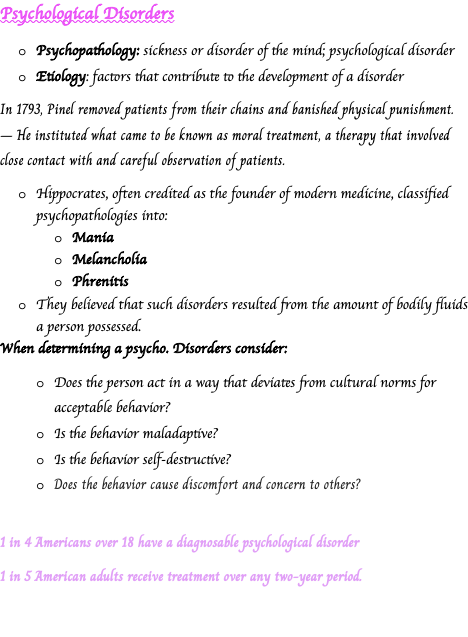
Psychological Disorders
o Psychopathology: sickness or disorder of the mind; psychological disorder
o Etiology: factors that contribute to the development of a disorder
In 1793, Pinel removed patients from their chains and banished physical punishment.
– He instituted what came to be known as moral treatment, a therapy that involved close contact with and careful observation of patients.
o Hippocrates, often credited as the founder of modern medicine, classified psychopathologies into:
o Mania
o Melancholia
o Phrenitis
o They believed that such disorders resulted from the amount of bodily fluids a person possessed.
When determining a psycho. Disorders consider:
o Does the person act in a way that deviates from cultural norms for acceptable behavior?
o Is the behavior maladaptive?
o Is the behavior self-destructive?
o Does the behavior cause discomfort and concern to others?
1 in 4 Americans over 18 have a diagnosable psychological disorder
1 in 5 American adults receive treatment over any two-year period.
o DSM: the Diagnostic & Statistical Manual of Mental Disorders
o Comorbidity: when two disorders are often seen to occur together (ex. Alcoholism & Depression, Anxiety & Depression)
o P factor: Higher scores on the p factor were associated with more life impairment, such as suicide attempts, Psychiatric hospitalizations, and criminal behaviors.
• High p scores also predicted a worsening of impairments over time
o Abnormal vs. Maladaptive
o Assessment: in psychology, examination of a person’s cognitive, behavioral, or emotional functioning to diagnose possible psychological disorders
Biological and environmental factors are thought to play important developmental roles in psychopathology.
o Diathesis-stress model: a diagnostic model that proposes that a disorder may develop when an underlying vulnerability is coupled with a precipitating event.
Situational Factors
o Family systems model: a diagnostic model that considers problems within an individual as indicating issues within the family
o Sociocultural model: A diagnostic model that views psychopathology as the result of the interaction between individuals and their cultures
Cognitive-behavioral approach: a diagnostic model that views psychopathology as the result of learned, maladaptive thoughts and beliefs
o Women often struggle with mood disorders
o Men struggle more with alcoholism, addiction, etc.
o Internalizing disorders: characterized by negative emotions (e.g., major depression, generalized anxiety disorder, panic disorder)
o Externalizing disorders: characterized by disinhibition (e.g., alcoholism, conduct disorders, antisocial behavior)
o Anxiety disorders: psychological disorders characterized by excessive fear and anxiety in the absence of true danger
*Exam question
Social Anxiety Disorder: A fear of being negatively evaluated by others
Generalized anxiety disorder: a diffuse state of constant anxiety not associated with any specific object or event
Panic Disorder: an anxiety disorder that consists of sudden, overwhelming attacks of terror.
· Typically last for several minutes, during which the person may:
o Sweat, tremble
o Heart racing
o Shortness of breath
o Dizzy/light-headed, chest pain
· Obsessions: recurrent, intrusive, and unwanted thoughts or ideas or mental images that increase anxiety
· Compulsions: particular acts that the OCD patient feels driven to perform over and over that reduce anxiety
· PTSD: a disorder that involves frequent nightmares, intrusive thoughts, and flashbacks related to an earlier trauma
· Major depression: a disorder characterized by severe negative moods or a lack of interest in normally pleasurable activities
· Bipolar disorder: a mood disorder characterized by alternating periods of mania and depression.
o Manic episode: characterized by elevated mood, increased activity, diminished need for sleep, grandiose ideas, racing thoughts, extreme
distractibility, and excessive involvement in pleasurable but foolish activities; last at least one week
· If you’re concerned about a friend who is depressed don’t be afraid to ask about suicidal thoughts.
· Dissociative Disorders: a sudden disruption of consciousness, which may alter memory or even personality
o Dissociative Amnesia: more severe than normal forgetting and can’t be explained with medical condition.
o Dissociative Fugue: Adoption of new identity and relocation
o Schizophrenia: a psychological disorder characterized by alterations in thoughts, in perceptions, or in consciousness, resulting in psychosis
· Positive symptoms: excesses in functioning, such as delusions, hallucinations, and disorganized speech or behavior
· Negative Symptoms: deficits in functioning, such as apathy, lack of emotion, and slowed speech, and movement
Delusion vs. Hallucination: A delusion (way of thinking) is a belief, whereas a hallucination(senses) is seeing things that aren’t there or hearing things that aren’t there.
· Personality disorder: Disruptive, inflexible, and enduring behavior patterns
that impair social functioning. This disorder forms three clusters, characterized by anxiety, eccentric or odd behaviors, and dramatic or impulsive behaviors.
· Antisocial personality disorder
– Lack of conscience for wrongdoing, even toward friends and family members; impulsive, fearless, irresponsible;
– Genetic predispositions may interact with the environment to produce the altered brain activity
· Autism spectrum disorder: a developmental disorder characterized by deficits in social interaction, by impaired communication, and by restricted interests
o This diagnosis classification is an excellent example of the dimensional approach to psychopathology.
· In DSM-5, 2 characteristics
o Impairments in social interactions( playing with hair)
o Restrictive or repetitive behaviors, interests, or activities
· ADHD (attention-deficit/hyperactivity disorder): a disorder characterized by restlessness, inattentiveness, and impulsivity
o Children are often friendly and talkative, but they can have trouble making and keeping friends because they miss subtle social cues and make unintentional social mistakes.
o The line between normal and abnormal behavior is hard to draw.
CH 13: Personality
Personality: a person’s characteristic thoughts, emotional responses, and behavior.
Personality trait: a pattern of thought, emotion, and behavior that is relatively consistent over time and across situations.
“Persona”-mask
There is evidence that personality traits have genetic components
Temperaments: biologically based tendencies to feel or act in certain ways
· 3 personality characteristics
o Activity level: overall amount of energy and behavior
o Emotionality: intensity of emotional reactions
o Sociability: general tendency to affiliate with others
· Situationism: the theory that situations determine behavior than by personality traits
History of Personality
Hippocrates & Galen
o 4 humors(fluids)
o Yellow Bile: Choleric, bad-tempered irritable
o Black Bile: Melancholic, gloomy, pessimistic
o Phlegm: Phlegmatic, sluggish, calm
o Blood: Sanguine, cheerful, passionate
Free association: saying whatever comes to no matter how irrelevant, threatening or nonsensical it seems
Id:
o Present from birth
o Operations are unconscious
o Contains the libido (source of motivation)
o Driven by the pleasure principle
o Hungry? Eat
o Angry? Lash out
Ego:
o Thinking, planning and protecting self (controls behavior)
o Some operations are unconscious
o Mediator
o Driven by the reality principle(to satisfy the needs of the Id in
a realistic way (delayed gratification)
o Hungry? Lunch is an hour away. Wait.
o Angry? Think this through before reacting
Superego:
o Last to develop ( around age 5)
o Holds internalized morals and ideals
o 2 components:
o Conscience: Internalized experiences for which a child has been punished.
o Ego ideal: Internalized experiences for which a child has been rewarded.
Erogenous Zones:
Oral Stage:
o 1st year of life
o Zone: mouth
o Sucking & swallowing
o Problems in this stage result in:
o Smoking
o Biting nails
o Drinking
o Fixated personality traits
o Gullible
o Good listener
o Sarcasm
o Cynicism
Anal
o 2nd yr of life
o Zone: buttocks
o Problems that result: Constipation
o Generous
o Creative
o Stinginess
o Perfectionism
Unconscious mind
Freudian slips: verbal accidents reveals true feelings
Manifest content: storyline
Latent content: hidden meaning
Clinical symptoms: depression, anxiety
Humor: Allows expression of repressed thoughts in a socially approved manner
Sublimation: sexual energy, aggressive energy. Rather than act out, we focus on something else
Displacement: shameful thoughts or desires, focus on something else: hate father, kick the dog
Projection: Impulses/desires that we are uncomfortable with, we project on others.
Rationalization: Giving a rational, logical (but incorrect) excuse for behavior.
Regression: returning to an early state in development. In times of strife, trauma, children might appear to return to more childish behaviors.
Types of Traits:
Cardinal:
influences almost everything individual does
▪ single theme that shapes one’s whole life
▪ Only a few people possess cardinal traits
▪ Christlike
▪ Dionysian
▪ Faustian
▪ Machavellian
Central
Basic building blocks that shape most of our behavior.
▪ Define our personality.
▪ Not as overwhelming:
as a cardinal trait.
▪ Most people have somewhere between five and ten of
these.
▪ Sensitive
▪ Friendly
▪ Honest
▪ Optimistic
Secondary
Present only under certain circumstances
▪ Idiosyncrasies
▪ Nervousness before speaking in public
▪ Snapping fingers when nervous
▪ Personal preferences
▪ Likes Chinese food
▪ Loves to wear yoga pants
Surface traits: Features that make up the visible areas of
personality (observable behavior)
Source Traits: Underlying characteristics of a personality
PEN: Psychotism-self control, Extroversion- Introversion, Neuroticism- emotional stability
Five-Factor Model:
Extraversion
▪ Other labels: Sociability, Social adaptability;
Assertiveness; Energy
▪ Common adjectives:
▪ Gregarious • Energetic • Timid (-)
▪ Outspoken • Seclusive (-)
Agreeableness
▪ Other labels: Conformity; Friendly Compliance;
Likeability
▪ Common adjectives:
▪ Friendly • Considerate • Spiteful (-)
▪ Kind • Cold (-) • Good-natured
Conscientiousness
▪ Other labels: Responsibility; Will to Achieve
▪ Common adjectives:
▪ Cautious • Frivolous (-)
▪ Serious • Careless (-) • Hard-working
Neuroticism (Emotionality)
▪ Other labels: Emotional Control; Emotional
Lability
▪ Common adjectives:
▪ Nervous • Anxious
Openness to Experience
▪ Other labels: Culture; Inquiring Intellect;
▪ Common adjectives:
▪ Imaginative • Creative • Unreflective (-)
▪ Polished • Simple (-) • Knowledgeable
**Factor with least consensus about meaning