Week 4/20-4/24
Bird Flu Lecture - 4/21
Control Methods
Many Asian countries had vaccinations
At least 168 million poultry birds affected in USA in 2025
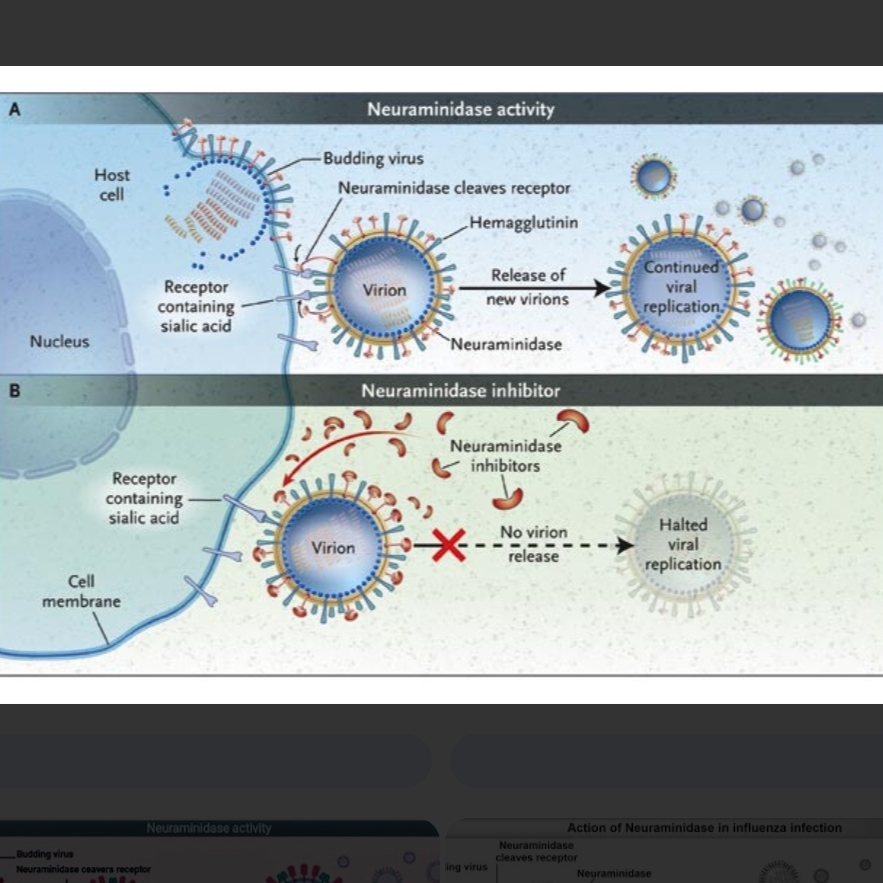
Tamiflu
Could also cure influenza, or bird flu
Neuraminidase Inhibitors
Spanish Flu
Symptoms - hemorrhagic fever
Vaccines
Viruses often kill the eggs before growth, now animal culture cells are used
Risk for humans being infected by bird flu is very low.
Sialic Acid and Influenza
Birds and humans bind to two different sialic acids
Lung
Bronchial cells-upper region of respiratory tract
Alveolar cells, lower region of respiratory tract
Human viruses bind preferentially to epithelial cells in the bronchi, less to alveolar cells
Avian viruses bind preferentially to alveolar cells, but less to bronchial cells
Avian viruses would have to mutate
The 2009 pandemic virus has the same amino acids at the tip of HA as the 1918 strain bound to an antibody (red and yellow ribbons)
Flu viruses are segmented ssRNA viruses that have the ability to evolve rapidly, particularly when two viral types infect a single host cell
Why are other people less susceptible to H1N1? How would you use this information to design vaccines?
West Nile Virus Lecture 4/24
Flavivirus - a group of RNA viruses that includes Dengue, Zika, and West Nile Virus
Corvid - crow-like birds
Encephalitis - inflammation of the brain
Diaphoresis - sweating
West Nile Virus
First isolated from West Nile District of Uganda
Emerged 1000 years ago
43 species can carry WNV
Geographical Distribution
How Israel passed WNV to New York
Possibilities: Migration, mosquitoes, air travel?
Lots of cases in 2004
Increases more in the summer due to increase in mosquitoes
Disease Risk
Amplification
Dilution
Each tick feeds only once per stage
Feedings spent on poorly-competent hosts are “wasted” for the disease
Competence - a host acquires and spreads a pathogen
American Robins are superspreaders
Alala can go extinct if infected
Control and Prevention
Mosquito repellent
Fix your screens
Classification
Flaviviridae
Genus - Flavivirus Japanese Encephalitis Antigenic Complex

WNV
Mosquito-borne flavivirus; ssRNA
+ Sense RNA genome that replicate in the cytoplasm of cells
Icosahedral, enveloped nucleocapsid
E-protein helps bind to the cell
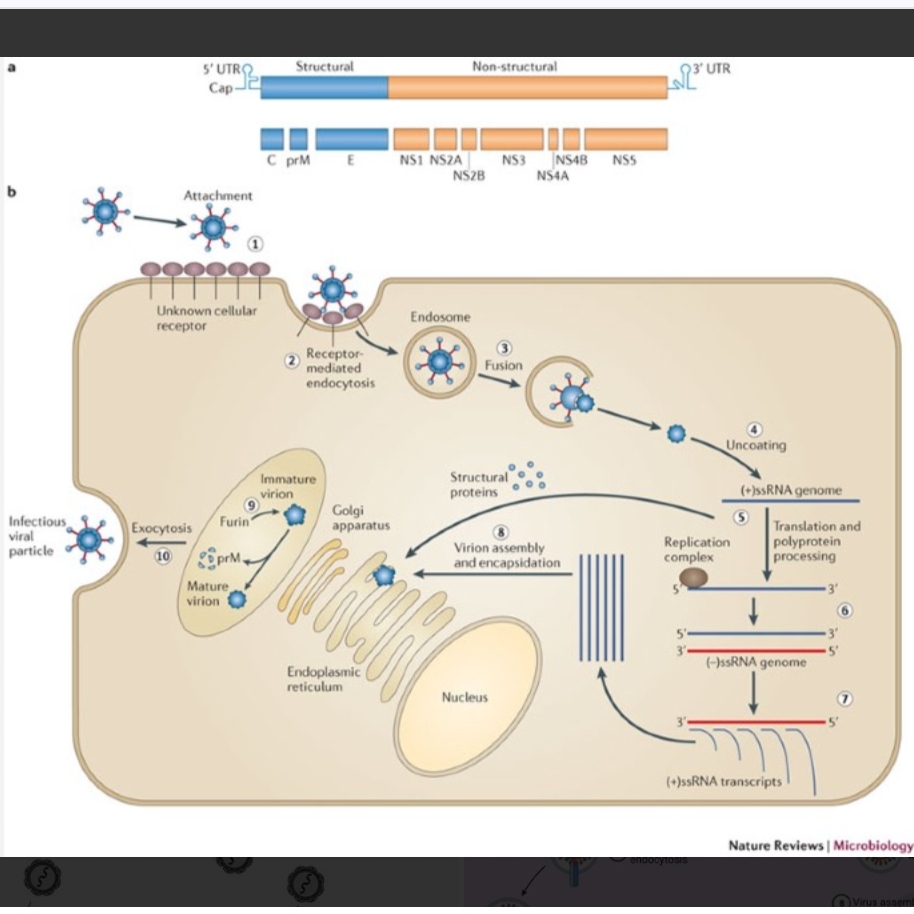
WNV Replication
WNV binds to some receptor protein (DC-SIGN, DC-SIGN-R (Dendritic Cell-Specific ICAM3-Grabbing Nonintegrin-Related Protein), and the integrin αvβ3 in vitro), E protein plays a role.
Symptoms
Asymptomatic infection
Mild febrile syndrome, fever
Neuroinvasive disease - infection or passive transport through the endothelium or choroid plexus epithelial cells
Meningitis or encephalitis
Diagnosis
IgM antibody detection in serum collected 8—14 days or CSF collected 8 days of illness onset using ELISA
Microsphere immunoassays - MOST EFFICIENT
Mechanism
Neutralization by the E16 monoclonal antibody that specifically binds DIII region of E protein
Neutralization
Large panel of envelope glycoprotein-specific monoclonal antibodies
10/12 potenly neutralizing antibodies (E16) selectively bind DIII of E protein
E16 - partially blocks viral attachment yet blocks infection