CHYS 2P51 Final (multiple choice questions)
Week 1 - INTRODUCTION TO QUALITATIVE RESEARCH
What is Qualitative Research?
And how is it different than quantitative research?
Qualitative Research Methods
Allows us to draw out the layers and complexities of social problems
Can be used to support transformative social, political, and economic change
Involve the carful description of situations, interactions, and behaviours
Require an ethical research practice
"At its heart, research is storytelling"
What is a story?
Narrative
How its being told
Discourse, e.g., ideologies, social norms, values
Language practices
Standpoint & experience of the person who has lived the experience
One's agenda or goal (e.g., political)
Having a goal in sharing their story about…
Exclusion and invisibility
i.e. who's silences or rendered invisible in a story?
What is the critique or asserted limitation of qualitative research?

Critiques and Perceived Limitations
Stories are "anecdotal" - not conclusive, too personal, not "hard" data
Unscientific - lacking rigour, process, and structure
When it's very processed based
Unreliable - not reproduceable or consistent
Lack usefulness - not applicable to policy arenas
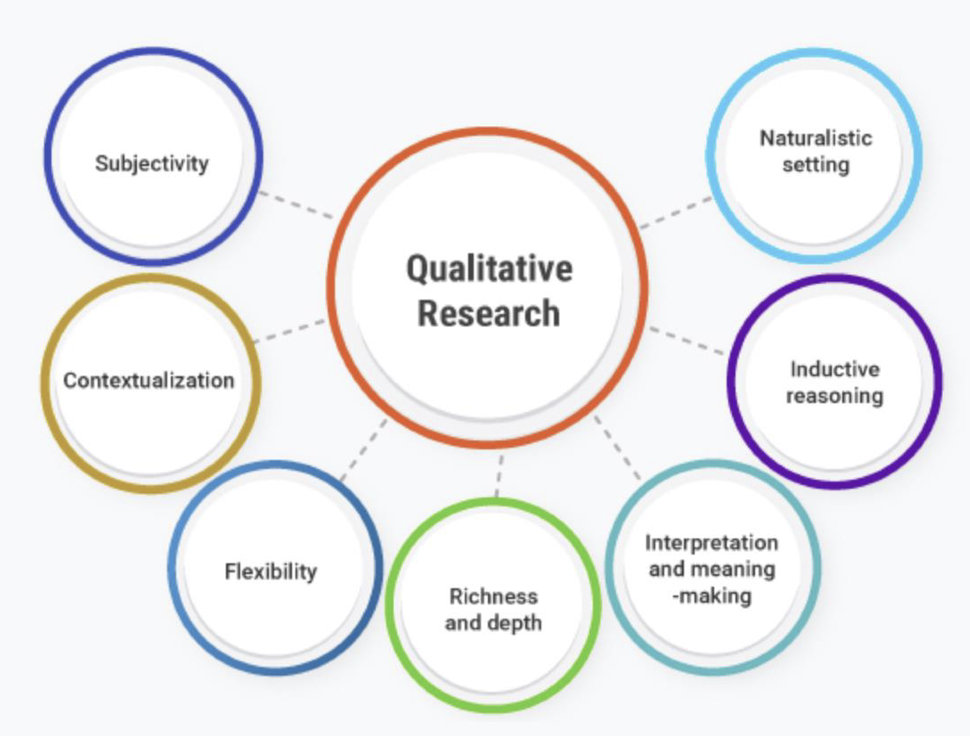
The Value of Qualitative Research
Data-based decision making in hospitals, schools, prisons, childcare centres, etc. has historically been centered on quantitative data
When working, data is gathered through systematic and unsystematic ways
Conversations, observations, interactions, feelings, relationships, etc.
Supports daily decisions on teaching, child welfare, healthcare, social services, etc.
Ethical Relationships and Honouring Stories
[E]thical research involves trust and reciprocal relationships
Dialogue, collaboration and humanity - its social science
Amplifying marginalized and silences voices
Historical dismissal of Indigenous voices and approaches to storytelling
Dismissing hardships and injustices, contributing to ongoing oppression of Indigenous children, families, and communities
Week 6 - THEORETICAL UNDERPINNINGS AND FORMS OF SOCIAL SCIENCE
What is the nature of things?
Everything, including our being in the world, has a singular point of origin
Ontology: the study of being (what we know)
Ontological position: where we locate the starting point of truth and reality
Can be difficult to grasp
Consider your "stand" on something by considering alternative position
What is the nature of the phenomena or social world that you with to investigate?
Consider the very nature, character or essence of the phenomenon of interest
Ontological Positions
Ontological positions reference what out "truth" is
There are aspects of ontology what may be competing and not complementary
Tensions exist in what we know -> confusion, disagreement, difficulties to reconcile and resolve
Formulation of different ideologies and paradigms
How do we know what we know?
Epistemology: the study of knowledge (how we know what we know, and how what we know has evolved over time)
Epistemological position: what we regard as knowledge or evidence of the phenomena or social world we want to examine
The theory that grounds your work
Your lens, ideolog, or paradigm
Positivist Social Science
Scientific method: how most quantitative research is conducted
Dominant epistemological position across many disciplines (psychology, statistics)
Experiments, surveys, statistics -> test hypotheses with exact measurement
Discover and confirm probabilistic casual laws that predict and prove patterns of human activity
Ontological position: social reality is patterned; research can estimate the odds of a predicted behaviour
Science is value free - objective, not based on values, opinions, attitudes, or beliefs; researchers personal, political, or religious views is at arms length of the research
Types of intellectual puzzles: developmental, casual/predictive
Methodology = grounded theory
Interpretive social science
Understanding a person's internal feelings, thoughts, reactions, and sense of reality -> how this guides their decisions to act in particular ways
Hermeneutics: meaning embedded in text (parts of a whole and text overall)
Detailed, nuanced observation - understanding of how a small group of people create meaning and navigate their social worlds in everyday life
Ontological position: subjectivity of experience and multiple truths; social life is fluid, fragile, and what people perceive it to be
Disciplines: anthropology, sociology, linguistics, humanities, cultural studies (symbolic interactionism and social constructionism)
Types of puzzles: experiential, ecological
Critical social science
Uncover the real structures in the material world to help people change conditions and build a better world
Our social reality is shaped by social, political and cultural factors (that need to be critiqued and transformed)
Action oriented: social research is moral-political activity
Epistemological traditions: feminist, intersectionality, critical disability, critical race, anti-colonial, post-structuralism
Types of puzzles: mechanical, processual, comparative, some experiential (if action-oriented and intention is to drive practice/policy change)
Week 9 - DATA GATHERING: METHODOLOGY AND METHOD
Theoretical Framework
Knowledge system that grounds you:
From what standpoint/social 'reality' does you research begin (Ontology)
Positivism, interpretive, Critical, Indigenous Ways of Knowing (Epistemological Positions)
Methodology
Rationale for your research approach:
What is your strategy that directs how the research will be undertaken?
Phenomenology, (critical) ethnography, grounded theory, narrative inquiry, institutional ethnography, community-based participatory action research, visual/arts-based methodologies, community-based participatory action research, etc.
Methods
Tools to conduct research:
What data sources are you involving to answer your research questions? (sapling and recruitment
How will you go about generating your data? (interview, focus group, document analysis, drama-based methods, arts-based methods, etc.
Indigenous Research Methods
Methods that:
Align with indigenous beliefs, values and worldviews
Facilitate research that is respectful, collaborative, and reciprocal
Consider issues of ownership, control, access and possession of data and the research process
Demand that the researcher consider their 'place' in the research - connects to positionality and reflexivity
Relationships, identities, insider/outsider standpoints
Much diversity across nations, communities, and research collaboratives
Week 11 - SAMPLING AND RECRUITMENT
Sampling and Selecting
“Principles and procedures used to identify and gain access to relevant data sources that are potentially generative in relation to a wider universe…for the purposes of gaining meaningful insights into your intellectual puzzle”
You can’t speak to everyone, you can’t read all the texts, and you can’t analyze a mountain of photographs – you need to narrow to some “sample"
What is "sampling"?
Rationale for who/what will be included in your study
People
Demographics (age, gender identity), sociocultural factors (education, employment characteristics), etc.
Texts
Where located? Context? Used/viewed by whom? Type (legislative, community-based, form of media, etc.)
Procedures you will utilize to select and represent your data sources
Purpose sampling
Theoretical sampling
Convenience sampling
What is the nature of sampling?
Purposive
Some informants are better situated to provide key insights and understanding than others -> intentionally invite specific perspectives
Emergent
Could evolve over time based o insights and categories that emerge through data collection and analysis (theoretical sampling)
Thoughtful
Interested in confirming an disconfirming perspectives; maximum variation and unique/extreme insights
Naturalistic
In ordinary settings where people "do" their lives (e.g., waiting rooms, soccer fields, universities, accessing programs/services)
Not predetermined
Don’t know what the final size will be; based on reaching "saturation" in new insights (difference from quantitative)
A Sampling Strategy
Is relevant
To your theoretical framework and research question
Generates rich information
About your social issue and phenomenon of interest
Is generalizable
Enable you to enhance applicability of study findings to a wider/broader audience and real world problems
Produced believable study results
Explanations are trustworthy, credible; study sample has been sought with rigour
Is ethical
How you find and engage your participants
Is feasible
Possible to carry out, and based on time allocated for the study
Identifying parameters for study "eligibility"
Your methodology informs decisions about eligibility and sample size
E.g., text for discourse analysis
People for phenomenology
Theoretical sampling for grounded theory (to develop and test a theory with people)
Sample Size Considerations
No "right" answer for sample size - aim is "saturation"
How many is enough to address you research question?
Is your sample appropriately generative (even if not fully representative)?
Can you make meaningful comparisons or relevant insights with the range you've included? (related to experiences)
Are you starting to hear similar / repeated stories
Have you challenged your assumptions?
Have you searched for "negative instances" or experiences that are different from what you’ve assumed or expected?
Study Recruitment
Where are your data sources located?
E.g., geographical spaces, social spaces, community programs
Relates to convenience sampling - reliance on participants who are readily available and accessible to the researcher
Accessing people:
Do you need permission / organizational approvals to gain access?
Are your recruitment plans:
Ethical: consider issues of coercion, conflicts of interest
Realistic: will you attract the "type" of participants you are seeking?
How will you locate participants?
Individuals-based strategies?
E.g. social media, posters in waiting rooms or in bulletin boards, word of mouth (snowball sampling)
Will potential participants see themselves reflected in the recruitment materials?
Organization-based strategies?
E.g., recruitment by a worker, coach, service provider who is at arms-length to the research (no coercion), provide information at intake/check-in, engage the parent (if involving children)
Who will approach (power, conflicts if interest)? Where and how often?
Language considerations?
Recruitment Challenges and Vulnerability
Rationale and importance to involve in research
E.g., address needs, amplify voices, historical exclusion in research and policy arenas
Is your population hard to reach and/or vulnerable?
Stigma and hidden nature of phenomenon of interest (e.g., people living with HIV)
Co-occurring vulnerabilities (e.g., homelessness, food and income insecurity, substance use, system navigation, health or social challenges)
What strategies might you implement to enhance participation and retention?
Time/ prolonged engagement, trauma-informed engagement
Involvement of peers/community leaders
Snowball sampling, chain-referral mechanisms
Building relationship, trust, reciprocity (community-based participatory action research)
Week 12 - DATA ORGANIZATION AND ANALYSIS
Organizing your data
What kind of data have you generated?
Interviews and focus groups: audio recordings -> transcript files
Textual analysis: text excerpts
Arts-based research: photos, body maps, collages, pictures of these things, etc.
How might you organize it?
Filing system? Software?
Who needs access to the data?
Practical and technical considerations, but essential for analytic process
What is expected by your REB approval?
Network folder, password protected, clear about who has access
Reading your data
Literal readings - what is there
Descriptive summary of words and language used
Sequence of interactions
E.g., frequency of words and concepts used
Qualitative content analysis
Qualitative descriptions
Interpretive reading
Constructing a version of what you think the data means or represents
What can you infer from the data beyond a descriptive, literal read?
Participants interpretations of their experiences
You interpretations of participant accounts
Reading through and beyond the data -> "thematic analysis"
Reflexive reading
Locate yourself as researcher - researcher's role and perspective in the analytic process
How dos your positionality connect to your interpretation of the data?
Revisit your theoretical framework, e.g. positivist, interpretive, critical
Why might you interpret the data a certain way? What other explanations are possible (Reflexivity)
Coding
Inductive
Developing a theory or conceptual model ('grounded' in the data)
Deductive
Testing or overlaying an existing theory or conceptual mode
What approach?
Depends on your purpose, methodology and research question; methodology determines style of analysis
Do the codes make sense for the intellectual puzzle you are trying to explain?
Too few codes -> vague and unspecified story?
Too refined and precise -> only tells part of the story>
Have you reached saturation?
Reflective Thematic Analysis
Adaptable to various research questions and intellectual puzzles
Experiences, perceptions, social context
Appropriate to use with many data sources
Interviews, focus groups (narrative , phenomenology)
Creative methods (carts-based research)
Not typically used in Critical Discourse Analysis
Themes in reflexive thematic analysis are not just topic summaries
They reflect patterns of shared meaning with interpretive depth
Not literal read of data, combination of interpretive and reflective read
The Six Phases of Reflexive Thematic Analysis
Familiarisation
Read and re-read data to ‘get to know’ it (literal read as per Mason, 2018)
Make early notes, observe surface patterns, emotions, surprises
Coding
Systematically tag interesting data segments with code labels
Codes evolve—may be split, merged, redefined
No pre-defined codes—emergent through interaction with data (inductive)
Developing and Completing Analysis
Initial Theme Generation
Cluster related codes to form initial themes
Focus on shared meaning, not topic summaries
All interpretations are provisional at this stag
Reviewing & Developing Themes
Revisit codes to ensure themes are coherent and reflect the data well.
Refine or discard themes; consider alternate mappings.
Refining, Defining, Naming Themes
Write theme definitions (scope, core concept).
Ensure names are evocative yet clear.
Avoid catchy but misleading theme titles.
6. Producing the Report
Final phase write-up, not just reporting.
Weave data extracts with analytic commentary.
Themes should tell an integrated, meaningful story tied to the research question.
Reflexivity continues through the writing process