AP Calculus AB Unit 3: Advanced Differentiation Techniques
Unit 3: Differentiation: Composite, Implicit, and Inverse Functions
Unit Overview
In Units 1 and 2, you mastered the definition of the derivative and basic rules (Power, Product, Quotient) for explicit functions. Unit 3 dramatically expands your toolkit, determining how to differentiate composite functions (Chain Rule), relations where cannot be isolated (Implicit Differentiation), and inverse functions. These techniques are the backbone of differential calculus and are heavily tested in both Multiple Choice and Free Response questions on the AP Exam.
The Chain Rule (Topic 3.1)
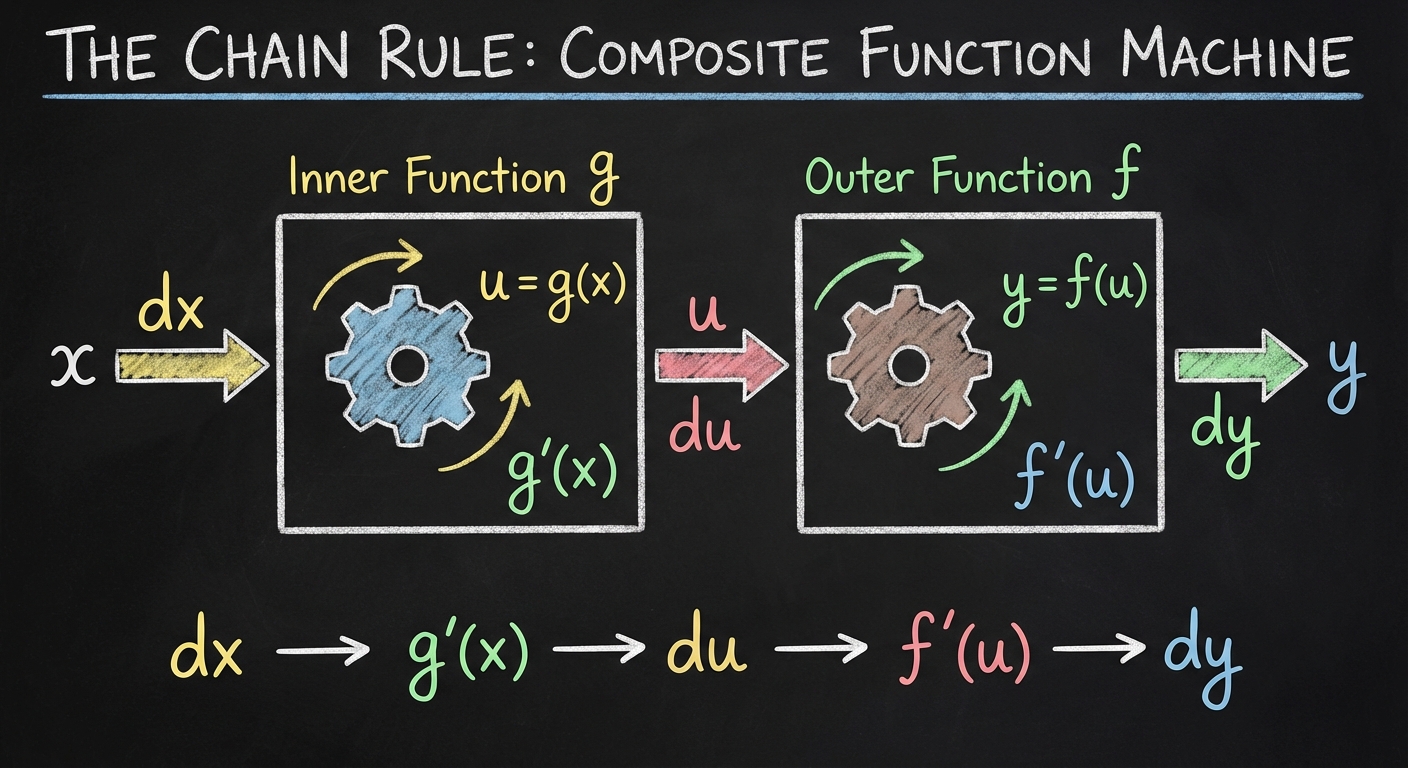
The Chain Rule is arguably the most vital differentiation rule in Calculus. It is used when differentiating composite functions—functions inside of other functions.
Definition and Formula
If , where is a differentiable function of and is a differentiable function of , then:
In Leibniz notation, if is a function of and is a function of :
Conceptual Approach: The "Onion" Analogy
Think of a composite function like an onion with layers. To get to the center, you must peel the layers one by one, starting from the outside.
- Differentiate the Outside Function: Treat the inside stuff as a single variable chunk. Do not change the inside yet.
- Multiply by the Derivative of the Inside: Apply the chain rule by multiplying your result by the derivative of what was inside.
Mnemonic: "Douter, Inner, Dinner"
A helpful memory trick introduced in previous study circles is "Douter, Inner, Dinner":
- Douter: Derivative of the outer function (keep the inner function inside parentheses unchanged).
- Inner: Keep the inner function alone initially.
- Dinner: Multiply by the Derivative of the inner function.
Worked Example
Problem: Differentiate .
- Outer function (): Derivative is
- Inner function (): Derivative is
Apply the rule:
Note: A common trap is forgetting to leave the inside function alone during the first step. The derivative is NOT .
Implicit Differentiation (Topic 3.2)
Explicit functions look like . Implicit relations have and mixed together, such as (a circle). You often cannot isolate easily, so you differentiate with respect to across the entire equation.
The Procedure
- Differentiate both sides of the equation with respect to .
- Crucial Step: Whenever you differentiate a term containing , you must multiply by the chain rule factor (or ). This is because is a function of .
- Collect all terms with on one side.
- Factor out and solve for it.
This method is essential when the variable you are deriving doesn't match the variable in the denominator of the derivative notation (e.g., differentiating with respect to ).
Worked Example
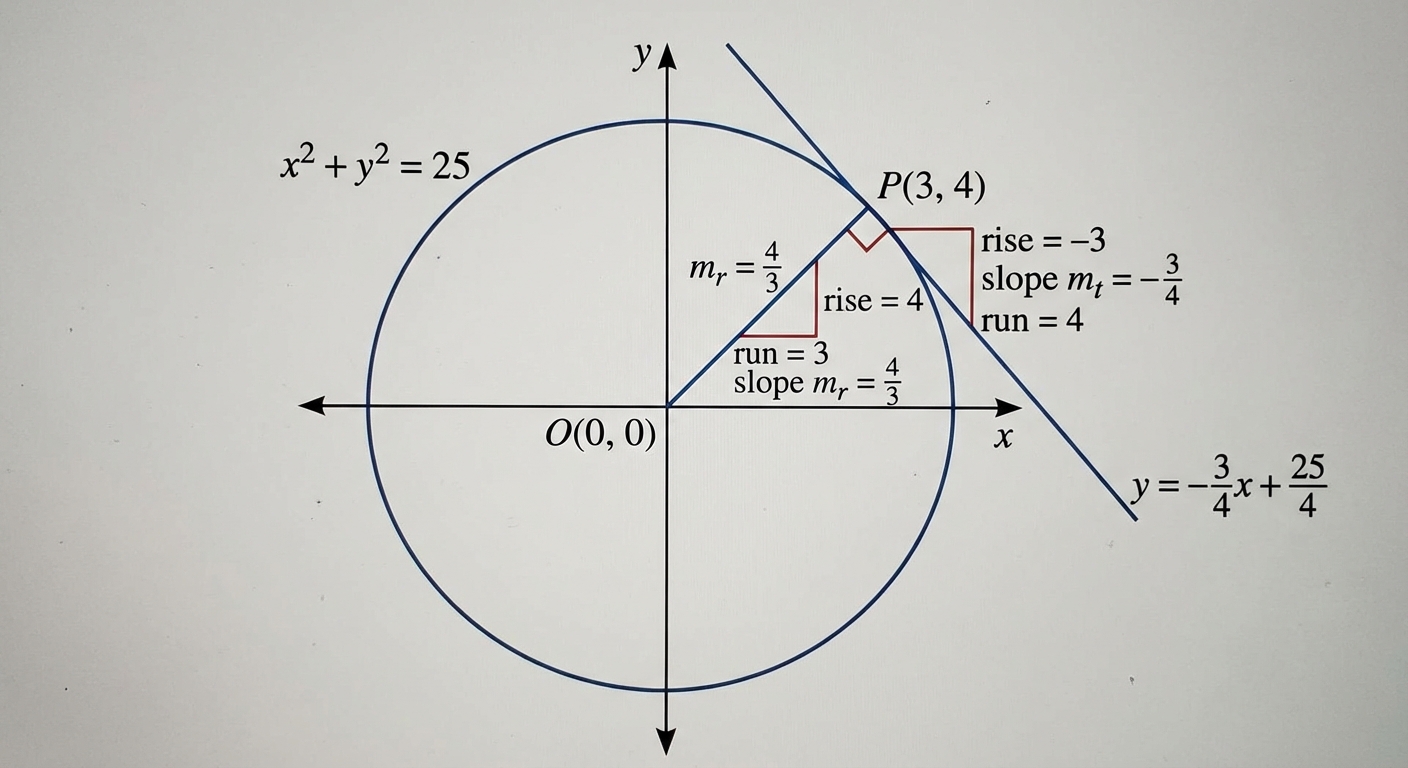
Problem: Find for the circle at the point .
Differentiate with respect to :
Isolate :
Evaluate at :
Tangent Line: Since we know the slope is and the point is , the tangent line equation is:
Higher-Order Implicit Differentiation
The AP Exam loves to ask for the second derivative () of an implicit relation.
Process:
- Find first.
- Differentiate your result again using Quotient Rule or Product Rule.
- Substitution: Your answer will likely contain a term. You MUST substitute your expression from Step 1 back into this term to express the final answer solely in terms of and .
Differentiating Inverse Functions (Topic 3.3)
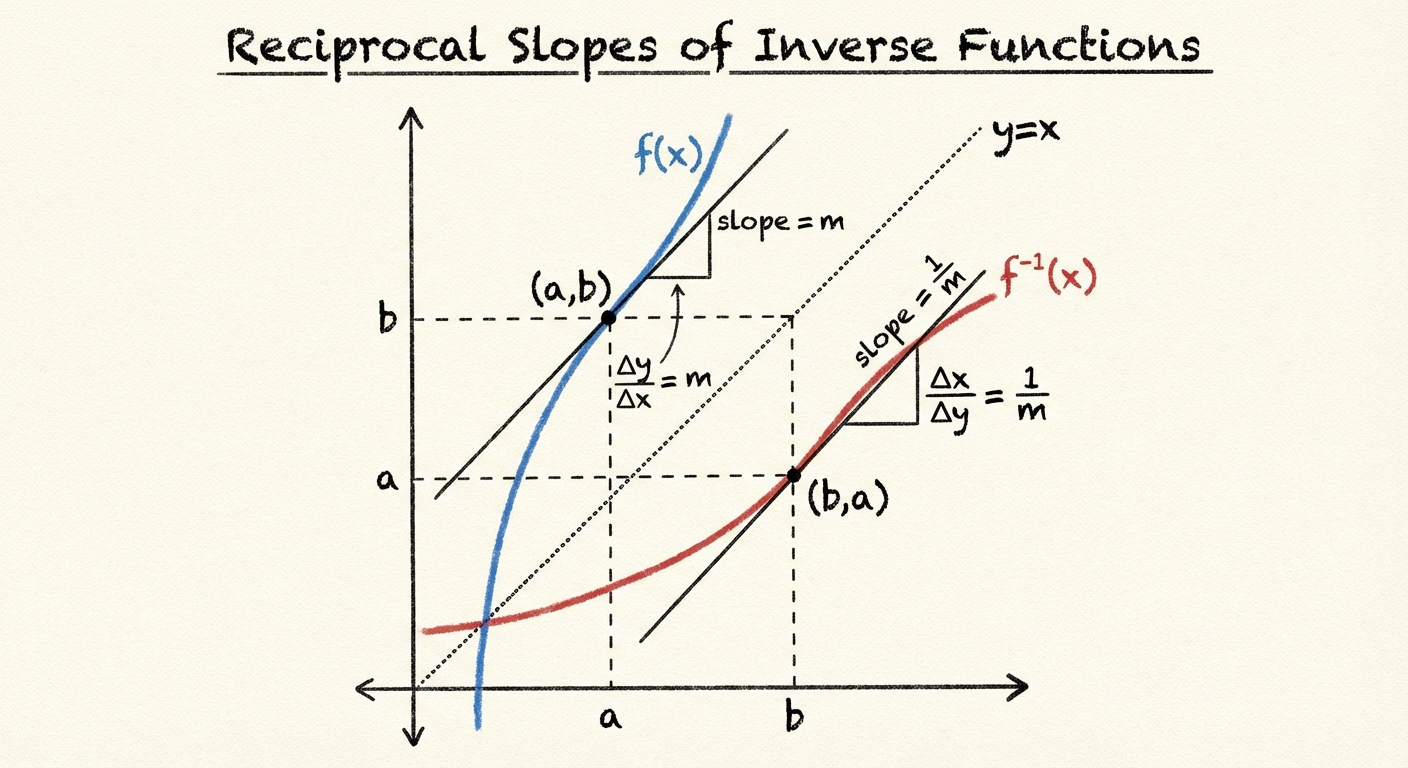
Inverse functions swap inputs and outputs. If , then . Geometrically, the graph of is the reflection of across the line . This reflection creates a specific relationship between their slopes.
The Rule
The derivative of the inverse function at a point is the reciprocal of the derivative of the original function at the corresponding point.
Or, simpler terms:
Where the point is on the original graph , and is on the inverse graph .
Strategic Approach for AP Questions
AP questions usually give you a table of values rather than a function definition. Follow this "Table Method" algorithm:
Question: Given is invertible and differentiable, find .
- Identify the Goal: We need the slope of the inverse at . This means the Input of the Inverse is 3.
- Swap to Original: If the Input of the Inverse is 3, then the Output of the Original is 3. Find such that . Let's say the table shows .
- Differentiate specific point: Find from the table/function.
- Reciprocate: Your answer is .
Memory Aid: The slope of the inverse is "1 over the slope of the original"… but at the swapped -value.
Inverse Trigonometric Functions (Topic 3.4)
You must memorize the derivatives of the inverse trig functions (arcsin, arccos, arctan). These appear frequently in multiple-choice sections and integration problems later.
The "Big Three" Formulas
Assuming is a differentiable function of (Chain Rule applied):
Arcsine:
Arccosine:
(Note: It is just the negative of arcsine)Arctangent:
(Note: No square root in the denominator)
The "Co" Rule
Just like with regular trig derivatives, the "Co" functions (arccosine, arccotangent, arccosecant) always gain a negative sign in their derivative.
Geometric Derivation Support
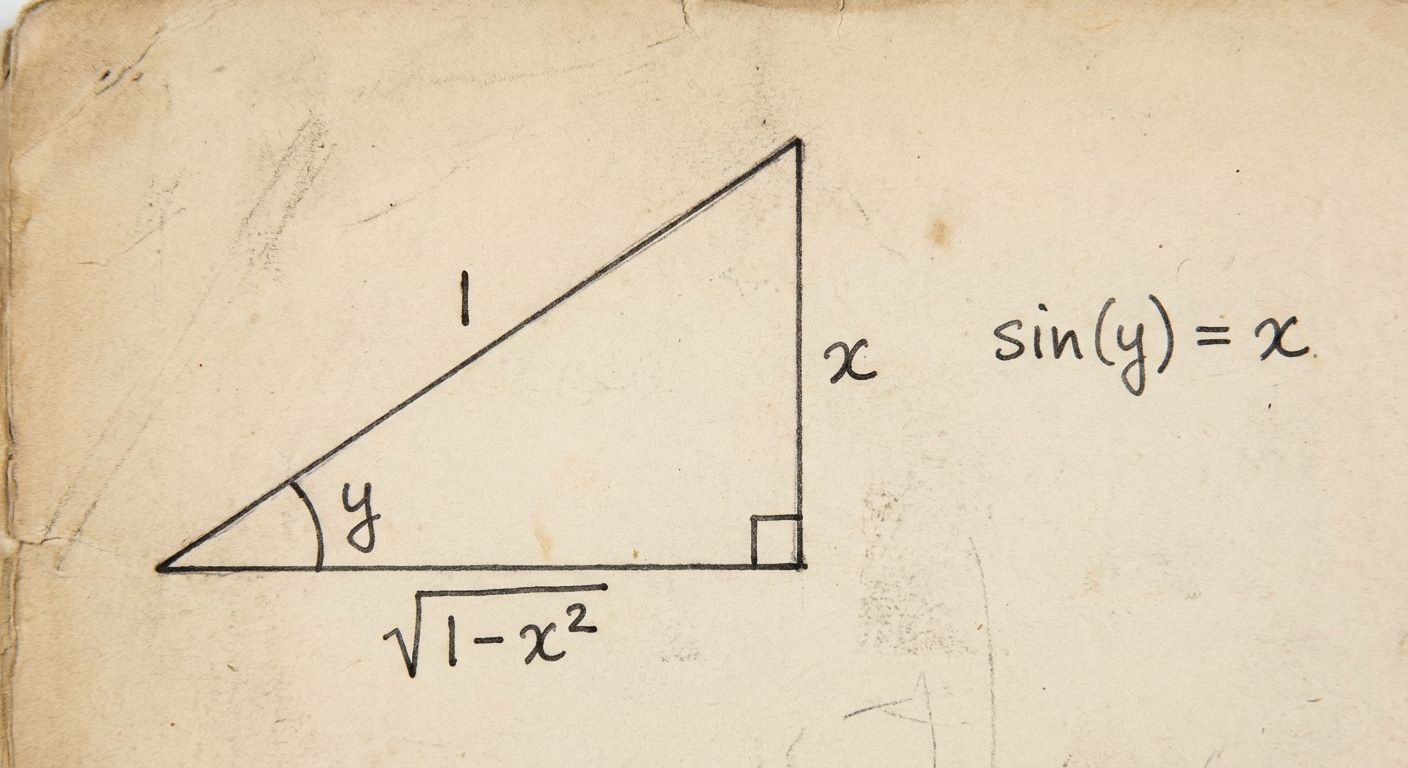
If you forget the formula for , you can use implicit differentiation:
- Rewrite as .
- Differentiate: .
- Solve: .
- Use a reference triangle with hypotenuse 1 and opposite side to find in terms of ().
Selecting Procedures & Exponential Bases (Topic 3.5)
In Unit 3, you also formalize derivatives for general exponential and logarithmic functions.
General Exponentials and Logs
While , bases other than require a correction factor of .
- Exponential:
- Logarithmic:
Strategy: When to use what?
- Variable in base, constant power (): Power Rule.
- Constant base, variable power (): Exponential Rule.
- Variable in base AND variable in power (): Logarithmic Differentiation. Take of both sides -> -> use Implicit Differentiation.
Summary of Common Mistakes & Pitfalls
- Chain Rule Incomplete: Students often differentiate the inner function but forget to multiply by it. Or, they change the inner function while differentiating the outer one (e.g., saying the derivative of is instead of ).
- Implicit Algebra Errors: When finding , forgetting to substitute the expression for back into the equation.
- Inverse Function Swaps: Confusing the and values. Remember: if the question asks for , look for where on the original graph, not where .
- Trig Chains: Forgetting that is . The derivative requires chain rule: .
- Notation Confusion: is the derivative of the inverse. is the reciprocal . These are completely different!
Final Hints from Previous Students
- When two variables are multiplied (like ), you MUST use the Product Rule during implicit differentiation: .
- Simplify your first derivative before taking a second derivative. It saves massive amounts of time.
- If evaluating a derivative at a specific point, plug the numbers in immediately after differentiating. Do not simplify the algebra of the derivative expression first; arithmetic is faster than algebra.
- For Inverse Trig: Memorize and thoroughly; they appear most often.