Different Types of Reinforcement
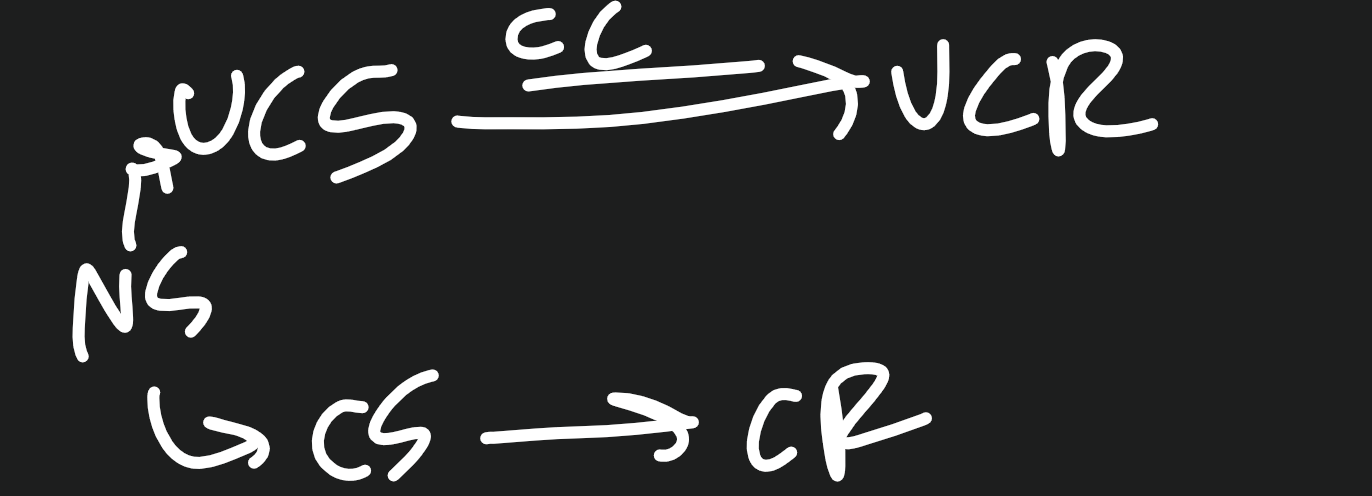
Classical conditioned, unconditional sctimulus to ucn conditioned response. Response comes from reflex. NS: neutral stimulus, no connection so far. Then connect NS to UCS
NS turns into condiitoned stiumulus. CS: learned stimulus, turns to conditoned response. UCR and CR are the same.
Reinformcement always means I want behavior to continue
You are being reinforced to continue behavior
When we dont want behavior ton continue we start punishment, makes repnse to behavior less likely to happen. Just like reinforcement, we are going to have positive and negative punishmnet
positve punishment - add something undesiarable into your lfe, something you dont like. Spanking is a positve punishment. Positve does not mean good, just adds something into your life. Hopefully you wont do thing you werent doing. Adding in something I dont like
Negative punishment - im going to take something you like away from you. You like this thing, too late im taking it away. take away something desirable. Remove thing you like doing. Taking away something you like
some people respond better to negative/possitve reinforcement. Timeouts are both positive and negative. Some things that are punishment to some are different to others, wont be same for everyone.
Dont want to just punish punish punish wont make person change behavior, will just break down punishment. But we do need punishment, theres a couple of rules you want to think about
Fear and anxiety - if this is what the reaction is, punishment is not going very well, not making person think about what theyre doing wrong. Not goal to make people have fear or anxiousness. Dont want constant anxiety.
Avoidance - when you only punish you just teach them avoidance, avoid having punishment happen, teaches you to be sneakier, dont want this, you want behavior change.
modeling of aggresion. If youre punshing using physical punishment youre also modeling aggresion, when people do what you dont want them to do we hit them, kids pick up on this. My mom hits me so im going to hit my friend since hes doing something you dont want. Multiple studies that children hit at home are more likely to be bullies/physically aggresive at school.
Theres guidlines to follow to make punishment lead to behavior change. What am I not allowed to do, doesnt matter if youre employer, heres the things you dont tolerate. If youre parent youll put in cant hit, say no whne parent asks you to do something, dont steal etc. Then when they do it thats when they get punished, we would preffer you take something away they dont like. After the spanking you have the mtell you why they got spanked, and what behavior they should have chosen instead, make it teaching moment. Its rewiring head to think about what choices should be made instead. Children who have been hit have a higher chance of developing mental health ilnesses. Using a lot of the take away things (negative) is better for them.
How we give out reinforcement to get a behavior to change, theres ratio type and interval types. Ratio reinforcmenet schedules has to do with number of times you do a behavior. Interval has to do witih passage of time, both ratio and interval schedules can be either fixed or varied.
Fixed Ratio: you know exactly how many times you have to do behavior before you get a rewards.
Variable Ratio: you dont know how many times you have to do behavior to get reward, reward is always moving around. Gambling is based off of this, how many times do I have to play blackjack to win? do whatever before I win, I never know how long its going to be.
Interval has to do with pasage of time
Fixed Interval: always same time before reinforcement opportunity. I need report by 5 oclock on friday. You get reward of doing whatever it is you need to do. When things are on fixed interval, you get people procrastinating. You tend to procrastinate, FI can be good for some things, but bad for others. This is good for paychecks
bVariable Interval: not knowing how much time you have. You have no idea how long you have before you have to do behavior. Dont want to miss out on reward.
Shaping: - When you want to make a big behavior change, taking behavior and breaking it down to smaller steps, shape yourself into wahtever it is you want to be doing. Want to start with small steps
Small steps - too big of a step will cause you to flare out.
Effective reinforcement - shaping someone else or soemthing else, give them a reinforcement that they enjoy, also shouldnt go against their goal.
Heavy early reinforcement - heavy at beginning beacuse beginnign is more likely for you to quit
Reinforce less and less - , as we move on we want to reinforce less and less. Goal of behavior change is to make it more of a routine/habit because its good for you, not because of the treat. Want it to be habit, not because of a reward
Incorporate harder and harder steps as we go - this can be for any behavior.
Final type of learnign is
Observational Learning - learn by watching other people, its a behavior, learning is a behavior change, something learned by watching a model behave.
Bandura is main observational learning guy.
Catharsis common belief was reliving yourself of negative effects. Watch someone beat someone else up makes you satisfied with need and goal to be violent. When we see violence and are already violent, doesnt make us much less violent. Bandura wanted to prove this wrontg
Study
Took 6-8 year old kids
Randomly assigned into 2 groups
Can show cause and effect, can only do true expiriment with random assignment
group A was control group. Sat down, curtain opened up, watched woman walk into room full of toys with bobo doll. Hit doll lightly and would go back and forth
Group B, same room, everything same, curtain opens up, same woman, same toys, but she beats up bobo doll aggresively, curtains close
One by one they would see what kids would play with and how they would play.
Group A played very nicely with toys
Group B beat up Bobo doll violently
When shown violence, insights violence inside of us.
Basis for ratings on movies, television shows and games. Because kids cant understand difference between reality adn difference, which is why we have things in place.
Peolpe still against this “kids know difference between fantasy adn reality cmon” most things for kids were cartoons. Cartoons were too far removed from who we are. Power rangers introduced, live action show. Bandura and people in behavioral sciences were concerned, reran experiemnt with power rangers. Power ranger kids were a lot more aggresive. Children will copy what they see.
Steps in observational learning
Paying attention - not paying attention will not let us copy what we see, pay attention and taking in information, copy it into our own neuron bundles
Memory - remember all the steps that goes into what you just saw in order for you to copy it. Leaner must be able to retain what was observed
Imitation - leanrer must be able to reprodue acitons of model. Can you do things youre seeing them do?
Motivation - learner must be motivated to resproduce observed behaviors. Want to do something they want to do.
Mirror Neurons - on both sides of cerebral cortex, both humans and higher level mammals like monkeys and dolphins have mirror neurorns, fire the same way watching someone do something the same as if we did the same thing. Will fire as if you did a cartwheel even though you didnt do one and only watched someone do one, same thing with empathy. Empathy is complex, requires us learnign it. Helps us connect to other people.
Neuroscientiss discovered mirror neurons