Growth
Prokaryote Growth
Introduction to Growth
Growth in microbiology refers to several processes, including and not limited to:
Increase in size of individual cells.
Increase in population numbers, which entails the division of cells to create more cells.
Survival and Growth
Liebig’s Law of the Minimum:
•Amount of growth of any organism is determined by the nutrient present in the lowest concentration in relation to the requirements of that organism
Shelford’s Law of Tolerance:
•For an organism to grow in a given environment, each of a complex set of conditions must remain within the tolerance range of that organism
•Conditions can interact
Microbial Growth Process
The microbial growth process can be summarized as follows:
A mother (parent) cell doubles in size.
The mother cell then divides into two daughter cells.
Definition of Microbial Growth: An increase in the number of cells by cell division over time.
Binary Fission
The key mechanism of prokaryotic cell division is binary fission, which includes the following stages:
The nucleoid (region of the bacterial chromosome) elongates and divides.
The cell wall and membrane begin to form a transverse septum, which eventually completes and separates daughter cells.
This process results in two daughter cells that are genetically identical to the parent cell.
Studying Microbes in a Laboratory
To study microbes effectively, it is necessary to grow them in a controlled laboratory environment by:
Providing an environment that supports growth.
Removing unwanted organisms to ensure purity.
Using monitoring methods to track growth and conditions.
Techniques for Culture Purity
Aseptic Technique: Essential for keeping cultures uncontaminated by unwanted organisms which ensures purity in microbial studies.
Measuring Microbial Growth
Direct Microscopic Counts
Utilizes a counting chamber where a bacterial suspension is placed to count cells manually within calibrated areas to determine the concentration of cells per mL.
Petroff-Hausser Counting Chamber
A specialized slide with shallow wells and an inscribed grid that allows for the counting of bacterial cells using a microscope.
Direct Counting with Haemocytometer
A tedious method that requires significant effort for counting small or motile cells.
Plate Count Method
Involves counting viable cells by diluting a sample and spreading it on a plate to incubate.
After incubation, colonies are counted, and the number of viable cells in the original sample is calculated.
Serial Dilution Process
A method often used in microbiology to determine the concentration of cells in a culture through numerous dilutions leading to distinct counts at each stage.
Methods of Colony Counts
Spread Plate Method: Involves adding a diluted bacterial culture to the surface of a solid agar and spreading it evenly.
Pour Plate Method: A technique where bacterial cultures are mixed into melted agar, poured into a Petri dish, and incubated to form colonies.
Growth-Related Measurements
Optical density (OD) measurements are another way to estimate bacterial growth in cultures as a function of the number of cells present, providing an indirect count by measuring how much light is absorbed by the bacterial culture.
The Bacterial Growth Curve
Represents the growth phases of bacteria over time, which encompasses:
Lag Phase: Cells adapt without significant increase in numbers but prepare for growth.
Exponential Phase: Active growth at a constant rate, maximum rate of cell division.
Stationary Phase: Nutrient limitations and waste accumulation leads to a decrease in growth rate.
Death Phase: Cells start to die; total count may remain high, but viable counts decrease.
Factors Affecting Bacterial Growth
Nutritional factors such as:
Carbon, nitrogen, sulfur, phosphorus, and sometimes vitamins.
Physical factors such as:
pH, temperature, oxygen concentration, and moisture.
Growth Curve
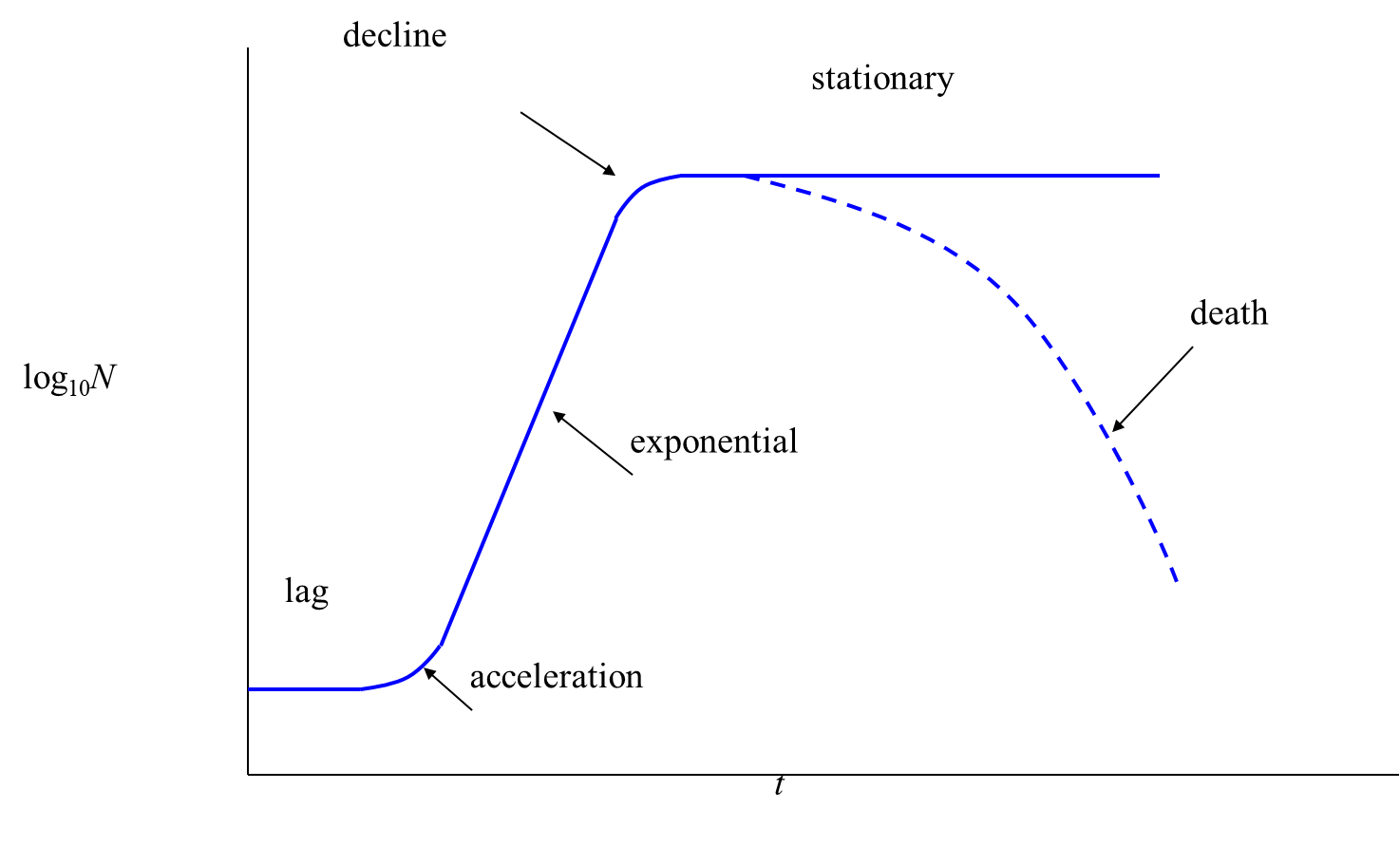
Lag Phase
• grow in size
• synthesise enzymes,
• incorporate molecules from medium
• produce energy (ATP)
Exponential Phase
Organisms have adapted
Growth occurs at exponential rate
Organisms divide at maximum rate
regular, genetically determined interval
generation time
Stationary Phase
Cell division rate decreases
Nutrient limitation
Build-up of toxic products
Oxygen limitation
Death Phase
Cell lose their ability to divide
Cells die
Total count mat remain high
Viable count decreases
Types of Culture Media
Complex Medium: Flexible, cheap, and variable for growth.
Synthetic Medium: Requires extensive knowledge; well-defined composition but more expensive.
Natural Medium: Utilizes natural extracts or samples, leading to variability in results.
Special Media
Selective Media: Designed to inhibit certain organisms while supporting others (e.g., MacConkey agar).
Differential Media: Allows differentiation of microbes based on biochemical properties and visible changes.