Bio final revision (term 3___notes-2.8,2.9,3.5,4.1,4.2,4.3
Tissues & organs in an animal(2.8)
Level of organisation
All multicellular organisms have 5 levels of organisation:
LVL1: Cell
LVL2: Tissue
LVL3: Organ
LVL4: Organ system
LVL5: Organism
Tissues are groups of similar types of cells that work together to carry out specific tasks
Most animals, including humans have 4 main types of tissues they are:
1- Muscle tissue:makes movement possible
2- Connective tissue:provides structure and support
3-Nervous tissue:carries messages to and from the brain
4- epithelial tissue:forms the protective outer layer of the skin and the thining of major organs and internal body cavities
Meanings
1-Cell: the building blocks of life
2-Tissue:group of many specialised cells working together to carry out a function
3-Organs:made up of 7 different tissues working together to carry out a function
4-Organ System:made up of several different organs working to carry out a function
5-Organism:made up of many different organs and organs and organ system working together
TISSUES WORK TOGETHER TO FORM ORGANS
Complex jobs in organisms require more than one type of tissue.
Organs are groups of different tissues working together to preform a particular job.
Organs and their jobs:
Brain- controls the body
Lungs- take in oxygen/remove carbon dioxide.
Liver- remove toxins & produces bile to help digestion
Intestine- absorbs nutrients from food
Kidney- filters the blood & produce urine
Bladder- stores urine
Stomach- digests food
Heart- pumps blood
Most organs do not function alone
Organ systems are grows of different organs that work together to complete a series of tasks.
The digestive system in made of:
1-The stomach
2-The small and large intestines
3-the liver
Blood absorbs ad transports nutrients from food to cells throughout the body.
Tissues and organs in plants(2.9)
The plants we see around us have 7 levels of organisation:
1.Organelle: Tiny structures inside a cell (nucleus, cell wall etc.)
2.Cell: The smallest unit of life.
3.Tissues: A group if cells working together.
4.Tissues system: Groups of different tissues that work together as a system.
5.Organ: A part of the plant made of multiple tissue systems.
6.Organ system: A group of organs that work together
7.Organism: The entire plant (a living being)
What they do:
1.Organelle:Each organelle has a special job (nucleus:control the cell, etc.)
2.Cell:Does basic life functions, like make food, using energy and diving to grow
3.Tissue:Performs a specific job
4.Tissue system:Supports bigger plant functions.
5.Organ: Does a big job for the plant
6.Organ system:Handles major functions
7.Organism:Grows, reproduce, and survives using all its systems and parts.
Types of tissues in plants:
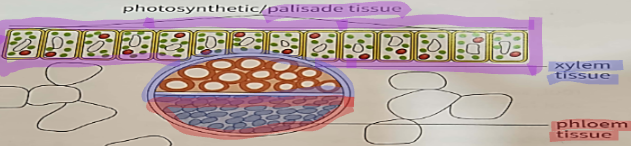
Xylem tissue:carries water
Phloem tissue: carries food
Palisade tissue:photosynthesis(absorb sunlight to make glucose ’plant food’)
Root system:
Anchor the plant
Absorb water and minerals from soil
Stare food
Shoot system:
Photosynthesis
support
transport substances
produce flowers for reproduction
They also have another system:
The reproductive system
but in most plants its only there for part of the year
Function of plants organs
organ 1:LEAVES- function: photosynthesis (shoot system)
organ 2:STEMS- function: supports &transport (shoot system)
organ 2:ROOTS- function: absorption & storage & conduction (root system)
Each plant tissue contains a particular types of specialised plant cells, working together to carry out a function in the plant.
TYPES | FUNCTION |
palisade tissue | capture light (photosynthesis) |
xylem tissue | Transport water and minerals from roots to leaves |
phloem tissue | Transport food from eaves to cells in the plant |
Food is made in a plants leaves
Food is needed in a plants cells
PICTURE OF TISSUES:
The decomposer(3.5)
What is a decomposer?
A decomposer is a living thing that breaks down dead plants, animals and waste, turning them into nutrient. that go back into the soil.
Examples of decomposers:
Fungi(like mushrooms and mold)
Bacteria
Worms
Some insects (like beetles and maggots)
What do they do?
Break down dead stuff
Return nutrients to the soil (like leaves, animal, waste)
Help plants grow by making the soil rich
Release carbon dioxide, water and nutrients into the environment.
Why are they important?
without decomposers, dead things would pile up, and plants wouldn’t get the nutrients they need. so basically, they keep the earth clean and healthy!
The physical environment(4.1)
key terms
Abiotic: non-living (light,temperature,water,PH)
Biotic: living (plants,animals,bacteria,fungi)
Why water is important?
Covers 71% of earths surface
Human body=60% water
Needed for:
- Transporting minerals & nutrients
- Photosynthesis body temperature
- Dissolving substances (solvent)
Water in organs
organ | water% |
lungs | 83 |
muscles | 79 |
kidneys | 79 |
heart | 73 |
brain | 73 |
skin | 64 |
bones | 31 |
Most amount of water: lungs(83%)
Least amount of water: bones(31%)
Properties of water
Good solvent- dissolves substances(important cells)
High heat capacity- helps regulate temperature
Ice floats- insulate water life in water
Why is it important that ice floats?
Because it forms a layer on top of water and keeps animals below from freezing.
Why does water being a good solvent matter?
Because it helps disslove and carry nutrients in living things.
The water cycle(4.2)
Water is always moving in and around earth. It never goes away but it does change form.
Its a gas in the atmosphere
Its a liquid in the surface
Its a solid in the glaciers
The movement of water around earth is called: the water cycle
The sun is the driving force of the water cycle.
There are 5 important process to the water cycle.
Steps of a water cycle:
1-Evaporation
2-Condensation
3-Precipitation
4-Transpiration
5-Runoff
1.Evaporation
The process of liquid water training into water vapour (gas).
The sun energy evaporates the water.
Liquid —> Gas
2.Condensation
the process of water vapour (gas) turning into liquid water.
Forms clouds
Gas —> Liquid
3.Precipitation
The process of liquid water falling back to earth.
4 types:
1.Water(liquid)
2.Snow(solid)
3.Hail(solid)
4.Sleet(solid)
4. Transpiration
process of plants releasing water vapour (gas) into the environment
Leaving have tiny openings called stomato. Plants open and close the stomato to release water vapour.
5. Runoff
The process of water flowing back to rivers,lakes,and the ocean.
Process of the water cycle:
Evaporation
The sun warms water on earths surface it causes liquid water to change into a gas this process is called
Condensation
In the atmosphere, water vapour cools and changes back into liquid form this process is called condensation tiny water droplets form on dust particles in the atmosphere to form cloud droplets. Cloud droplets combine to form clouds
Precipitation
Clouds eventually become “too heavy” and the water falls from the atmosphere to earth surface. This process is called precipitation water can fall as liquid droplets (rain) solid crystals (snow) or frozen droplets (hail)
Transpiration
plants need water just like we do and they store water in their leaves. Leaves have small openings. when the sun warms plants, it causes water to evaporate out of the leaves,through the small openings this process is called transpiration
Collection(runoff)
precipitation that falls to earths surface move from high to low elevation. This water is called runoff. Runoff collects in rivers that flow into lakes and oceans this process is called collection
Global warming and water cycle(4.3)
What is global warming?
Burning fossil fuels (cars,electricity) releases carbon dioxide (CO2)
CO2 traps heat —> Earth gets warmer=climate change
Impact on the water cycle
Global warming causes:
Icecaps/glaciers melt—> sea level rise
More evaporation—> more rain in some places
Droughts in other places
Melting ice & Rising seas
Most freshwater is stored as ice in glaciers
Melting ice—> less freshwater + rising sea levels
Some islands and coastal areas may disappear in 100 years
More floods
Warmer air holds water—>bigger storms
Heavy rain causes flooding, especially in coastal areas
floods damage homes, soil,and lives
More droughts
Hotter weather dries soil
No rain= drought
When it does rain, its too fast= runoff not soaking in
Rain changes
Some areas get more rain (north Europe, east Africa)
others get less rain(north Africa,middle east)
What causes sea levels to raise?
- melting ice and warmer oceans that expand
What damage do floods cause?
-They destroy homes, wash away soil, and can cause deaths.
Why are droughts lasting longer?
- Because hotter weather dries the soil and theres less rain for longer time