16: Publicity
Chapter 16: Publicity: Promotion Using Earned Media, Owned Media, and Social Media
Publicity, the Promotion Blend, and Marketing Strategy Planning
Chapter 16 is the final chapter covering Promotion.
Previous chapters covered:
Integrated marketing communications (Chapter 13).
Personal selling and customer service (Chapter 14).
Advertising and sales promotion (Chapter 15).
Publicity: Any unpaid form of nonpersonal presentation of ideas, goods, or services.
Includes earned, owned, and social media.
Publicity works best when integrated into the entire marketing mix.
Marketing managers must understand how the right promotion blend moves customers through the buying process.
Integrating Publicity into the Promotion Blend
Example: Kat's purchase of a backpack demonstrates the role of publicity.
Magazine ad and friend's recommendation capture attention and interest.
Visits Osprey website, watches video, and reads reviews.
Sponsored post on Facebook rekindles interest.
Salesperson at REI provides information; Kat buys Osprey Aura AG 65 EX.
Kat likes to show fellow hikers all features of her new backpack whenever asked and often “Liking” their posts and photos.
Osprey's promotion blend combines advertising, sales promotion, publicity, and personal selling.
Kat generates positive word-of-mouth for Osprey.
Paid, Earned, and Owned Media
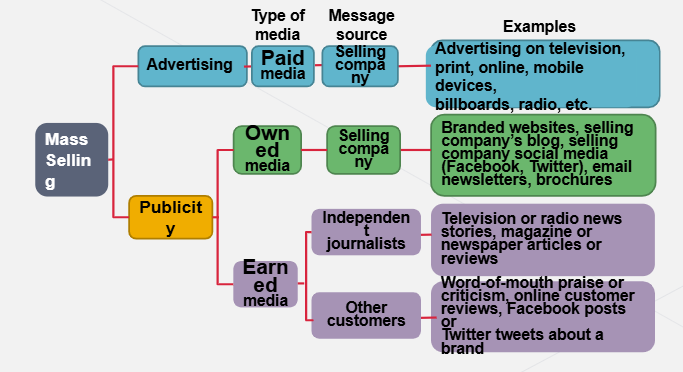
Advertising uses paid media.
Publicity relies on unpaid media (owned or earned).
Media
The means used for mass communication.
Advertising utilizes paid media.
Messages generated by a brand communicated through a message channel the brand pays to access.
Owned media.
Promotional messages generated by a brand communicated through a message channel the brand directly controls.
Examples: brochures, catalogs, website, blog, social media pages (YouTube, Facebook, Instagram).
Earned media.
Promotional messages not directly generated by the company or brand, but by third parties.
Examples: journalists or customers.
Company earns attention through interesting stories or valuable information.
Can be positive or negative.
Example: Bad Yelp review.
User-generated content: Communication created by customers for other customers.
Credibility
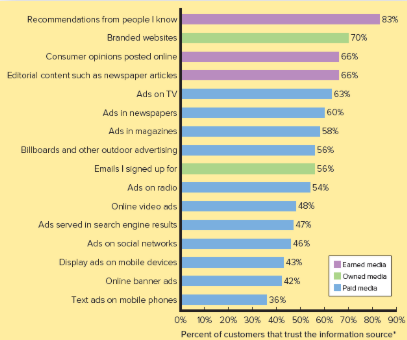
Customers generally view earned and owned media as more credible and trustworthy than paid media.
Research: Top trusted sources for buying information:
Recommendations from people they know (89%).
Editorial content (newspaper articles) (69%).
Online consumer opinions (reviews) (67%).
Emails they signed up for (72%).
Branded websites (71%).
Benefits and challenges for each media type
Paid media (advertising).
Benefits: High message control, precise targeting, potentially large audience.
Challenges: becoming less trusted, easily avoided, more costly, declining effectiveness.
Owned media.
Benefits: High message control, relatively low cost, niche audiences, versatile messaging.
Challenges: Slow (takes time to build traffic and create value), needs to work with paid and earned media, requires resources to manage and maintain.
Earned media.
Benefits: Most trusted information source, customers most likely to act on it, can be lower cost.
Challenges: Unreliable, little message control, can be negative, difficult to measure, create, or target.
Customers Obtain Information from Search, Pass-Along, and Experience
Advertising media are generally broadcast.
Customers discover owned and earned media in different ways.
Search
Customers search for information during the shopping process.
Marketing managers need to ensure useful material is found when target customers search online.
Search engine optimization (SEO).
Designing a website so it ranks high in a search engine's unpaid results.
Considers how target customers search, keywords, and search engine prioritization.
Technical elements are beyond the scope of this textbook.
Pass-Along
Customers search for answers offline as well.
This may lead them to a salesperson who can answer their questions.
It might also lead them to a neighbor or friend who might help them “find a new dentist” or “recommend a preschool.”
Pass-along occurs when one customer passes information on to one or more other customers.
Customers pass along videos, articles, coupons, or websites.
Viral promotion: When customers spread a message far and wide.
Six STEPPS to increase pass-along (Dr. Jonah Berger):
Social currency: Sharer looks good by sharing.
Triggers: Topic is easy to remember and encourages conversation.
Emotion: People like to share happiness and other emotional connections.
Public: Noticeable features spread quickly.
Practical value: Make the information obviously useful to the recipient.
Stories: Capture imagination and make an idea easy to remember and share.
Experience
Customers gain experience with a brand by using its product (goods/services).
Branded services: Valued services a brand provides that are not directly connected to a core product offering.
Designed to share a message and make the brand cares by offering some free service.
Create Owned Media Content Your Customers Can Use
When solving a problem, customers have choices about where to find information.
When faced with a new problem or need, many customers turn first to the Internet.
When a business or organization creates owned media content that helps customers solve their problems, their messages influence buyers’ decisions.
Types of Owned Media
Social media (Facebook, Instagram, Twitter).
Exhibit 16–5 provides an overview of the types of owned media discussed in this section.
Shows how customers typically discover each type of media.
Lists representative promotion objectives.
Examples of Owned Media
Educational web pages
Build awareness, educate/inform customers, foster trust.
White papers and case studies
Authoritative reports or guides addressing important industry issues and offering solutions.
Often used by business customers seeking solutions.
Webinars
Live educational presentations where viewers can interact.
Generate leads, build reputation as thought leader, retain customers.
Landing pages
Customized web pages that logically follow from clicking a link.
Goal: Move customers along purchase process.
Blogs
Regularly updated websites written in an informal, conversational style.
Position a firm as a thought leader or caring company.
Podcasts
Informative or entertaining content can be created by brands to educate or build reputations.
Branded apps
Sponsored software applications that benefit customers.
Brand communities
Groups of customers joined around a particular brand or shared interest.
E-mail newsletters
Build ongoing customer relationships and increase purchases.
Dark Patterns:
Features added to a website such that it can trick users into doing things they don’t intend to do.
Earned Media from Public Relations and the Press
Media coverage can be earned from customers or from the press.
Some companies earn editorial coverage in magazines, newspapers, or on television.
A good public relations effort often lays the groundwork for companies that get positive attention in the press.
Some firms' public relations people write the basic copy of an article and then try to convince magazine or newspaper editors to print it.
Press kits
Promotional materials specifically designed for the media which can be online as well.
The press enjoys covering do-good stories.
Bloggers
Citizen “journalists” who can be objective sources of information.
Identifying influential bloggers who have the attention of target customers can be helpful.
Ethics require disclosure of conflicts of interest.
Earned Media from Customer Advocacy
Customers trust and act on recommendations from friends, family, and colleagues.
Customers acquired from word-of-mouth are more loyal and have higher lifetime values.
Opinion leaders
Like to share their views and get attention from other customers.
Motivate consumers
Help to spread the word and start conversations.
Consistently high performance gives a customer confidence that it happens all the time.
Ethics and danger of falsifying earned media.
Referral programs
Offer incentives for recommending a new customer to a business.
Ratings and reviews
Let customers do the selling.
Manage negative reviews when they come along.
Social media simplify and amplify pass-along.
Social Media Differs from Traditional Media
Social media refers to websites or software applications that allow users to create and share ideas, information, photos, and videos and interact in a social network.
Examples of social media include Facebook, Twitter, Instagram, Pinterest, Snapchat, YouTube, LinkedIn, and TikTok.
Paid, owned, and earned media may appear on social media.
Have no direct media cost, but that doesn’t mean use of social media platforms is free.
Advertising is a one-to-many model of communication.
Social media operate in a many-to-many model of communication.
Advertising through paid media typically involves a relatively long planning cycle.
Social media plans, can be reacted to respond to current or emerging events/comments immediately.
Major Social Media Platforms
One of the primary differences across social media platforms are the demographic characteristics of the users.
YouTube
Used by more online Americans (81 percent of U.S. adults) than any other social media.
Anyone can create an account on YouTube and then subscribe to a channel.
Most used (though YouTube has higher percentages among Americans).
Online social networking website that allows registered users to create profiles, upload photos and video, and send messages to connected friends.
Users typically scroll through their “newsfeed,” viewing posts (videos, photos, status updates) from “Friends,” “Liking” businesses or organizations, and sponsored posts (paid advertising).
All of this user engagement gives Facebook a great deal of data on individual customer interests.
Those big data allow firms to precisely target customers with advertising.
Photo- and video-sharing service geared to mobile phones.
Forty percent of American adults use the app.
Users typically scroll through their “newsfeed,” viewing posts (videos, photos, status updates) from “Friends,” and sponsored posts (paid advertising).
Website that allows registered users to share ideas and images they find online with fellow users.
The ideas and images are organized into “pinboards”—a kind of online bulletin board.
The site appeals across age groups more than other social media.
Networking website for businesspeople who create personal or company profiles.
Businesspeople used to think of LinkedIn as a place to network for jobs.
Now many companies and salespeople use LinkedIn in their marketing strategy.
Snapchat
Mobile app and service for sharing photos, videos, and texts with other people.
Commercial applications in its “Discover” section allow brands to post advertising-supported content.
Snapchat continues to work on adding features to make its service more friendly to marketers; most opportunities are forms of paid media.
Microblogging service that allows registered users to send short (280 characters or less) messages called “tweets.”
Twitter operates like a public message board, with most tweets available for anyone (even people not signed up for Twitter) to see them.
Most Twitter users follow friends, celebrities, news sites, and brands.
A simple “hashtag” (#) allows fans to pass along support for well-known brands and helps marketing managers assess engagement and interact with potential leads.
TikTok
Social networking service where users share short-form videos.
designed to entertain.; the videos often feature pranks and stunts, but also useful information, and are generally less than 60 seconds
Algorithm allows lesser-known influencers to go viral. Brands are finding creative ways to use the platform.
Other social networks
Tumblr is a microblogging site that makes it easy for users to share all types of media from their browser, phone, desktop, or email.
Triller and Vimeo.Other social networks like WhatsApp and Facebook Messenger focus on voice or text communications.
Strategy Planning for Social Media
Exhibits 16–6 and 16–7 provide some demographic information about users of some of the major platforms. In addition, all the social media platforms presented here collect significant amounts of data about their users.
Steps for Strategy Planning for Social Media
Set objectives:
Some companies make the mistake of focusing on short-term objectives like generating millions of Facebook fans or thousands of followers on Instagram.
The marketing manager should keep in mind where target customers reside along the purchase funnel (see Exhibit 13–2).
Choose the social media platform that fits the objective:
It takes time to build a social media following, so this decision should not be taken lightly.
Exhibit 16–8 provides a summary of the Big Eight social media showing how each can be used for paid, owned, and earned media—and the pros and cons of each for marketing strategy.
Create content that delivers value to followers:
Ultimately, a company’s social media needs fans and followers—or few people see the content. Target customer follow companies and brands that deliver some sort of value, and followers will show support for valued posts by “liking,” sharing, retweeting, or commenting.
Exhibit 16–9 shows some creative examples of value delivery through social media.
Engage with and encourage followers:
Some followers create user-generated content.
Most marketing managers should not be afraid to experiment with social media. New posts can be measured on criteria like number of views, number of comments, number of link clicks, and more.
There are many opportunities for social media sites—and a lot to manage. Fortunately, because social media is online, there are good software tools to aid in implementation and control.
Software to Manage, Measure, and Automate Online Media
Implementing paid, owned, earned, and social media requires that managers follow many of the principles discussed elsewhere in this textbook.
Segmentation remains important because different types of earned, owned, and social media occur online, software can be used to monitor and manage the process.
What can software do?
Manage social media for multiple platforms.
Measure results from online media.
Use and monitor the bounce rate of websites.
Uses marketing automation to make the customer carry on through the purchase funnel.