3.1 Enzymes
Metabolism - the totality of all enzyme-catalysed reactions that occur within a living organism
Because of enzyme specificity, many different enzymes are required by living organisms, and control over metabolism can be exerted through these enzymes
Metabolic reactions serve two key functions:
They provide a source of energy for cellular processes (growth, reproduction etc.)
They enable the synthesis and assimilation of new materials for use within a cell
Anabolism - the set of metabolic reactions that build up complex molecules from simpler ones
The synthesis of organic molecules via anabolism occurs via condensation reactions (water is produced)
Examples of anabolic reactions include:
Production of glucose by photosynthesis (and its subsequent polymerisation into glycogen/starch)
Synthesis of polypeptide chains (proteins) from amino acid subunits (i.e. translation at the ribosomes)
Semi-conservative replication of DNA and the formation of RNA transcripts via transcription
Catabolism - the set of metabolic reactions that break down complex molecules into simpler ones
The breakdown of organic molecules via catabolism occurs via hydrosis reactions (water is consumes)
Examples of catabolic reactions include:
Breakdown of macromolecules (polymers) into monomers during the process of chemical digestion
Oxidation of substrates in cell respiration (i.e. breaking down glucose via glycolysis)
Why do we need enzymes?
Without enzymes, the rate of chemical reactions in organisms would be too low to support life
To form product molecules, the reactants would need to collide at the correct angle and speed in order for a reaction to occur
The chances of this occurring under normal conditions would be so low, that this would be an insignificant event
Enzymes ensure that substrate molecules are orientated (positioned) correctly and close enough for a reaction to occur
The cell has control over the enzymes being produced, which in turn gives the cell control over the chemical reactions occurring in the cytoplasm
Enzyme structure and function
Enzymes are globular proteins
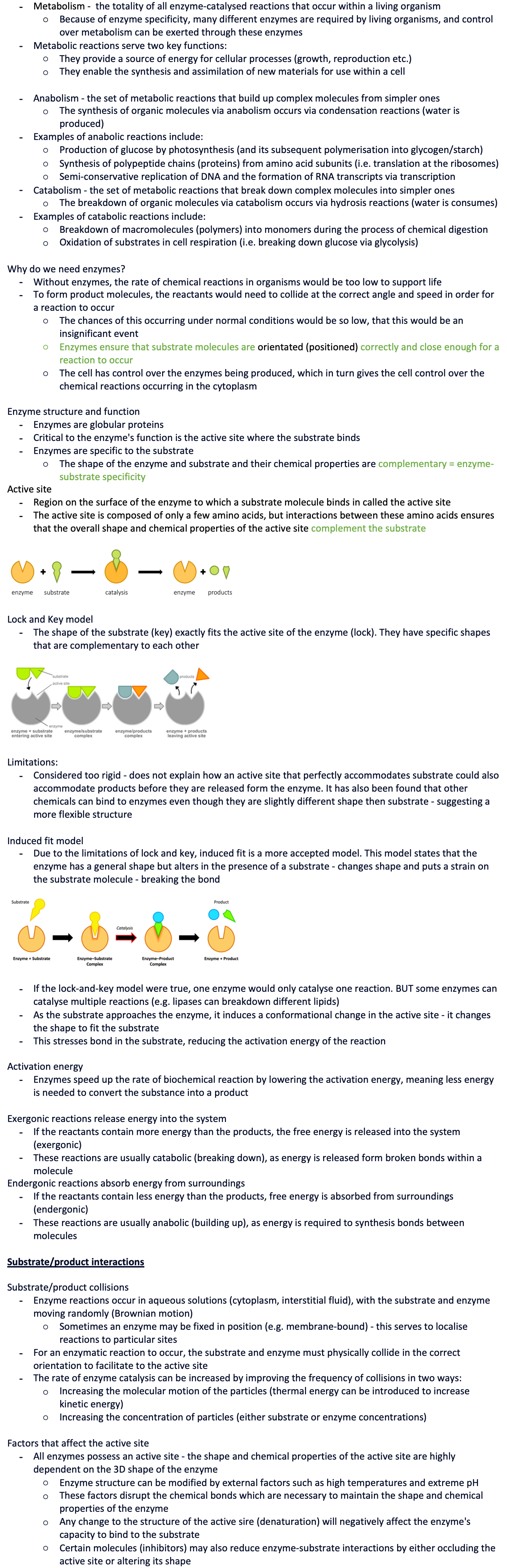
Critical to the enzyme's function is the active site where the substrate binds
Enzymes are specific to the substrate
The shape of the enzyme and substrate and their chemical properties are complementary = enzyme-substrate specificity
Active site
Region on the surface of the enzyme to which a substrate molecule binds in called the active site
The active site is composed of only a few amino acids, but interactions between these amino acids ensures that the overall shape and chemical properties of the active site complement the substrate
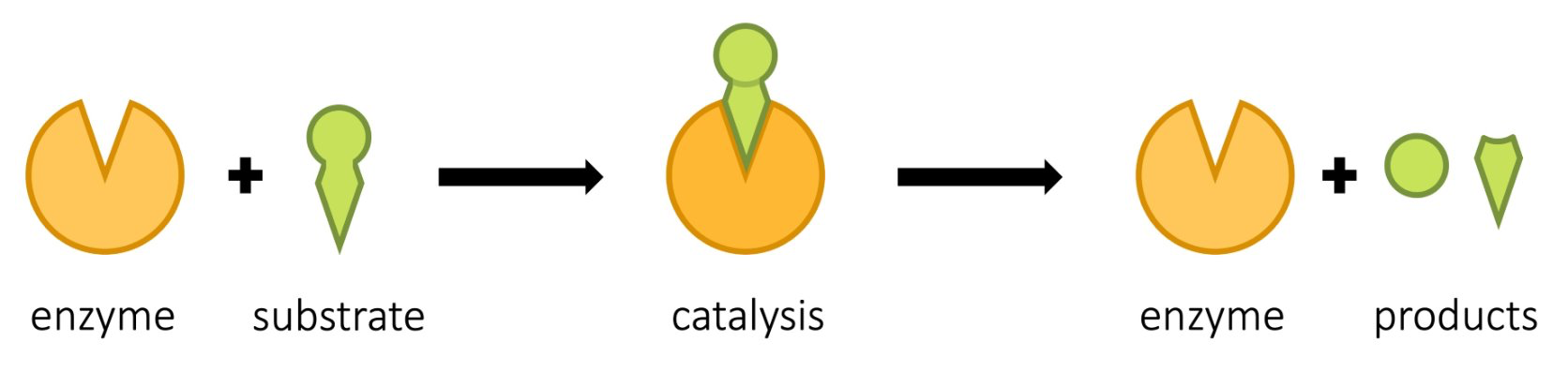
Lock and Key model
The shape of the substrate (key) exactly fits the active site of the enzyme (lock). They have specific shapes that are complementary to each other
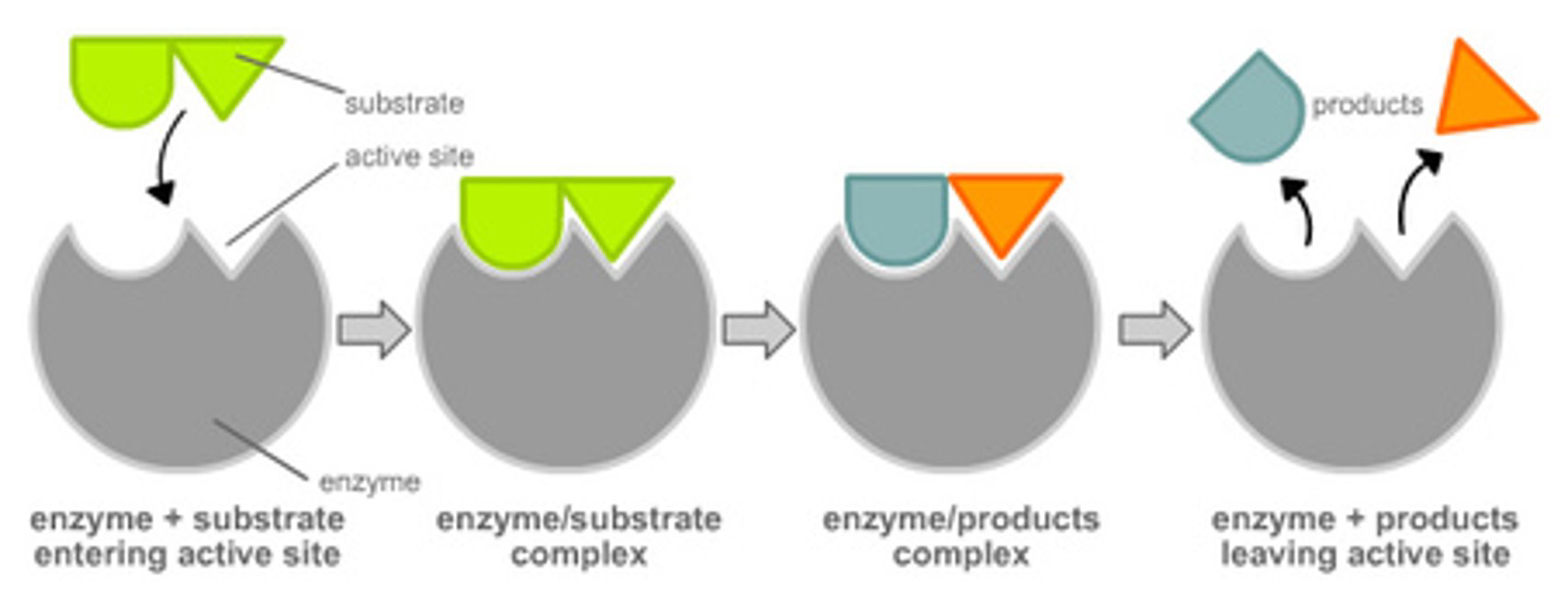
Limitations:
Considered too rigid - does not explain how an active site that perfectly accommodates substrate could also accommodate products before they are released form the enzyme. It has also been found that other chemicals can bind to enzymes even though they are slightly different shape then substrate - suggesting a more flexible structure
Induced fit model
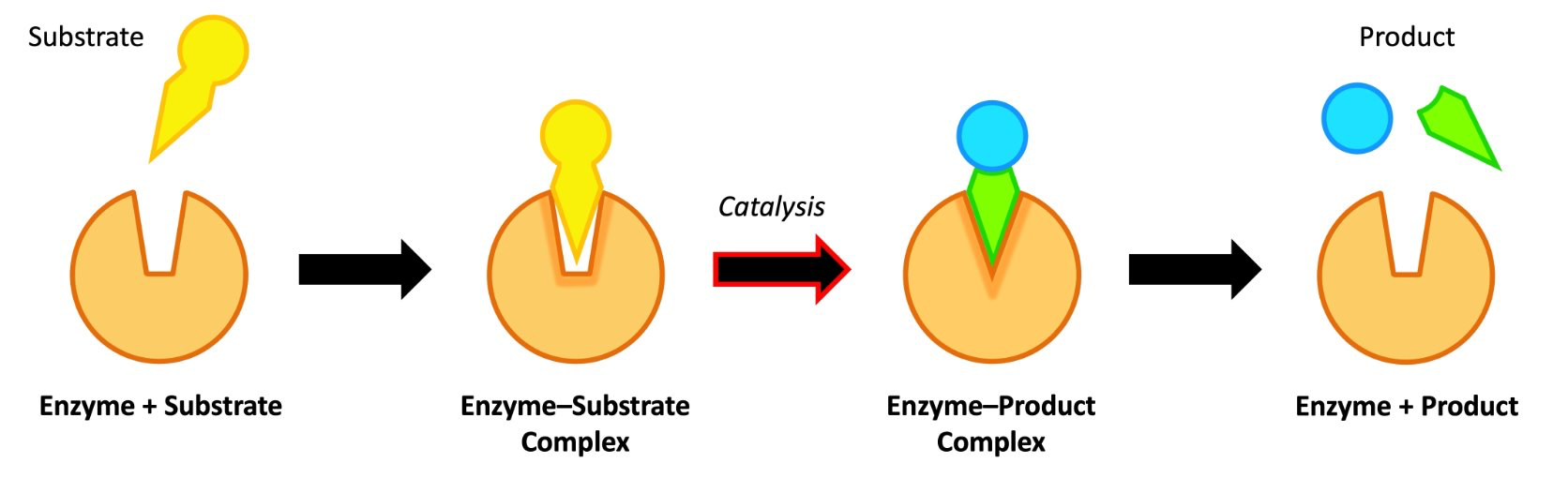
Due to the limitations of lock and key, induced fit is a more accepted model. This model states that the enzyme has a general shape but alters in the presence of a substrate - changes shape and puts a strain on the substrate molecule - breaking the bond
If the lock-and-key model were true, one enzyme would only catalyse one reaction. BUT some enzymes can catalyse multiple reactions (e.g. lipases can breakdown different lipids)
As the substrate approaches the enzyme, it induces a conformational change in the active site - it changes the shape to fit the substrate
This stresses bond in the substrate, reducing the activation energy of the reaction
Activation energy
Enzymes speed up the rate of biochemical reaction by lowering the activation energy, meaning less energy is needed to convert the substance into a product
Exergonic reactions release energy into the system
If the reactants contain more energy than the products, the free energy is released into the system (exergonic)
These reactions are usually catabolic (breaking down), as energy is released form broken bonds within a molecule
Endergonic reactions absorb energy from surroundings
If the reactants contain less energy than the products, free energy is absorbed from surroundings (endergonic)
These reactions are usually anabolic (building up), as energy is required to synthesis bonds between molecules
Substrate/product interactions
Substrate/product collisions
Enzyme reactions occur in aqueous solutions (cytoplasm, interstitial fluid), with the substrate and enzyme moving randomly (Brownian motion)
Sometimes an enzyme may be fixed in position (e.g. membrane-bound) - this serves to localise reactions to particular sites
For an enzymatic reaction to occur, the substrate and enzyme must physically collide in the correct orientation to facilitate to the active site
The rate of enzyme catalysis can be increased by improving the frequency of collisions in two ways:
Increasing the molecular motion of the particles (thermal energy can be introduced to increase kinetic energy)
Increasing the concentration of particles (either substrate or enzyme concentrations)
Factors that affect the active site
All enzymes possess an active site - the shape and chemical properties of the active site are highly dependent on the 3D shape of the enzyme
Enzyme structure can be modified by external factors such as high temperatures and extreme pH
These factors disrupt the chemical bonds which are necessary to maintain the shape and chemical properties of the enzyme
Any change to the structure of the active sire (denaturation) will negatively affect the enzyme's capacity to bind to the substrate
Certain molecules (inhibitors) may also reduce enzyme-substrate interactions by either occluding the active site or altering its shape