Required Practical 4: Temperature Changes
Investigating the temperature change of a neutralisation reaction and how the temperature changes depending on the amount of a reactant.
Hydrochloric acid + Sodium Hydroxide —> Sodium Chloride + Water (exothermic)
IV: Volume of sodium hydroxide
DV: Maximum temperature reached by the solution
CV: Volume of hydrochloric acid, Concentration of sodium hydroxide and hydrochloric acid
Method:
Measure 30cm3 of dilute hydrochloric acid using a measuring cylinder
Transfer acid into a polystyrene cup as the cup is a good thermal insulator
Stand cup in a beaker to stop cup falling over
Use thermometer to measure temperature of the acid
Measure 5cm3 of sodium hydroxide
Add to the cup then place a lid after with a hold for the thermometer to still fit through
Use the thermometer to gently stir the solution and then read the thermometer until the highest temperature possible is seen and then is recorded.
Repeat experiment by adding another 5cm3 of sodium hydroxide each time until 40cm3 is reached.
Repeat the whole experiment again to find the mean temperature of each volume of sodium hydroxide
plot graph as seen below
Result:
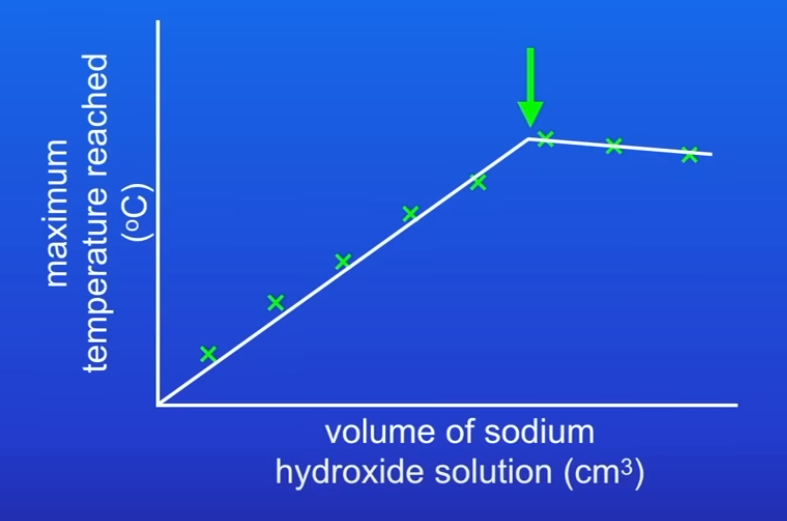
Beginning: As more sodium hydroxide is added, the maximum temperature reached increases because there are more particles of sodium hydroxide there to react with the hydrochloric acid
Arrow on diagram: The point where the maximum temperature reached is the highest, will be when the volume of the two solution is the same (if both concentrations are equal)
End: Temperature starts to decrease as there is too much sodium hydroxide so the hydrochloric acid cannot react with all of it. Furthermore, there is a greater volume of solution with each experiment so the thermal energy released is spread out into a greater volume so the maximum temperature actually decreases instead of remaining stagnant.