Unit 4: Cell Communication and Cell Cycle
Slogan: Homeostasis
Unit notes
Homeostasis & Feedback loops
Homeostasis: The internal environment of the body is in a dynamic state of equilibrium
Feedback: Can be described as a “loop.“ There are two ways in which a system can respond to a signal ↴
Negative Feedback: The goal of negative feedback is to keep internal conditions stable / return to stability and therefore homeostasis
Working in the opposite direction (You’re sweaty HOT, you sweat to COOL down)
Example: Thermoregulation: environment gets colder → you shiver → the movement of your muscles produce heat → you warm up → you’ve returned to homeostasis
Positive Feedback: The main goal is to increase the effect/product in a living system
Working in the same direction (Fruit ripening produce ethylene gas, which then ripens the fruit more and produces more gas)
Example: Contractions during labor. The onset of contractions stimulates the release of oxytocin, which stimulates more contractions
Receptor- The signal
↳ A coordinator at Publix who sees a spill on aisle 5 and reports it to the manager
Control Center- The manager
↳ The manager sends an employee to clean the spill
Effector- The thing that makes a change
↳ The employee cleans the spill
↳ NEVER A HORMONE
*However the three separate ideas may not be physically separate in what things actually do them*
↳ The manager for instance may see the spill and clean it up themself, thus performing all three jobs
Cell Communications
yip yip!!
Signaling pathway symbols
“-” is inhibition
“+” is activator
Practice ↴
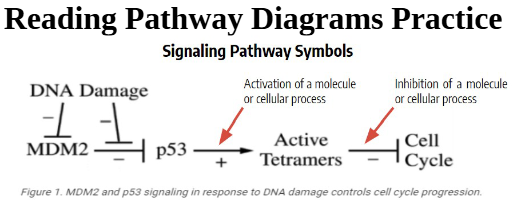
What is P53’s function in the pathway?
What is MDM2 function in the pathway?
How does DNA damage affect the outcome of the pathway?
Ligand- A signal MOLECULE
↳ The chemical structure of molecule determines how ligand enters the cell
↳ Ex: RANKL
Receptor- A MOLECULE that a ligand activates
↳ Ex: RANK
Cytoplasmic receptors- accepts hydrophobic molecules which pass through the membrane easily
Membrane receptors- accepts hydrophilic molecules and ions that need assistance to enter the membrane
Types of Cellular communication:
Juxtracrine- Involves contact between cells in which a ligand on one cell surface binds to a receptor on the other
↳ Juxta- Latin for near/beside
Paracrine- Occurs only when molecules travel short distances
↳ Tends to have a faster response but a short-lived effect
↳ Parasailing- a short distance
Endocrine- Used for long distance communications
↳ In humans, found in endocrine glands
↳ Tends to have a slower response and a longer-lasting effect
Autocrine- Factor that is secreted acts on the same cell and then elicits a response
↳ “Self signaling“
↳ independent queen
Signaling pathway
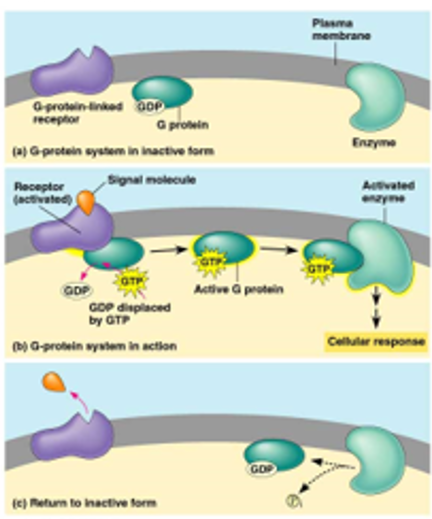
Signal goes to signal receptor
the G Protein is phosphorylated to become active
G Protein moves to enzyme to activate it
Tyrosine Kinase Receptor
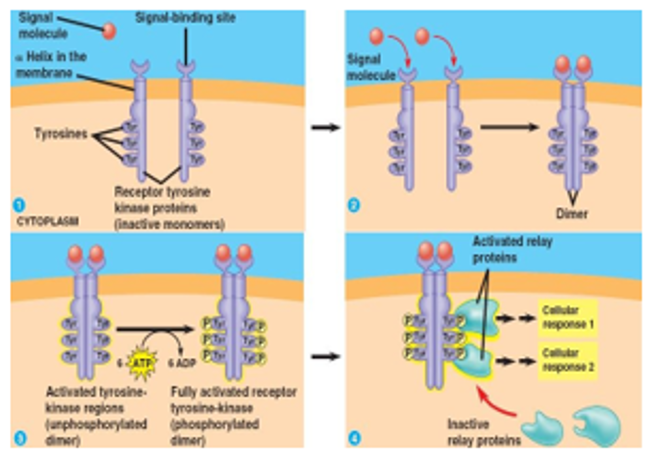
Two sticks: signal molecules on both sides of the sticks
called dimerizing when they bind
The sticks together combined phosphorates to become activated
They activate new target proteins
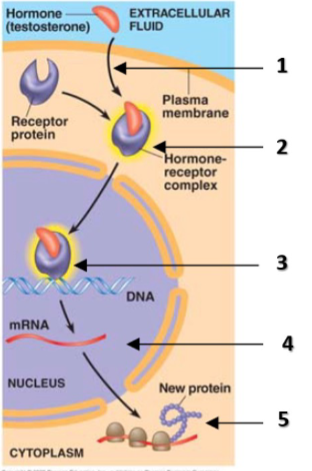
Going through the membrane, hydrophobic
Gene expression is promoted
Binds to receptor protein, intracellular
New Protein
The receptor + Ligand complex binds to DNA
Kinases
Adds phosphate groups (Phosphorylation)
Generally turns “ON“ signals
Phosphatases
removes phosphate groups
Generally turns “OFF“ signals
The phosphate acts as a switch
cAMP Pathway ↴
cAMP is a second messenger
Neurons and muscle cells
These cells are excitable
a specialized cell capable of generating and propagating electrical signals, known as action potentials, in response to stimuli
Most cell maintain a constant voltage; Resting potential
Bone Remodeling
Osteoblasts- Builds the bone
↳ Bone remodeling
↳ Produces RANKL and OPG
Osteocytes- Occur when osteoblasts get stuck in the bone while remodeling
Osteoclasts- chaos/crash/clast- breaks the bone
↳ Bone resorption
RANK- Receptor found on osteoclasts
RANKL- Ligand which can bind to RANK or OPG
↳ Found on Osteoblasts
OPG- Binds to RANKL which indirectly inhibits osteoclasts
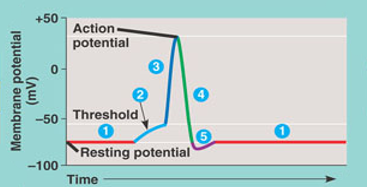
Resting potential- Nothing is actively happening
Threshold- the membrane potential that must be crossed to cause a reaction
↳ All or nothing
Depolarization- The inside of the membrane becomes less negative
↳ Neurons are polarized
↳ Sodium gates are opened, Potassium gates are closed
Repolarization- The membrane returns the resting membrane potential
↳ The sodium inactivation gate closes
↳ Potassium gates open
Hyperpolarization- The inside of the membrane becomes more negative than the resting potential
↳ Overshoots the polarization
Saltatory conduction- Signals jump to occur faster through nodes of Ranvier
↳ Prevents short circuiting in nerves
Synaptic delay- Rate limiting step or neural transmission
↳ Time for neural transmitter to bind to neural receptor
↳ Stops neural transmission from going out of control
↳ Prevents short circuiting
Plant communication
Auxin- Stimulates growth in shoots
↳ Inhibits growth in roots
Cytokinin- Cell division in shoots and roots
↳ Promotes lateral growth
↳ Delays decay
Gibberellins- Promote cell elongation in shoots
Ethylene- Promotes ripening and maturation
Abscisic Acid- Produces mature leaves and fruits
↳ Protects plants from the environment
Pathogens
Cause diseases
Immune responses in plants
Continuous defense:
Made as a part of the cell structure
Energy efficient
EX: Cell walls, bark
Inducible defenses:
Initiated by detection of pathogens
Need a bunch of energy
EX: Poison Ivy’s toxins
Transpiration
Cell Cycle & Regulation
Genomes- is all of a ce
lls genetic information
Chromosomes have a short arm (q) and a long arm (p)
Two chromatids are attached together with a centromere to create a chromosome
Somatic cells
Body cells
Diploid (2n): 2 of each type of chromosome
Divide my mitosis
humans: 2n = 46
Gametes
Sex cells
Haploid (n): 1 of each type of chromosome
Divide by meiosis
Humans: n = 23
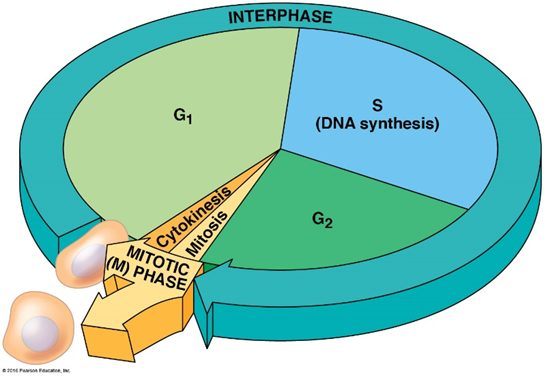
Interphase contains G1, S, G2
G1- Cells continue normal function
↳ Great day!
S- Chromosomes Duplicate
G2- Prepare for cell division
↳ Makes organelles that mitosis will need
Miotic (M) Phase: Contains mitosis and cytokinesis
Mitosis- PMAT
↳ Prophase- Chromosomes become visible
↳ Chromatin condenses
↳ Metaphase- chromosomes line in the middle & the spindle fibers attach
↳ Anaphase- The spindle fibers are shortened: chromosomes are pulled apart
↳ Telophase- Chromosomes gather at opposite ends
Cytokinesis- Cytoplasm pinches in half
↳ Cytoplasm Cut
↳ animals cells = cleavage furrow
↳ plant cells = cell plate forms
Cell cycle regulation
G1 checkpoint- The most important
G2 checkpoint- make sure everything is in order, no mutations
M spindle (metaphase) checkpoint- make sure spindle fibers attached properly
Internal regulatory molecules
Kinases- adding a phosphate and active when connected to cyclin
Cyclin- attached to kinases to activate
MPF- the maturation promoting factor
allows cells to pass G2 and go to M phase
it’s the cyclin-CDK complex
Growth factor
Density dependent
anchorage dependence- must stay where it is, on the outside of the cell
Cancer cells
Kahoot/Additional notes to be moved later
Plants community by sending small molecules, ions through PLASMODESMATA
Examples of a typical first messenger: Hormones and neurotransmitters
When a ligand binds to its receptor protein, the protein typically does what?
↳ Changes shape
Transduction my involve al of the following except: binding of ligand to receptor protein
Cyclin + CDK = MPF, MPF formation depends on the increasing concertation of CYCLIN
An example of external signal can trigger the cell cycle/mitosis is/are GROWTH FACTORS
At the end of meiosis 1, there are: 2 haploid cells, ready to go through Meiosis 2
During anaphase 1 of meiosis 1, what separates?
↳ homologous pairs
During anaphase 2 of meiosis 2, what separates?
↳ sister chromatids
Genetic diversity increases fitness!
What is used for long distance signaling?
↳ hormones
Receptor tyrosine kinases: trigger multiple responses connecting phosphates to tyrosine
Which cell messenger system acts as a gate?
↳ Ligand-gated ion channel
Where are intracellular receptor proteins found?
↳ In the cytosol and nucleus
cAMP activates and deactivates other proteins through phosphorylation
phosphorylase removes the phosphate from an activated protein kinase
Essential Questions
How do organisms use positive feedback to return to homeostasis? Have a solid example to reference
How do organisms use negative feedback to maintain homeostasis? Have a solid example to reference
How do cells communicate using signals, receptors, and transduction pathways?
What is some example pathways that can be used by animals and plants to initiate cell responses?
How could mutations in a ligand or a receptor protein alter cell signaling?
What are some cell functions and processes that are controlled by cell signlaing?
How is the cell controlled? How does the cell move through the cell cycle to accomplish cell division?