Unit 5– Land and Water Use
Module 24– The tragedy of the commons; clear cutting
The tragedy of the commons describes the harm that can occur to public and shared resources
The tragedy of the commons: common resources can become depleted if they aren’t regulated in some way
Externalities: the cost of benefit of a good or service that isn’t accounted for or included with the price— tragedy of the commons results from a negative externality
We can regulate commons by applying different methods to the commons
Public lands are classified according to their use
Around 3.2 billion hectares are protected throughout the world
Public lands in the United States:
Managed by the Bureau of Land Management, the United States Forest Service, the National Park Service, and the Fish and Wildlife Service
BoLM lands: grazing, mining, timber harvesting, and recreation
USFS lands: timber harvesting, grazing, and recreation
NPS lands: recreation and conservation
FWS lands: wildlife conservation, hunting, and recreation
Land management differs in rangelands and forests
Rangelands are dry, open grasslands which are used for grazing cattle— but when overused, they can lose biodiversity and can erode the land, making it difficult to retain water and nutrients
Forests are areas dominated by trees and woody vegetation that are sometimes used for commercial logging— where logging companies pay a percent of their revenue to the government
Clear-cutting can adversely impact soils, streams, and atmospheric carbon dioxide concentrations
Clear cutting: removing all the trees in an area to harvest them
Clear cutting makes slopes more susceptible to wind and water erosion, leading to the loss of soil and nutrients as well as sediment to nearby streams— it can also lead to soil compaction, which lessens water infiltration, and also leads to increased decomposition which can increase carbon dioxide concentrations
Selective cutting: harvesting trees that involves the removal of single trees/ smaller numbers of trees, which lessens the consequences of clear cutting but doesn’t stop them completely
Ecologically sustainable forestry: removing trees that don’t affect the viability of other, noncommercial tree species— most beneficial for the environment but costs a lot
Forest management influences biodiversity in a variety of ways
Reforestation— clear cutting leads to tree plantations, where trees are replaced with a single species, leading them to never develop into full forests. Soil can also become depleted if overused
Federal regulation of land use
1969 National Environmental Policy Act— mandates an assessment of the environmental impact of all projects
Endangered species act— a law designed to protect plant and animal species that are threatened with extinction, and the habitats that support those species
Module 25– The green revolution
Agriculture has undergone a number of transformations over time
We have domesticates plants and animals
First agricultural revolution— domestication
Second agricultural revolution— mechanization of farming
Transition from subsistence (farming for consumption) to mass farming
Use of fossil fuels has increased
Industrial agriculture/ agribusiness has become an industry
The green revolution led to greater food production
Green revolution: A shift in agricultural practices in the twentieth century that included new management techniques and mechanization, as well as the triad of fertilization, irrigation, and improved crop varieties, that resulted in increased food output.
The green revolution led to advances in mechanization, fertilization, irrigation, and the use of pesticides
Mechanization: mass planting, irrigation, plowing, sorting, etc. that reduces the cost of labor through machines
Economies of scale: the average costs of production fall as output increases
Fertilizers: contain nitrogen, phosphorus, and potassium
Organic fertilizers are composed of organic matter/ manure
Synthetic fertilizers are produced commercially with the use of fossil fuels
Irrigation: transforms land into useable land
Water logging: soil degradation when soil remains under water for too long
Salinization: when salts in irrigation water degrade soil after becoming highly concentrated on the soil surface through evaporation
Pesticides: natural or synthetic, that kill pests
Insecticides kill insects and invertibrates
Herbicides kill plant species
Broad-spectrum kills many
Selective kills a specific few
Monocropping: planting a single species (like wheat, corn, soybean)— has improved agricultural productivity, but can lead to soil degradation, and pest attacks
Genetic engineering and the introduction of genetically modified organisms are revolutionizing agriculture
Benefits of GMOS:
Increased crop yield due to developing more resistant strains
Increased profits= more money saved+ more product
Concerns:
Safety for human consumption
Effects on biodiversity that can eliminate plant varieties
Regulation: GMO labeling law requires all GMOs to be labeled
Mechanization results in the energy subsidy in agriculture
Energy subsidy: the fossil fuel energy and human energy input per calorie of food produced
Fossil fuels increase energy input
Module 26– Impacts of Agricultural Practices
Many agricultural practices work against succession and other natural processes
Succession is reversed when a field is plowed
Plowing and tilling reverse succession and mobilize organic matter
Plowing: turning soil over and digging deep
Tilling: stirring, digging, and cultivating soil to prepare it/ bury weeds
Aerates soils and exposes nutrients
Exposes rock to chemical weathering, also increasing nutrients
Can also lead to erosion and increase particulate matter in the air as well as sediment runoff
Slash and burn farming causes short term gains and long term losses
Land is burned to release nutrients and farmed until soil is depleted
Pressure has led soil to become overused, not giving it enough of a chance to recover
Can contribute to soil compaction
Burning the soil releases carbon monoxide and dioxide inputs
Fertilizer use affects soil and water
NPK (nitrogen, phosphorus, potassium)
Synthetic fertilizers can increase yields, but can cause eutrophication in water bodies which results in algal blooms and dead zones
Module 27– Irrigation and Pest Control Methods
Groundwater and surface water are used for irrigation
Stored in aquifers, or pore spaces found within permeable layers of rock and sediment under soil
Unconfined aquifers: porous rock covered by soil
Confined aquifers: surrounded by a layer of impermeable rock or clay, which impedes water flow
Water table: the uppermost level at which groundwater fully saturates rock or soil
Recharge: precipitation percolates through soil into groundwater
Groundwater serves a purpose for many organisms, and drilling into aquifers and creating wells (artesian well) can cause water to rise to the surface and be pumped out
Major uses of water: we can tell by a water footprint
Crop irrigation can be done by furrow, flood, spray, and drip irrigation
Furrow: trenches are dug along the crop and filled with water (67% efficient)
Flood: fields are flooded with water (66-80% efficient)
Spray: water is sprayed onto a field (75-90% efficient)
Drip: a hose is slowly dripped beneath the soil and delivers water to plant roots (95% efficient)
There are three major adverse consequences of irrigation
Water logging: can happen from flood irrigation and degrade soil
Salinization: salt becomes highly concentrated, can result in crop degradation
Aquifer depletion: for example, the ogallala aquifer has declined in size
Too much use and not enough recharge can result in a cone of repression, which is an area surrounding a well that doesn’t contain groundwater
Pesticides reduce pests but have some adverse consequences
(There are also fungicides and rodenticides)
Pesticides can increase crop yield and make agriculture more efficient
Some pesticides, like DDT are persistent pesticides (meaning they remain in the environment for decades, accumulating in the fatty tissues of animals)
Some are nonpersistent, meaning they break down easily, but they do need to be applied more often
Integrated pest management uses a various amount of techniques to minimize pest outputs
Organisms can become pesticide resistant
Pests have large populations and gene pools, meaning they’re more likely to develop resistance
Benefits of genetic engineering: can reduce the need for pesticides (ex. Bt and HT corn)
Module 28– Meat production methods and the impact of overfishing
Concentrated animal feeding operations and free range grazing each have their advantages and disadvantages
Meat production is less efficient than crops because you grow crops to feed meat and it also requires more land
High density animal farming: CAFOS improve feeding efficiency and increase the fraction of food energy that goes into the production of animal body mass, making meat prices much lower (but require more antibiotics and water)
Water disposal and waste lagoons: people use manure lagoons to hold CAFO waste, however, overflow/ leaks can result in water seeping into local water bodies and causing disease/ eutrophication
Diversion of corn and soy from people to livestock: more crop is being used to feed animals
Free-range grazing: less antibiotics and no fossil fuels, no massive quantities of manure and can help maintain grasslands
Nomadic grazing
Can cost a lot of money and take too much land (too many people need to be fed!)
Overgrazing and desertification
Overgrazing can remove vegetation and erode or compact soil, which can lead to unproductive (desertified) land
Harvesting fish can lead to fishery decline
Overfishing can lead to fishery (harvestable populations of fish) collapse
Major fishing methods:
Purse seine nets surround fish
Bottom trawl nets run along the bottom of the ocean
Midwater trawl nets are pulled through the water above the ocean
Gill nets have larger holes and are set up so fish swim into the holes and can’t escape
Longlines have baited hooks along the line
Commercial fishing leads to bycatch (catching a nontarget species)
More sustainable fishing: fishery management plants are created, US passes Sustainable Fisheries Act
Fishery quotas (total allowable catch amounts)
Module 29– Impacts of Mining
The distribution of mineral resources on earth has social and environmental consequences
There is a crustal abundance of certain ores and metals in the crust (silicon, oxygen, calcium, iron, etc)
Ores= minerals
Metal= elements that can conduct electricity
The amount of minerals/ supply isn’t fully known: we don’t know much about the reserves but they can be quantified in years
Mining techniques
Surface mining - close to the surface of the earth
Strip mining= removing vegetation and strips of soil to expose ore
Mine tailings= unwanted waste material
Open pit mining= creates a visible hole/ pit in the ground (copper mines)
Mountaintop removal= mountaintops are removed with explosives
Placer mining= looking for minerals and precious metals in river sediments
Subsurface mining: digging a tunnel underground and are used when the resource is more than 100m deep into the surface of the earth
Mining impacts our ecosystems
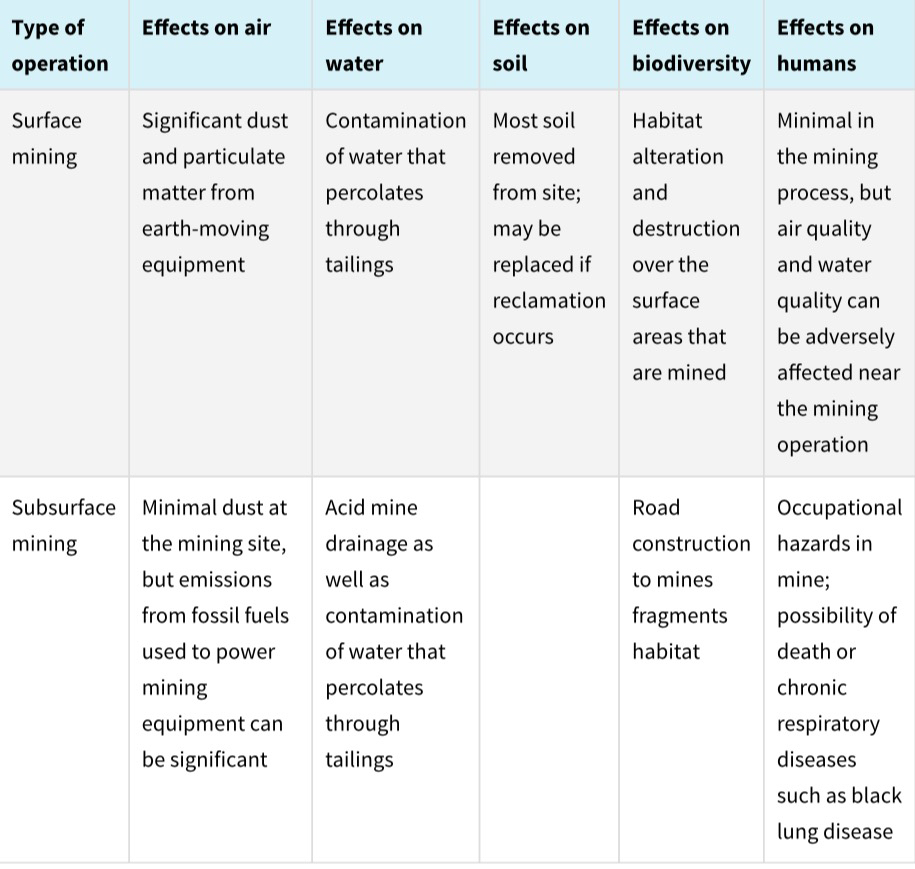
Mining affects human safety and the economy
Coal mining releases methane
Extraction efforts become more desperate and ppl turn to difficult to reach deposits
Module 30– Impacts of urbanization and the Methods to Reduce Urban Runoff
Increasing population density has many environmental implications
More population= more urbanization
Developing countries have less urban areas compared to developed countries
Many urban areas have public planning (transport, waste, etc. that depletes resources)
Developed countries and urbanization also leads to less infrastructure
Increasing urbanization/. Urban sprawl: suburbs have formed un the US, greater populations use more aquifers
Drawing too much water from aquifers in the coast results in saltwater intrusion, where seawater contaminates groundwater
Increased impervious surfaces (like pavement that doesnt allow water to pass through) results in a reduction of filtration
Causes and consequences of urban sprawl (urban areas that spread into rural areas)— more automobile use means more emissions, and is caused by more automobiles, reasonable living costs in suburbs, lack of support of urban communities (urban blight) and government policies that fund highways and subsidize mortgages for suburban areas
Reducing impacts of urbanization and urban sprawl: smart growth— encouraging healthy communities and fostering communities with a sense of place
EPA lists: walkable neighborhoods, mixing residential, retail, recreational, and business land uses, encouraging community and stakeholder collaborations in development decisions for the neighborhood, preserving open space, etc
A variety of methods can reduce urban runoff (Water that doesn’t evapotranspire or infiltrate the soi)
Replacing pavement with permeable pavement
Collecting rainwater
Planting more trees
Reducing pulpit ants deposited on urban surface makes runoff cleaner
Module 31– Ecological footprints
The ecological footprint is an environmental assessment tool
Ecological footprint: origins and purpose
It’s a measure of the area of land and water an individual, population, or activity requires and the resources it consumes/ waste it generates
Meant to assess environmentally impact
Calculating (IPAT— summing land requirements for the food we eat, water/ energy we use, clothing we wear, and structures we occupy)
Carbon footprint calculates carbon dioxide emitted into the atmosphere
A measure of the total carbon dioxide and other greenhouse gases emissions from the activities, both direct and indirect, of a person, country, or other entity.
Used for transportation, food etc
Module 32– Introduction to sustainability
Sustainability is the most comprehensive assessment of environmental impact
Impact of consumption on the environment= overexploitation of resources
We must not damage environmental systems, renewable resources must not be depleted faster than they can regenerate, and nonrenewable resources must be used sparingly
Sustainable development balances well being and economic advancement with sustainability
Maximum sustainable yield: largest quantity of a renewable resource that can be harvested indefinitely
Scientists use environmental indicators to monitor the stage of the earth
Indicators like population (individuals), ecological footprint (hecatares), foot production (metric tons of grain), carbon dioxide (ppm), annual precipitation (mm), water quality (concentration), etc
We look at biodiversity, food production, average global surface temp/ carbon dioxide concentrations, human population, and resource depletion
Biodiversity: decreasing
Food production: increasing
Temperature/ co2: increasing
Population: increasing
Depletion: resources are extracted !
Module 33– Integrated pest management and sustainable agriculture
Integrated pest management increases agricultural output while minimizing environmental harm
Crop rotation (season to season planting)/ intercropping (planting crops within each other), encourages death without exposing soil and some plants help each other
Biocontrol: using biological organisms/ natural predators to control pests
IPM training in farmers
Sustainable agriculture reduces environmental impacts
Allows for soil conservation
Traditional techniques: subsistence farming, intercropping, agroforestry (intercropping trees and veggies), windbreaks (planting tall plants to break wind and stop erosion), strop cropping (planting differently spaced crops to prevent erosion), contour plowing (to the land’s topography), terracing (shaping land into terraces)
More sustainable farming techniques: planting perennial (non replantable) plants, no-till agriculture
Soil additives: green manure, compost, limestone (calcium), rotational grazing
Organic agriculture: no synthetic fertilizer
Delaney clause: in the Food, Drug, and Cosmetic act prevents harmful carcinogenic food ingredients
Organic agriculture still uses fossil fuels
Module 34– Aquaculture and sustainable forestry
Aquaculture is increasing in importance and its environmental impacts are less
Netted enclosures in ponds, enclosed structures, and open ocean are used to breed fish
Aquaculture systems:
Nets, ponds, recirculating above ground tanks
Can pump out antibiotics and wastewater into the ocean
Solutions to this can be using fish poop as fertilizer and filtering it out/ using it more responsibly
Sustainable forestry uses principles found in agriculture to minimize the effects of logging
Reforestation repopulates forests
Sustainable forestry manages forests so they can provide wood and clean water, maximizing biodiversity
Other sustainable logging techniques: certification of sustainable forestry
Fire management: using prescribed burns to increase biomass, decreasing the effects of wildfires