Memory
Long-term memory
Explicit memory - conscious recollection of information e.g. remembering phone number
Explicit - Events & Experiences
Semantic - Concepts & Facts
Implicit memory - unconsciously brought about e.g. writing or riding a bike
Procedural - How to do things
Priming - Stimulus exposure affects responses to a later stimulus
Emotional Conditioning - Classically conditioned emotional responses
Short-term memory/working memory
Auditory/Verbal Span
Visuospatial Span
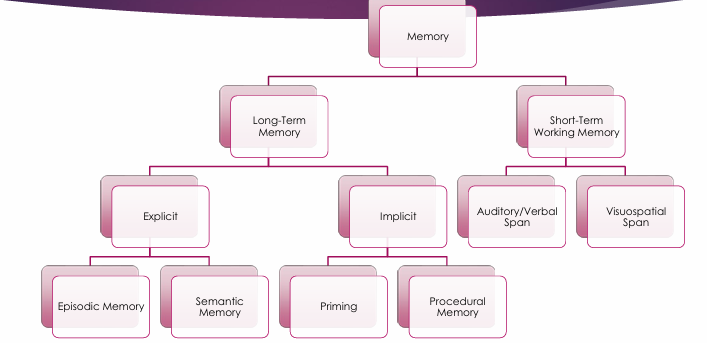
For the purpose of the exam I will be focusing on visuospatial memory.
Memory studies usually from amnesia patients e.g. HM
anterograde amnesia - Cannot form new memories after amnesia onset
retrograde amnesia - Cannot remember past memories
*Medial Temporal Lobe → Hippocampus (spatial navigation; association)
Inferotemporal cortex - storage of viusal memory
amygdala - associated w/ emotions tied to memories
cerebellum - motor skills
striatum - stimulus and response/habit formation
Parietal Lobe
associated with visuo-spatial awareness, coordination and awareness of spatial orientation
also is primary sensory area for pain, touch and temperature
damage causes Agnosias and hemi spatial neglect
left parietal damage causes dyscalculia and some working memory problems
Glutamate: The main excitatory neurotransmitter, important
for learning and memory
Recall
Recognition
Relearning
working memory
Mnemonics, chunking, rehearsal
Memory - encode, store (& retain), and retrieve information
short term memory - limited capacity
Atkinson & Shiffrin’s Multi-Store Model (1968)
Classic model describes memory as a system with three distinct stores:
Sensory Memory
Briefly holds incoming sensory information (visual, auditory, etc.) for a fraction of a second
Short-Term Memory (STM)
Temporarily stores information for about 15-30 seconds and has a limited capacity (7 ± 2 items)
Long-Term Memory (LTM)
Stores information indefinitely, with virtually unlimited capacity
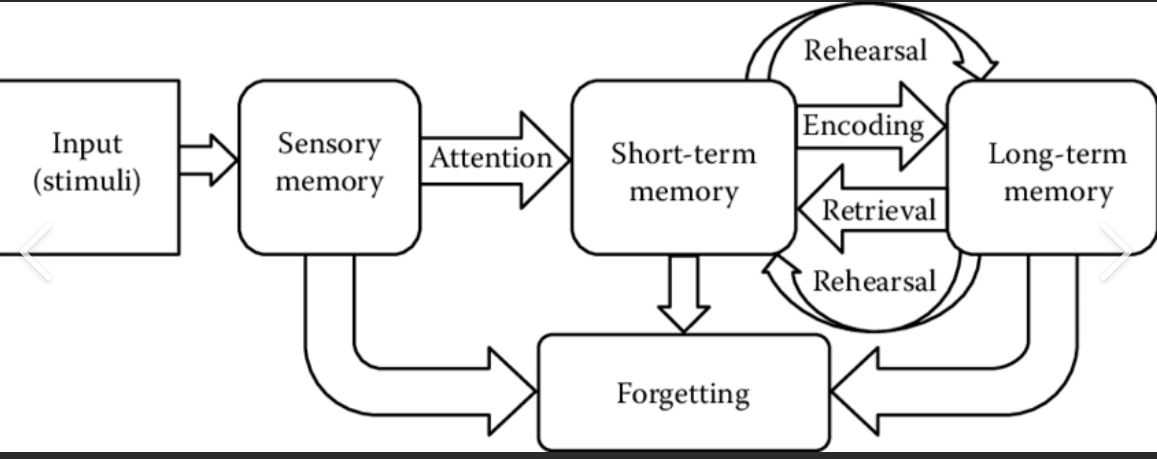
Forgetting can occur due to decay, displacement, interference, retrieval failure
This model was foundational but too simplistic, leading to refinements like Baddeley & Hitch’s Working Memory Model (1974), which expanded on STM by introducing multiple components. The shift recognised that working memory is more than just passive storage, it actively processes and manipulates information in real time.
Baddeley & Hitch Working Memory Model (1974)
central executive - determines order, controls other components (PL and VSS) attend too and ignore. Directs attention and coordinates cognitive tasks
phonological loop - sensory storage system/processing sound-based (auditory) info (phonological store - inner ear - stores sound, focus on speech perception, repetition) (articulatory process (inner voice - rehearse sound - reading book)
visuo-spatial sketchpad (inner eye) - spatial and visual info (visual cache - stores visual data e.g. shape and colour) (Inner Scribe - records spatial arrangement and movement of objects and transfers it to central executive). Allows us to mentally manipulate images.
episodic buffer (interaction between working memory and long-term memory) integration of all components
KF case study - motorbike accident. short-term memory, verbal recall, could only remember 2 things from a list but visual could remember everything
criticism - visuo-spatial sketchpad - blind individuals (spatial awareness not dependent on vision e.g. can use touch. Wolbers et al.)
Visuospatial memory refers to the general ability to remember and recall visual and spatial information. This includes remembering locations, objects, faces, and how things are arranged in space over time. It involves both short-term and long-term memory. i.e. the whole storage system for visual and spatial details.
Short-term visuospatial memory involves briefly holding and recalling visual and spatial details, like remembering a phone number before dialling or temporarily keeping track of a set of objects
Long-term visuospatial memory stores visual and spatial information for extended periods - like remembering the layout of a childhood home, recognising faces, or recalling directions to familiar places.
Since it’s a broad cognitive function, different tasks engage various aspects of visuospatial memory, such as pattern recognition, navigation, and object-loccation memory.
Brain Regions (visuospatial memory)
Hippocampus: located in the medial temporal lobe, the hippocampus is essential for spatial navigation and memory formation. It helps create cognitive maps for navigating environments.
Parietal Lobe: Involved in visuospatial awareness, spatial coordination, and the processing of spatial orientation. Damage to this area can lead to difficulties in perceiving spatial relationships.
Inferotemporal Cortex: Responsible for storing visual memory, including object recognition and perception
Amygdala: Though primarily associated with emotions, it plays a role in linking emotional significance to spatial memories.
Cerebellum: Critical for coordinating movement and motor-related aspects of spatial memory.
Striatum: involved in habitat formation, stimulus-response associations, and reinforcement learning
Neurotransmitter
Glutamate - The powerhouse neurotransmitter behind learning and memory, including visuospatial memory
Glutamate is the brain’s main excitatory neurotransmitter, meaning it helps neurons communicate efficiently.
It plays a crucial role in synaptic plasticity, the process that allows neurons to strengthen connections based on experience, essential for memory formation.
The hippocampus, critical for spatial memory, relies heavily on glutamate to form and retrieve memories.
NMDA receptors, a type of glutamate receptor, are particularly involved in long-term potentiation (LTP), a mechanism where repeated stimulation strengthens synaptic connections, making memories more durable.
Glutamate also supports the parietal lobe, which handles spatial awareness and visuospatial coordination.
However, excessive glutamate activity can lead to neurotoxicity, potentially damaging neurons. That’s why the brain finely regulates its levels to ensure optimal cognitive function.
Glutamate is essentially the fuel that powers our ability to recognise places, recall spatial details, and interact with our environments effectively.
Interventions/Techniques to boost visuospatial memory:
Mnemonics
Memory aids that use imagery and associations
creating vivid mental images can strengthen recall
e.g. the colours of the rainbow. Richard Of York Gave Battle In Vain (ROYGBIV) red, orange, yellow, green, blue, indigo, violet
Chunking
Breaking down large amounts of information into smaller, meaningful groups
e.g. phone numbers
The Method of Loci (Memory Palace)
One of the most powerful visuospatial techniques.
It involves associating information with specific locations in an imagined space (like your home).
e.g. If you need to remember a shopping list, imagine placing items in familiar spots in your house
Mind Mapping
A visual organisation method
Drawing out concepts in a diagram can enhance spatial recall
e.g. sketching relationships between ideas when studying
Visual Association
Linking new information with familiar visuals
e.g. to remember someone’s name, picture an object that rhymes with it
Spatial Reasoning Games & Activities
Engaging in puzzles, mazes, and navigation tasks
e.g. playing games like chess, Tetris, or memory card matching can strengthen spatial skills
Meditation & Focus Training
Helps with cognitive clarity and awareness of spatial surroundings
e.g. mindfulness exercises can improve mental imagery and concentration
External (e.g. alarms) and internal memory (e.g. writing, chunking, etc.) aids
Daily Functioning
Visuospatial memory plays a huge role in daily functioning, influencing tasks that require visual recognition, spatial awareness, and navigation
Navigation & Wayfinding
Remembering routes, landmarks, and directions.
Using mental maps to find your way in familiar or new environments
Object & Face recognition
Identifying people, places, and objects
Recognising familiar faces and distinguishing between similar-looking items
Reading & Writing
Tracking words on a page
Organising letters and words spatially when writing
Driving & Sports
Judging distances, speeds, and spatial relationships e.g. London Taxi drivers
coordinating movements in sports or physical activities
Problem-Solving & Creativity
Visualising solutions to puzzles or tasks
Designing layouts, artwork, or planning spatial arrangements
Daily Tasks & Organization
Arranging furniture, packing bags, or organising items efficiently
Remembering where you placed objects (keys, phone, etc.)
If visuospatial memory is impaired, it can lead to:
Difficulty navigating (getting lost easily)
Trouble recognising faces (prosopagnosia)
Challenges in reading/writing (tracking words)
Poor spatial awareness (bumping into objects)
Issues with organisation (misplacing items frequently)
Research suggests that visuospatial memory declines with age, affecting mobility and cognitive function. However, training techniques like puzzles, visualisation exercises, and spatial reasoning games can help strengthen it.
Visual and Verbal Domains in Memory
Visual Memory: Helps store and recall images, spatial layouts, and object recognition. It is essential for navigation, facial recognition, and pattern recall.
Verbal Memory: Involves encoding and retrieving words, language-based information, and auditory details. It supports communication, learning and problem-solving.
Interestingly, research suggests that verbal encoding can enhance visual memory - naming objects or associating words with images improves recall. However, when visual and verbal tasks compete, they can interfere with each other, highlighting cross-domain limitations in working memory.
I will be focusing on the Brief Visuospatial Memory Test Revised (BVMT-R) and Traumatic Brain Injury