Ch 10a Bonding/Lewis Model lecture notes
Introduction to Chemical Bonding
Basic Theory: Introduces one of the simplest theories of chemical bonding.
Ewan Lewis:
Named after Ewan Lewis, known for the theory of enthalpy of formations.
Lewis is a significant figure in the field of chemistry.
Valence Electrons:
Emphasizes balanced (valence) electrons as crucial for chemical reactions.
Lewis Theory
Simplification of Wave Functions:
The model simplifies the complex wave functions of electrons.
Example: Electron configuration of oxygen:
Core vs. Valence Electrons:
Core electrons are not involved in bonding; focus on valence electrons.
Lewis Structures
Definition: A Lewis structure represents the valence electrons of an atom.
Oxygen Example:
For oxygen with electron configuration :
Core electrons included in the symbol, leaving valence as dots.
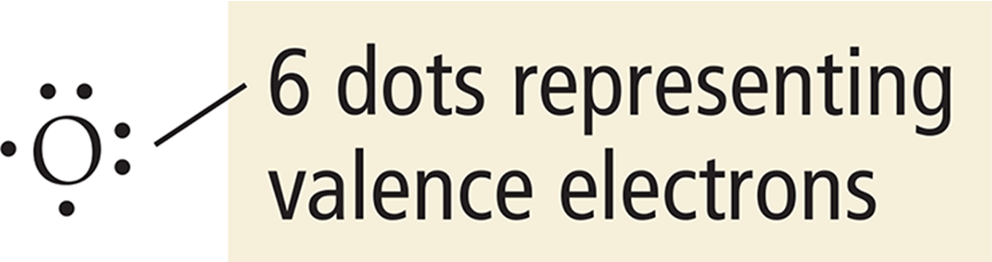
Total valence electrons for oxygen: 6 (2 from 2s and 4 from 2p).
Drawing Lewis Structures:
Importance of proper representation.
Dots can represent electrons, with positions being less critical for central understanding.
Draw at least 6 dots representing the valence electrons.
Chemical Bonds
Chemical Bond Formation:
Atoms bond to lower potential energy.
E.g., CO2 has lower potential energy than isolated carbon and oxygen.
Lewis symbols can be used to represent the transfer of electrons from a metal atom to a nonmetal atom, resulting in ions that are attracted to each other and, therefore, bond.

Types of Bonds:
Ionic Bonds:
Formed typically between metals and nonmetals.
Involves transfer of electrons between atoms forming ions (e.g., NaCl).
Covalent Bonds:
Formed between nonmetals sharing electrons.
Results in molecular structures with specific properties.
Metallic Bonds:
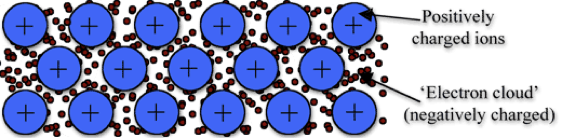
Formed between metals with a shared pool of electrons.
Metal lattice structure, delocalized electrons contribute to conductivity.
Detailed Explanation of Bonding Types
Ionic Bonding:
Metals (low ionization energy) lose electrons to form cations.
Nonmetals (high electron affinity) gain those electrons forming anions.
Process is typically exothermic (heat is released).
Covalent Bonding:
Difficult to remove electrons from nonmetals (high ionization energy).
Nonmetals share electrons leading to pairs of electrons stabilizing the bond.
Metallic Bonding:
Characterized by delocalized electrons within a metal lattice.
Electrons can move freely, explaining conductivity of metals.
An organization of metal cation islands in a sea of electrons
Electron Behaviors in Bonding
Valence Electrons:
Valence electrons dictate bonding behavior.
Lewis models can simplify visual representation.
Octet Rule:
Atoms tend to form bonds to achieve a stable octet configuration (8 electrons).
Lewis model predicts the number of electrons a metal atom should lose or a nonmetal atom should gain in order to attain a stable electron arrangement.
This allows us to predict the formulas that result.
Exceptions exist; this is not a strict law.
Lattice Energy
A crystal lattice is the alternating cations and anions from the gaseous ions coming together in a crystalline structure.
The crystal lattice is held together by the electrostatic attraction of the cations for all the surrounding anions.
Attractions between cations and anions are maximized, leading to the most stable arrangement.
The extra stability that accompanies the formation of the crystal lattice is measured as the lattice energy.
The lattice energy is the energy released when the solid crystal forms from separate ions in the gas state, always exothermic (-)
Definition: Energy required to form a crystalline ionic solid from gaseous ions.
Measures the stability and strength of ionic bonds.
Relationship to Potential Energy:
Bonds lower potential energy during formation (exothermic reaction).
Calculation:
Involves considering ion sizes, charges, and distances in lattice arrangements.
Use of Hess's law to indirectly measure lattice energy via changes in process.
Born-Haber Cycle to find Lattice Energy
The Born–Haber cycle is a hypothetical series of reactions that represents the formation of an ionic compound from its constituent elements.
The reactions are chosen so that the change in enthalpy of each reaction is known except for the last one, which is the lattice energy.
Purpose: A thermochemical cycle used to calculate lattice energy, which cannot be measured directly.
Applies Hess's Law, stating that the total enthalpy change for a reaction is the same regardless of the path taken.
Steps Involved: ALL ARE FOUND IN TABLE
Standard Enthalpy of Formation (ΔHf): The overall enthalpy change for the formation of the ionic solid from its constituent elements in their standard states.
Sublimation Energy (ΔHsub): Energy required to convert the solid metal into gaseous atoms.
Bond Dissociation Energy (ΔHd): Energy required to break the covalent bond in the nonmetal element (if it's diatomic) into gaseous atoms.
First Ionization Energy (IE1): Energy required to remove electrons from gaseous metal atoms to form gaseous cations.
Electron Affinity (EA): Energy released or absorbed when gaseous nonmetal atoms gain electrons to form gaseous anions.
Lattice Energy (ΔHlattice): The energy released when gaseous ions combine to form one mole of an ionic solid. This is the unknown usually calculated by the cycle.
Born-Haber Cycle Equation
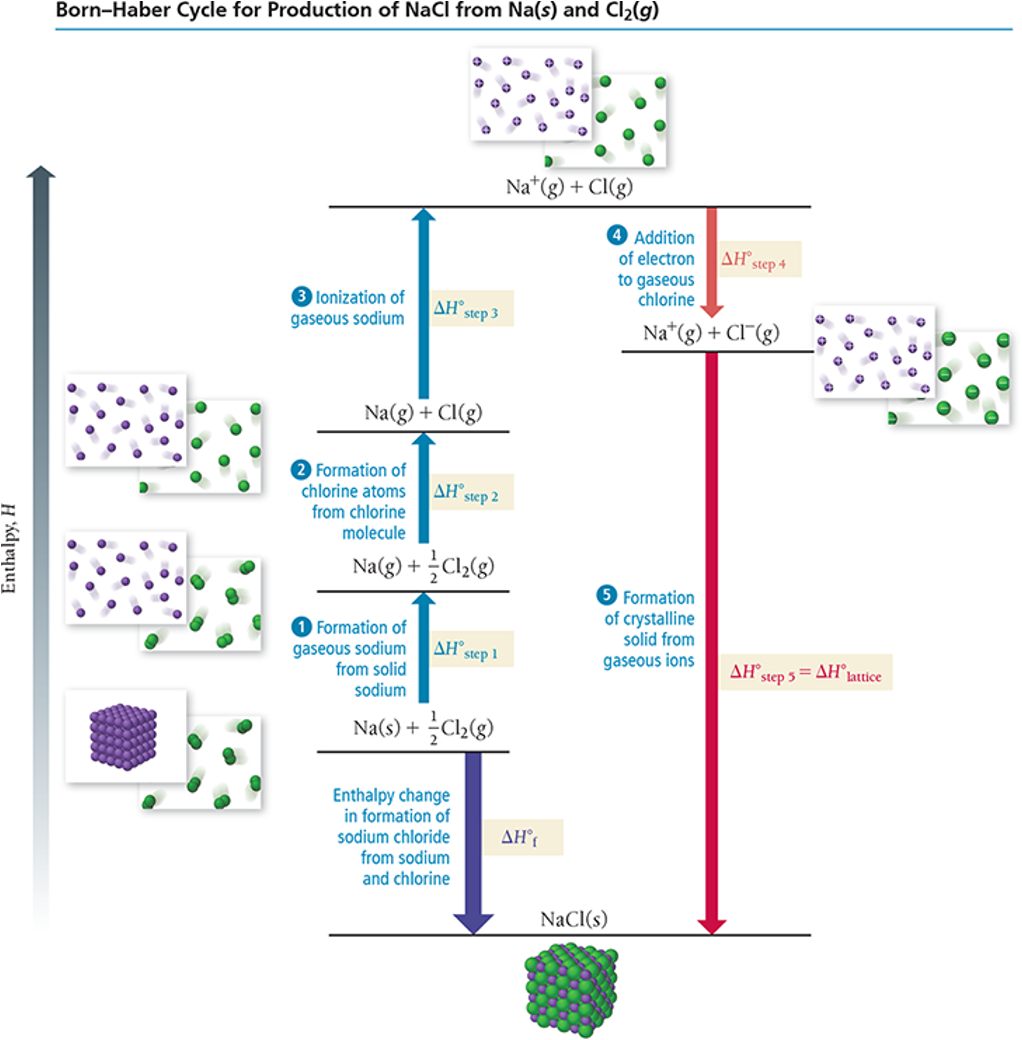
General Born–Haber equation for formation of an ionic compound
ΔHf∘=ΔHsub+IE1+1/2D(X2)+EA+ΔHlattice
Solve for the lattice energy
Rearrange the equation to isolate ΔHlattice: ΔHlattice = ΔHf∘ - [ΔHsub + IE1 + 1/2 D(X2) + EA]
Lattice Energy: Ion Size
The force of attraction between charged particles is inversely proportional to the distance between them.
Larger ions mean the center of positive charge (nucleus of the cation) is farther away from the negative charge (electrons of the anion).
Less exothermic lattice energy with larger ionic radius
More exothermic lattice energy with increasing magnitude of ionic charge
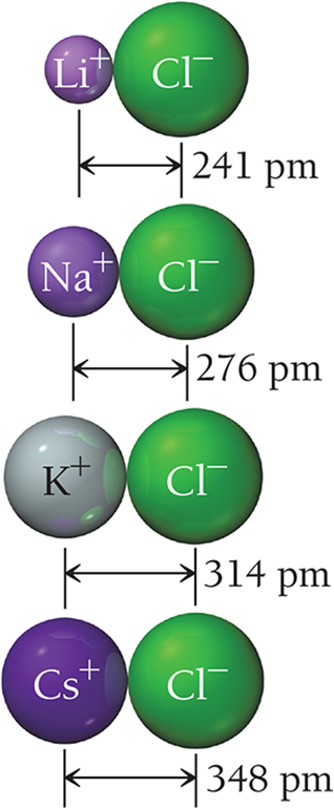
Metal Chloride | Lattice Energy (kiloJoules/mol) |
LiCl | −834 |
NaCl | −788 |
KCl | −701 |
CsCl | −657 |
Lattice Energy: Ion Charge
The force of attraction between oppositely charged particles is directly proportional to the product of the charges.
Larger charge means the ions are more strongly attracted.
Larger charges = stronger attraction = Stronger attraction = larger lattice energy
Of the two factors, ion charge is generally more important.
This is due to Coloumb’s law,
E=1/4πε01 x q1q2/r
where E is the electrostatic energy, ε0 is the permittivity of free space, q1 and q2 are the charges of the ions, and r is the distance between their centers.
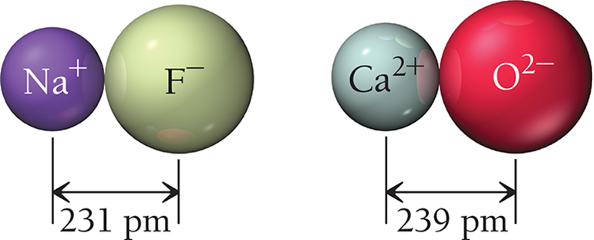
NaF = -910 kJ/mol
CaO = -3414 kJ/mol
Lewis Model in Reality
Lewis theory implies that the attractions between ions are strong.
Lewis theory predicts ionic compounds should have high melting points and boiling points because breaking down the crystal should require a lot of energy.
The stronger the attraction (larger the lattice energy), the higher the melting point.
Ionic compounds have high melting points and boiling points.
Melting points generally > 300 °C.
All ionic compounds are solids at room temperature.
Electrostatic attraction is nondirectional!
No direct anion–cation pair
Therefore, there is no ionic molecule.
The chemical formula is an empirical formula, simply giving the ratio of ions based on charge balance
Lewis model accounts for high melting points of ionic solids.
Lewis model implies that if the ions are displaced from their positions in the crystal lattice, repulsive forces should occur.
This predicts the crystal will become unstable and break apart. Lewis theory predicts ionic solids will be brittle.
Ionic solids are brittle. When struck, they shatter.
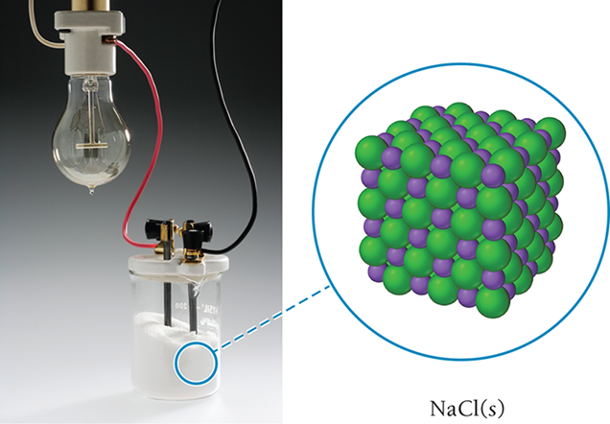
To conduct electricity, a material must have charged particles that are able to flow through the material.
Lewis model implies that in the ionic solid, the ions are locked in position and cannot move around.
Lewis model predicts that ionic solids should not conduct electricity.
Ionic solids do not conduct electricity.
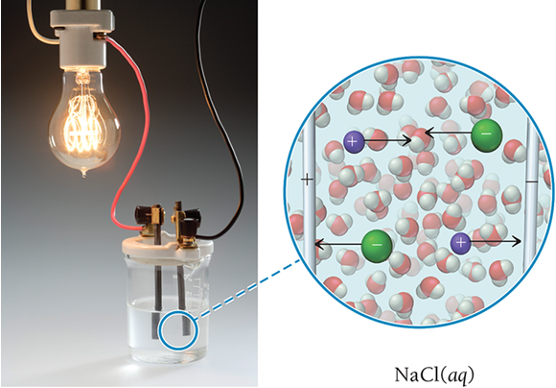
Lewis model implies that in the liquid state or when dissolved in water, the ions will have the ability to move around.
Lewis model predicts that both a liquid ionic compound and an ionic compound dissolved in water should conduct electricity.
Ionic compounds conduct electricity in the liquid state or when dissolved in water.
In NaCl(s), the ions are stuck in position and not allowed to move to the charged rods.
In NaCl(aq), the ions are separated and allowed to move to the charged rods.