Chapter 6: Sponges
}}Sponges}}
Characteristics
- Multicellular
- More than one cell
- Cells must be specialized
- Some move water, some collect food, some create skeleton
- Reproduction is limited to certain cells
- Unique Body Organization
- Adapted to filter feeding
- Exception: deep ocean lineage
- Carnivores
- Example: Harp sponge (Chondrocladia lyra)
- Velcro-like barbed hooks on branching limbs snare crustaceans
- Enveloped in a thin membrane and digested
- Cellular Level of Organization
- Cells independent
- Dissociated cells can re-form a new sponge (reaggregation)
}}Sponge Taxonomy}}
Classes
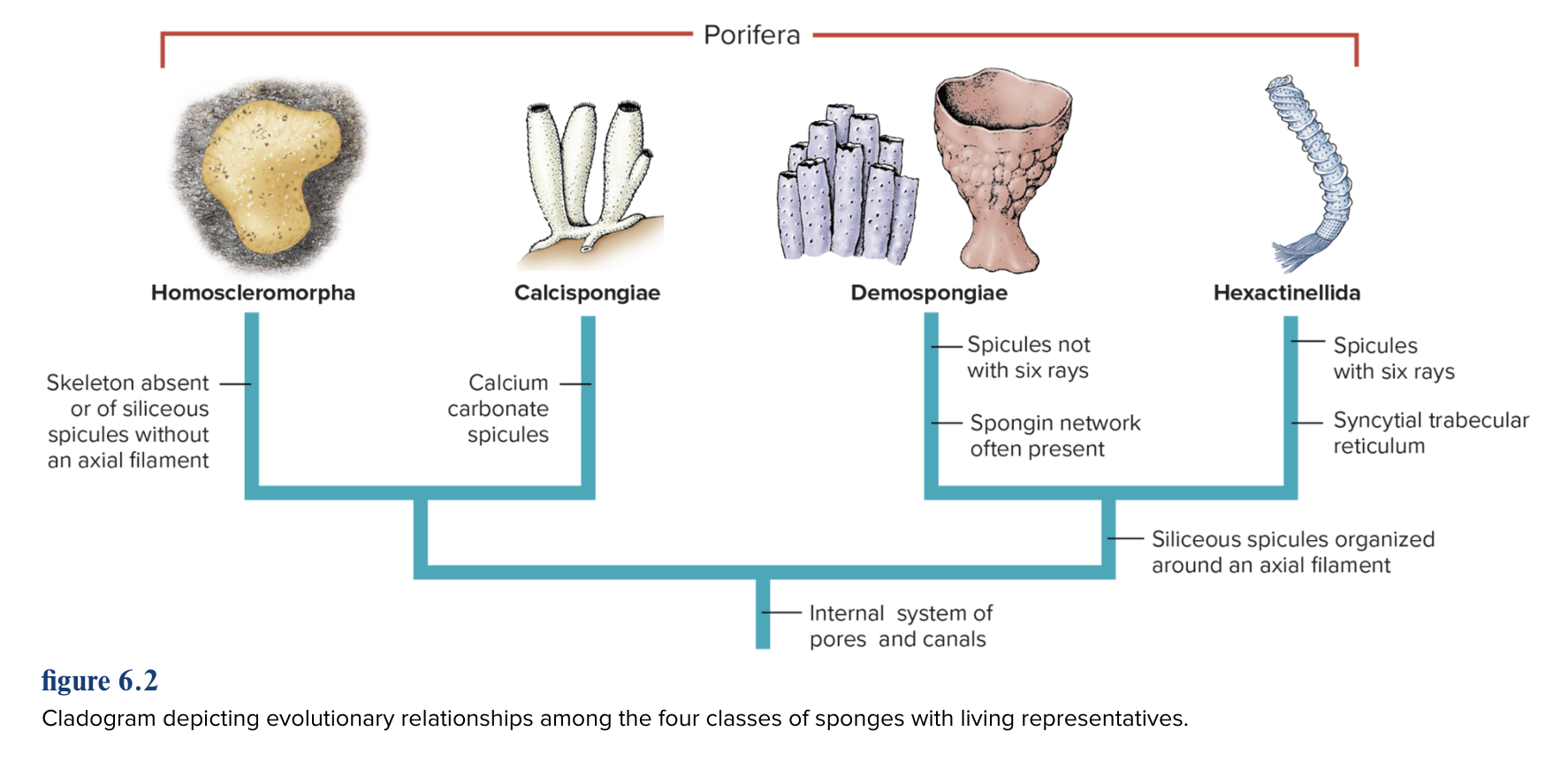
- Calcarea (a.k.a. Calcisspongiae)
- Calcareous spicules
- Made of calcium carbonate
- Demospongiae
- Spicules made of silica
- Spongin network
- Modified type of collagen protein
- Only found in this class of sponges
- Hexactinellida
- Glass sponges
- 6-rayed spicules made of silica
- Homoscleromorpha
- Thin encrusting sponges
- Some: no spicules
- Others: simple spicules
}}Form and Function}}
Sponges are sessile.
%%Pores%%
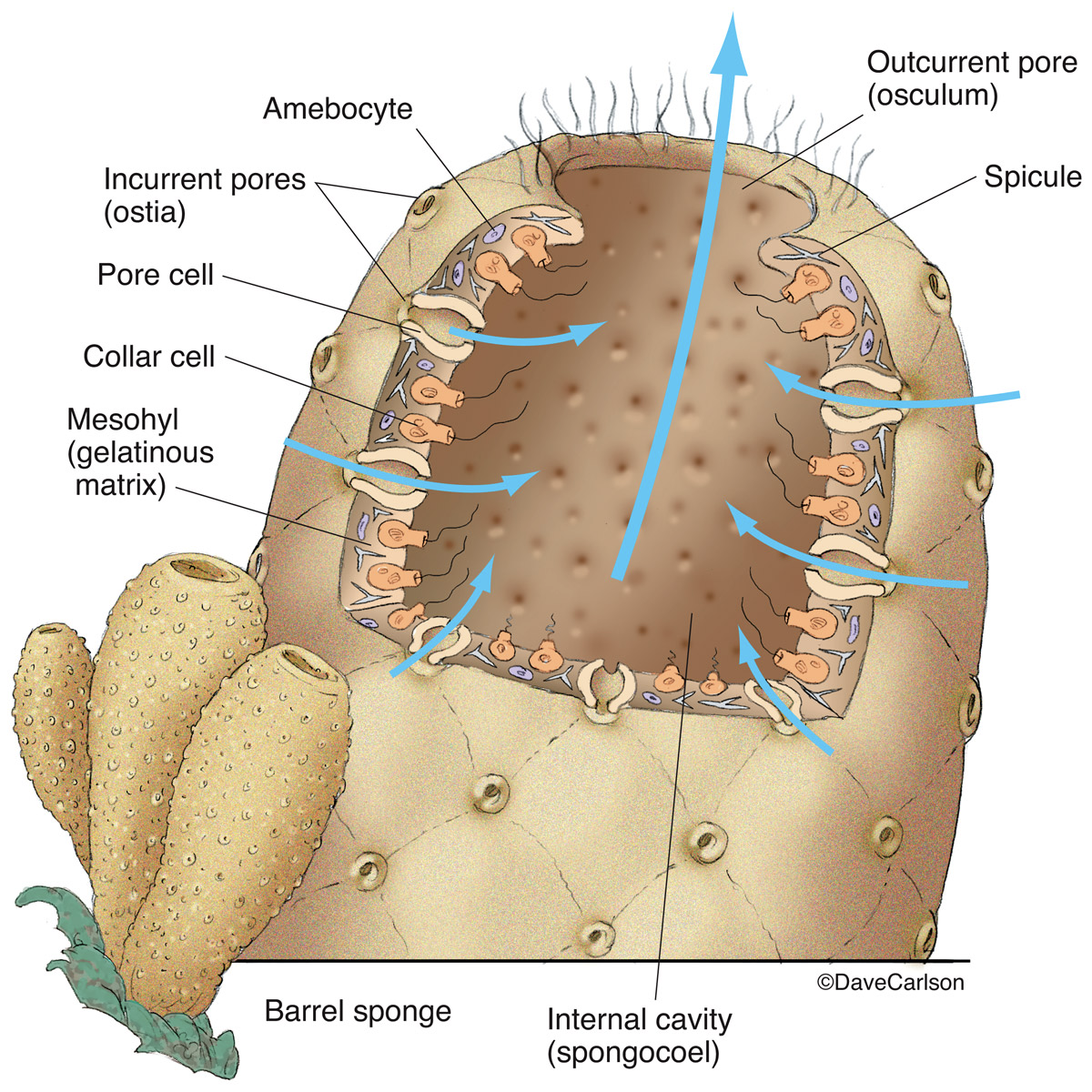
- Openings in body
- Dermal Ostia
- Tiny pores for incoming water
- Oscula
- Large pores that serve as water outlets
- Connected by a system of canals
- Some lined with choanocytes
- Flagellated collar cells
- Flagella maintain water current through canals
- Also trap and phagocytize food particles
- Shape maintained by skeleton
- Spicules
- Mesh of spongin fibers
- Combination of both
%%Mesohyl%%
- Gelatinous matrix that contains cells
%%Physiology%%
- Suspension/filter feeders
- Digestion is entirely intracellular
- Occurs within cells
- Respiration and excretion
- Performed by diffusion
- All activities depend on a current of water flowing through the body
- Large sponges can pump up to 1500 liters of water a day!
%%Reproduction and Development%%
All sponges can reproduce both sexually and asexually.
- %%Sexual reproduction%%
- Most sponges are monoecious
- One individual has both male and female sex cells
- Fertilization
- Internal in some species
- External in others
- Development
- Zygotes → flagellated larvae
- %%Asexual reproduction%%
- Fragmentation
- Budding
- Detach or remain to form colonies
- Gemmules
- Formed by freshwater and some marine sponges
- Cystlike reproductive unit
- Formed during unfavorable conditions
- Can survive periods of drought, freezing, and 3+ months without oxygen
- When favorable conditions return, cells escape and develop into new sponges