Inclined Planes and Circular Motion Notes
Solve problems involving force due to gravity (weight) and mass using 𝐹𝑔 = 𝑚𝑔.
Fg: Force of gravity (N)
m: Mass (kg)
g: Acceleration due to gravity (9.8m/s²)
Describe the concept of normal force.
Normal Force: The normal force is the support force exerted by a surface on an object, acting perpendicular to the surface.
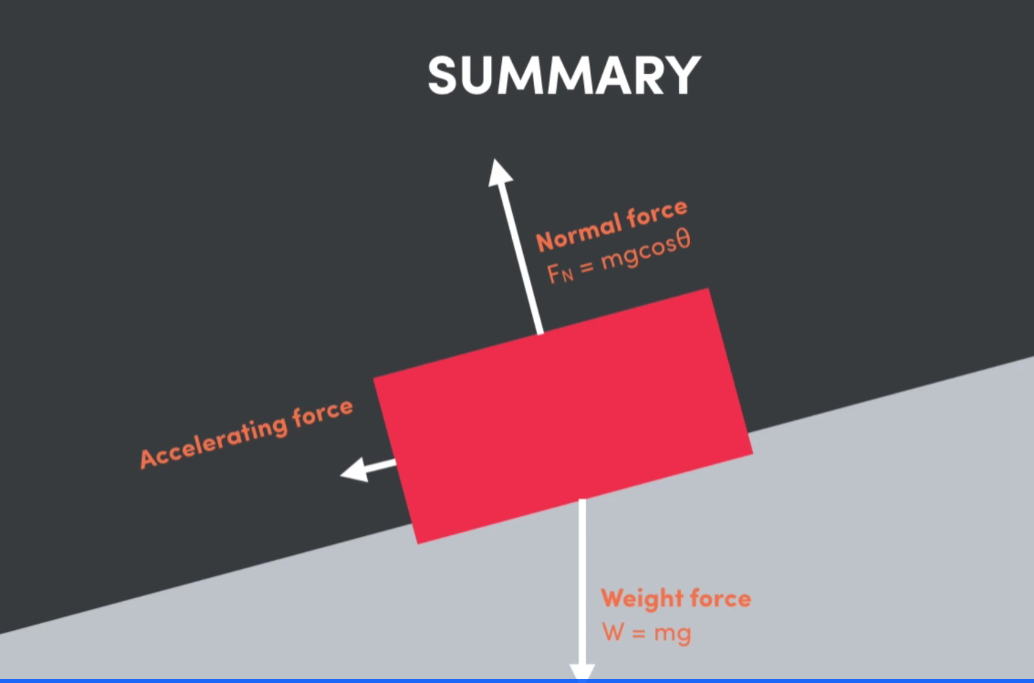
Describe the forces acting on an object on an inclined plane (e.g. force due to gravity, normal force, tension, frictional force and applied force) through the use of free-body diagrams.
Force Due To Gravity: The force pulling the object straight down toward Earth.
Normal Force: The force from the surface pushing perpendicular to the plane, supporting the object.
Tension: A pulling force transmitted through a rope or cable attached to the object.
Frictional Force: The force that opposes motion along the plane, acting parallel to the surface.
Applied Force: Any external push or pull acting on the object from outside the system.
Free Body Diagram:
Determine the net force acting on an object on an inclined plane using vector analysis.
How to determine: Use a free body diagram to do calculations
Describe the concept of uniform circular motion.
Uniform Circular Motion: Motion in a circle at constant speed.
Describe the concepts of average speed and period.
Average Speed: In uniform circular motion, the speed depends on teh period and radius.
Period: Time to complete one revolution (one cycle).
Solve problems involving objects undergoing uniform circular motion at a constant speed using 𝑣 = 2𝜋𝑟 𝑇 and 𝑎𝑐 = 𝑣2 𝑟 .
Describe the concepts of centripetal acceleration and centripetal force.
Centripetal Acceleration: The acceleration experienced by any object moving in a circular path, directed toward the centre of motion.
Centripetal Force: The force acting on an object travelling in a circle that constantly pushes or pulls the object in toward the centre of motion.
Solve problems involving forces acting on objects in uniform circular motion using F𝑐 = 𝐹𝑛𝑒𝑡 = 𝑚𝑣2/𝑟