Chapter 5 Language Topics
{{Multilingual States / Monolingual States{{
-multilingual examples
The U.S.
India
Canada
China
South Africa
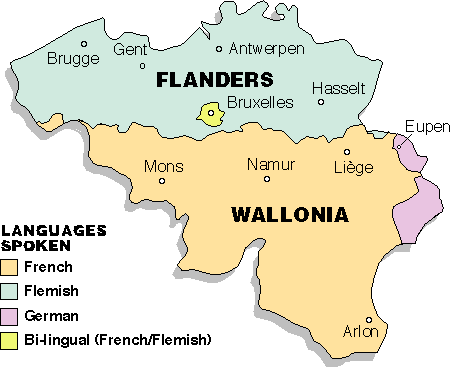
Belgium
Nigeria
Russia
contain linguistic minorities → pwr imbalance (centrifugal)
-monolingual examples
North Korea
Japan
Iceland
France
not really exist
centripetal
-reasons for geography (Belgium)
distance decay by country borders
both indo-european
compete for power
Flanders wealthier, advocates to be separate
{{Centrifugal / Centripetal Forces{{
centrifugal - fracture
centripetal - pull together
centrifugal
multilingual states may experience tension when one language is prioritized over the other
Multilingual states may have difficulty communicating with each other
- Cultural tension: Discrimination, segregation, barriers to social or political interactions, ethnocentrism.
- Centrifugal political forces: Regionalized language areas within the country may seek independence or become areas of political or armed conflict; separatism may affect economy or weaken the political state (devolution).
- Challenges to unity: Loss of understanding and translation problems with the creation of country-wide policies and/or the delivery of services.
- Education: Higher public or private costs incurred to educate language groups separately or to include both languages in a single education system.
- Economic disadvantages: Increased costs to print or broadcast public information, documents, signage, or provide public services, perform elections, or enforce laws and public safety; imposition on businesses, practically or legally, to advertise and provide products and services in more than one language.
- External threat: Irredentism, any country using the excuse of linguistic connections to interfere with internal affairs of the other country.
centripetal
multilingual states create a strong identity tied to language
monolingual states are united by one language
- Cultural diversity/multiculturalism: Bilingualism fosters an openness to immigrants, minority empowerment, minority rights, and the expression of unique cultural products (e.g. music, literature, film, television).
- Political identity: Bilingualism attempts to establish local, regional, or provincial government, which allows some level of self-government and prevents potential political conflict.
- Sense of place: Bilingualism gives minority language speakers a feeling of belonging or value and produces a unique cultural landscape (e.g., architecture, farming, signage).
- Syncretic culture: The use of two languages leads to mixed figures of speech or synthetic vocabulary, or the use of two languages in a single conversation (code-switching), which leads to diverse social interaction.
- Education: Bilingual students, as opposed to monolingual students, can have more improved knowledge, perspectives, and skill sets.
- Political linkages: Bilingualism improves political relationships and creates additional allies.
- Economic advantages: A multiple-language population can develop global business opportunities and promote tourism.
{{Language Tree / Branch for Multilingual States{{
Canada
French - Romance - Indo-European - Nostratic
English - West Germanic - Germanic - Indo-European - Nostratic
Belgium
French - Romance - Indo-European - Nostratic
Dutch - West Germanic - Germanic - Indo-European - Nostratic
India
English - West Germanic - Germanic - Indo-European - Nostratic
Hindi - Indo-Aryan - Indo-Iranian - Indo-European - Nostratic
}}Lingua Franca}}
-examples
English
Spanish
Mandarin
used for trade because its a common language
East Africa Swahili from muslin traders
reflects colonization + imperialism (French in Cameroon, English in India)
}}Historical Reasons}}
Imperialism + colonization → relocation
- British, French, and Spanish empires
Conquest
- Arabic with Islamic Empire and standardized within Islam
Trade Routes
- Arabic Islamic Traders
}}Language Cultural Landscape}}
Toponyms are place names seen on the landscape and can reflect cultural identity
-show ownership/control/colonization (Bombay India from British colonization)
-prideful (Constantinople named after Constantine, Istabul meaning “to the city“ )
-show origins/settlement (St Petersburg Russia, Santa Barbara CA)
-commodification (Target Feild, U.S. Bank Stadium)
Ojibwe names
Ziinzibaakwutakaming
- the place for making maple sugar
Ginewigwasensikag
- long promontory of birch trees
"Those people really had a sense of place and a sense of belonging to the land," which is reflected in naming practices, said Rick Anderson, a Bois Forte tribal citizen who worked on the project.
"Young porcupine swimming place"
}}Centripetal / Centrifugal Forces}}
centrifugal - fracture
centripetal - pull together
centrifugal
multilingual states may experience tension when one language is prioritized over the other
Multilingual states may have difficulty communicating with each other
- Cultural tension: Discrimination, segregation, barriers to social or political interactions, ethnocentrism.
- Centrifugal political forces: Regionalized language areas within the country may seek independence or become areas of political or armed conflict; separatism may affect economy or weaken the political state (devolution).
- Challenges to unity: Loss of understanding and translation problems with the creation of country-wide policies and/or the delivery of services.
- Education: Higher public or private costs incurred to educate language groups separately or to include both languages in a single education system.
- Economic disadvantages: Increased costs to print or broadcast public information, documents, signage, or provide public services, perform elections, or enforce laws and public safety; imposition on businesses, practically or legally, to advertise and provide products and services in more than one language.
- External threat: Irredentism, any country using the excuse of linguistic connections to interfere with internal affairs of the other country.
centripetal
multilingual states create a strong identity tied to language
monolingual states are united by one language
- Cultural diversity/multiculturalism: Bilingualism fosters an openness to immigrants, minority empowerment, minority rights, and the expression of unique cultural products (e.g. music, literature, film, television).
- Political identity: Bilingualism attempts to establish local, regional, or provincial government, which allows some level of self-government and prevents potential political conflict.
- Sense of place: Bilingualism gives minority language speakers a feeling of belonging or value and produces a unique cultural landscape (e.g., architecture, farming, signage).
- Syncretic culture: The use of two languages leads to mixed figures of speech or synthetic vocabulary, or the use of two languages in a single conversation (code-switching), which leads to diverse social interaction.
- Education: Bilingual students, as opposed to monolingual students, can have more improved knowledge, perspectives, and skill sets.
- Political linkages: Bilingualism improves political relationships and creates additional allies.
- Economic advantages: A multiple-language population can develop global business opportunities and promote tourism.