Unit 6 Study Guide: Innovation, Rebeldía, and Identity in the 20th Century
Compendio General de la Unidad 6
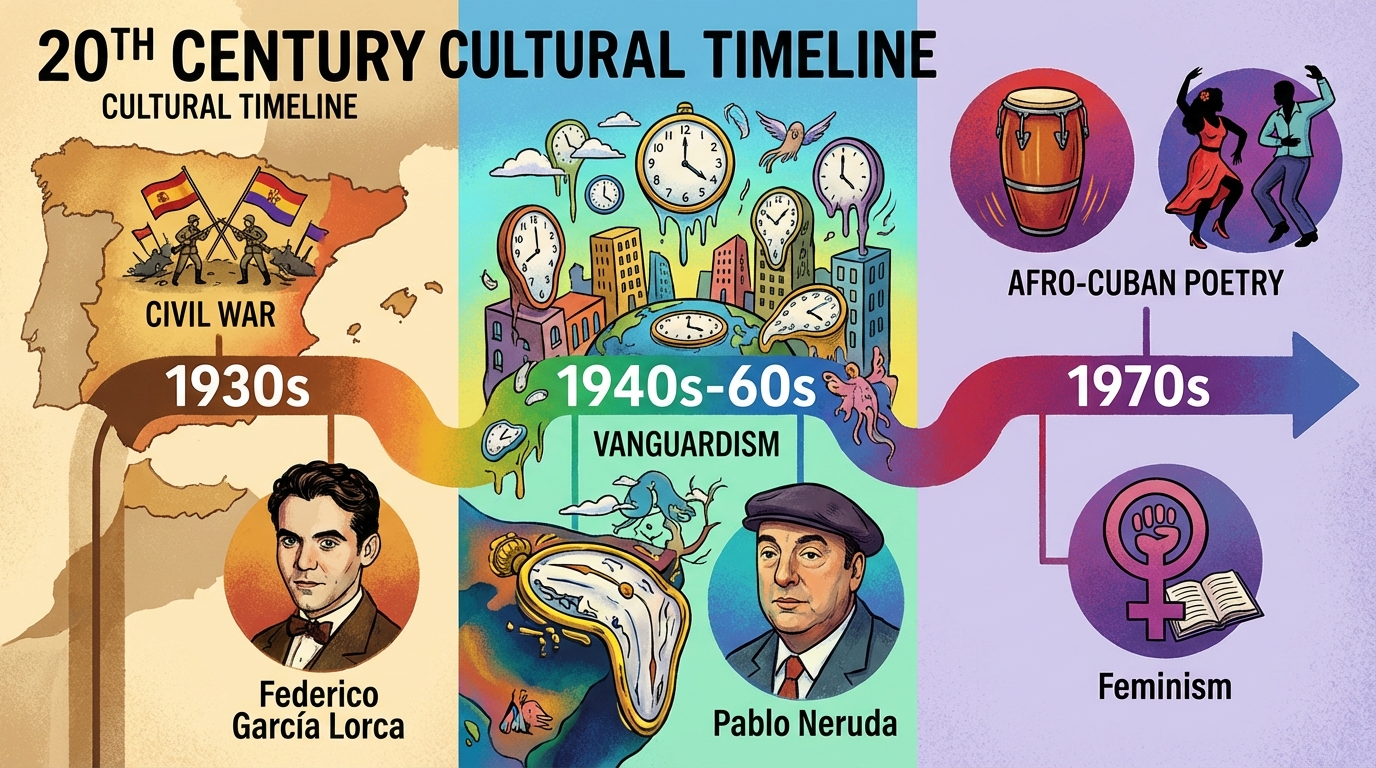
Unit 6: Teatro y poesía del siglo XX represents a pivotal moment in Hispanic literature. This period is characterized by a violent rupture with 19th-century Realism and Romanticism. Authors in Spain and Latin America turned to Vanguardismo (Avant-garde movements) to express the chaos of modern life, political instability (Civil Wars, Dictatorships), and the fragmentation of human identity.
In this unit, you will analyze how literary forms—drama and poetry—were deconstructed to address social critique, gender roles, and racial identity.
Key Literary Movements in Unit 6
- La Generación del 27 (España): A group of poets (including Lorca) who blended the Spanish avant-garde with traditional folklore (Romancero). They focused on metaphors and symbolism.
- Vanguardismo Latinoamericano: Authors like Neruda and Dragún who used Surrealism and Absurdism to criticize the dehumanization of modern society.
- Poesía Negra / Afroantillana: Writers like Guillén and Morejón who elevated the rhythm, culture, and struggle of Afro-descendants in the Caribbean.
- Feminismo y Posmodernismo: Storni and Burgos challenging the patriarchal status quo through introspection.
Contexto Histórico y Cultural
To understand these texts, you must understand the world these authors lived in.
España: La Guerra Civil y la Dictadura
- The Crisis: The early 20th century in Spain led to the Spanish Civil War (1936–1939), followed by the dictatorship of Francisco Franco. This environment of repression deeply influenced the themes of authoritarianism and silence found in Lorca's work.
- Cultural Impact: Literature became a tool for resistance or a way to encode forbidden desires.
Latinoamérica: Inestabilidad y Búsqueda de Identidad
- Politics: The region experienced rapid urbanization, economic imperialism (U.S. influence), and military dictatorships.
- Social Movements: The rise of indigenismo and negrismo sought to legitimate the identities of marginalized groups mixed with European heritage (mestizaje).
Sección 1: La Generación del 27 y Federico García Lorca
Federico García Lorca is the central figure of this unit. His work bridges the gap between traditional Spanish lyrics and modern avant-garde symbolism.
6.1 "Prendimiento de Antoñito el Camborio en el camino de Sevilla"
- Genre: Poesía (Romance).
- Collection: Romancero gitano (1928).
- Structure: Octosyllabic lines ($8a, 8-, 8a…$) with rima asonante in even verses. This is the traditional form of oral storytelling in Spain.
Synopsis:
The poem narrates the arrest of a Roma (gypsy) man, Antoñito, by the Civil Guard while he goes to Seville to see a bullfight. He is passive and does not fight back, losing his "honor" in the eyes of his ancestors, before being thrown in jail.
Key Concepts & Analysis:
- Metonimia: Lorca uses the "tricornios" (three-cornered hats) to represent the Guardia Civil, dehumanizing them into symbols of oppression.
- Symbolism: The "vara de mimbre" (willow stick) represents Antoñito's power and connection to nature, which he loses upon arrest.
- Tone: The tone shifts from admiring description to critical disappointment (by his ancestors) to tragic containment.
6.2 La casa de Bernarda Alba
- Genre: Teatro (Drama / Tragedia).
- Sub-genre: Poetic Realism.
Definition: La España Profunda
Refers to the deep-seated, traditional, and often backward mentality of rural Spain, characterized by strict adherence to religious dogma, classism, and patriarchy.
Synopsis:
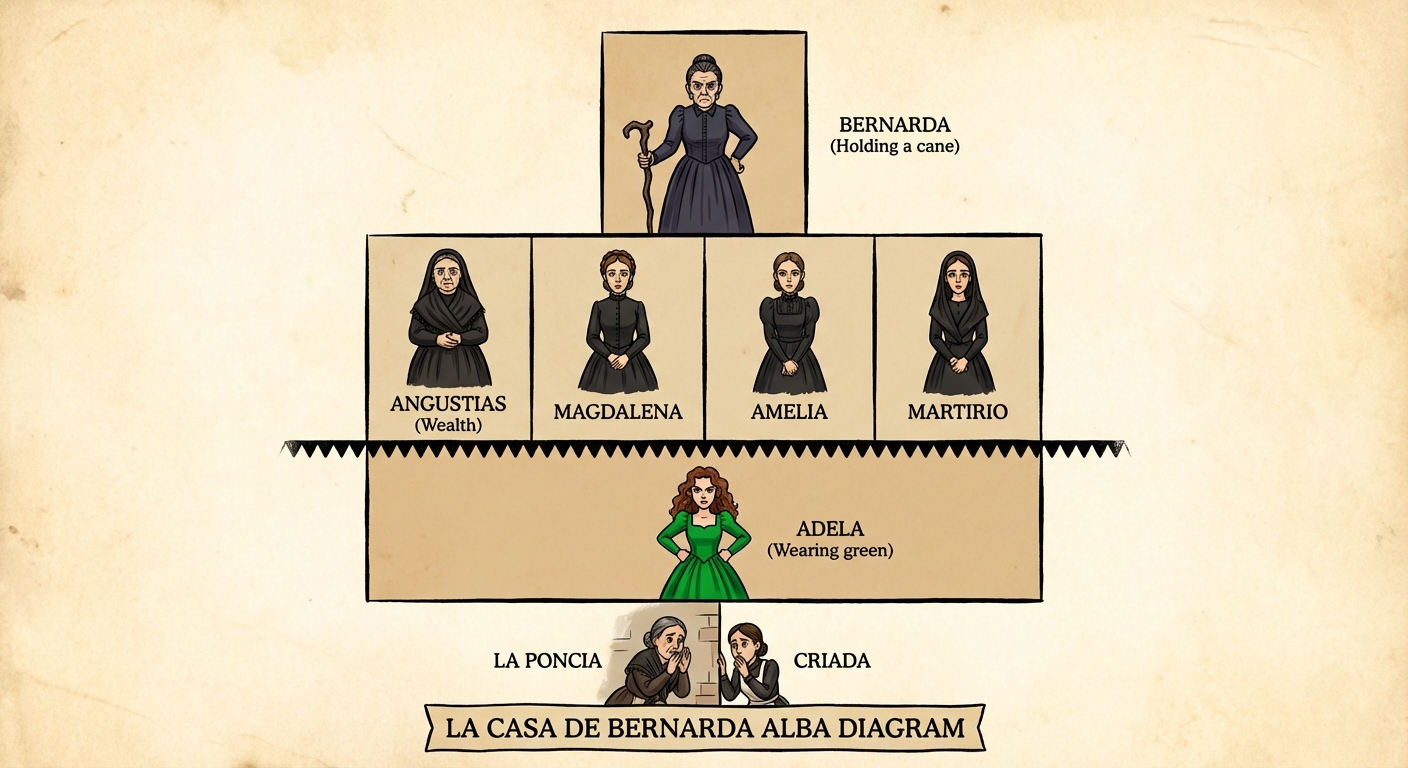
Following the death of her second husband, Bernarda Alba imposes an 8-year mourning period on her five daughters. Sexual tension rises when the eldest, Angustias, is betrothed to Pepe el Romano, but the youngest, Adela, is having an affair with him. The play ends in tragedy.
Character Archetypes:
- Bernarda: Representative of tyranny, repression, and "el qué dirán" (fear of public opinion).
- Adela: The symbol of rebellion, vitality (dresses in green), and freedom. Her suicide represents the tragic cost of breaking social norms.
- María Josefa: Bernarda's mad mother. She speaks the truth through her "madness," serving as an oracle figure.
- La Poncia: The head servant. She represents class struggle and knows the secrets of the house.
Advanced Analysis: Symbols
- The Cane (El bastón): Phallic symbol of Bernarda’s power. Adela breaking it marks the climax of rebellion.
- Heat (El calor): The oppressive atmosphere intensifies sexual desire and tension.
- Water (El agua): Running water represents life/freedom (which the town lacks); stagnant water represents death (the village wells).
- The Walls: The walls are described as white at the start and bluer/dingier by the end, symbolizing the loss of purity.
Sección 2: Vanguardismo y Existencialismo
This section deals with the crisis of the modern individual in urban and capitalist environments.
6.4 "Walking around" – Pablo Neruda
- Genre: Poesía (Vanguardismo / Surrealismo).
- Collection: Residencia en la tierra.
Concept: Feísmo (The Aesthetic of the Ugly)
Neruda moves away from beauty to describe the grotesque reality of modern life: rotting clothes, intestines, used surfaces. This reflects the poet's existential fatigue.
Analysis:
- Speaker: The "yo lírico" is tired of being a man ("Sucede que me canso de ser hombre").
- Imagery: Surrealist images like "swans made of felt" or "water filled with ashes" denote a disconnect from nature.
- Structure: Free verse, reflecting the chaos of the city.
- Themes: Alienation, urban decay, consumerism.
6.2 El hombre que se convirtió en perro – Osvaldo Dragún
- Genre: Teatro (Teatro del Absurdo / Teatro Abierto).
- Context: Written in Argentina during economic and political instability.
Definition: Teatro del Absurdo
A post-WWII designation for plays that depict human existence as meaningless and chaotic. Language breaks down, and situations are illogical.
Synopsis:
An unemployed man can only find work as a watchdog. He eventually moves into the doghouse, eats dog food, and forgets how to speak human language. Actors swap roles (Actor 1, Actor 2, Actress) to show the universality of the condition.
Key Techniques:
- Meta-theater: The actors speak directly to the audience, breaking the "fourth wall."
- Dehumanization: The gradual loss of language (barking) critiques how capitalism strips workers of their dignity.
Sección 3: Poesía Afroantillana y Social
These works focus on race, history, and the definition of Caribbean identity.
6.5 "Balada de los dos abuelos" – Nicolás Guillén
- Genre: Poesía Negra / Afroantillana.
- Key Term: Mestizaje
The biological and cultural mixing of European and Indigenous/African roots. Guillén celebrates this "synthesis."
Analysis:
- Structure: Uses distinct rhythms. The black grandfather (Taita Facundo) is associated with drums/gongs. The white grandfather (Don Federico) is associated with silence/armor.
- Resolution: The poem ends with the two grandfathers embracing ("se abrazan"), symbolizing the reconciliation of Cuba's dual heritage.
- Rhetorical Device: Jitanjáfora (use of nonsense words for rhythm) typically found in this genre, though this specific poem relies more on paralelismo.
6.6 "Mujer negra" – Nancy Morejón
- Genre: Poesía contemporánea / Feminismo.
- Structure: Free verse, epic narration.
Synopsis:
The poetic voice narrates the collective history of black women in Cuba, from the Middle Passage (slavery) to the independence wars, and finally to the Cuban Revolution (Communism).
Analysis:
- Temporal Progression: Uses verbs to mark time deviation: "Me rebelé" (rebellion against slavery) $\to$ "Bajé de la Sierra" (Cuban Revolution).
- Triple Marginalization: The protagonist overcomes oppression based on Race, Gender, and Class.
- Note: The ending creates a connection between the personal "I" and the collective "We" ("Nosotras").
Sección 4: Voces Femeninas y la Dualidad del Ser
Two poems that explore the internal conflict of women in a patriarchal society.
6.7 "A Julia de Burgos" – Julia de Burgos
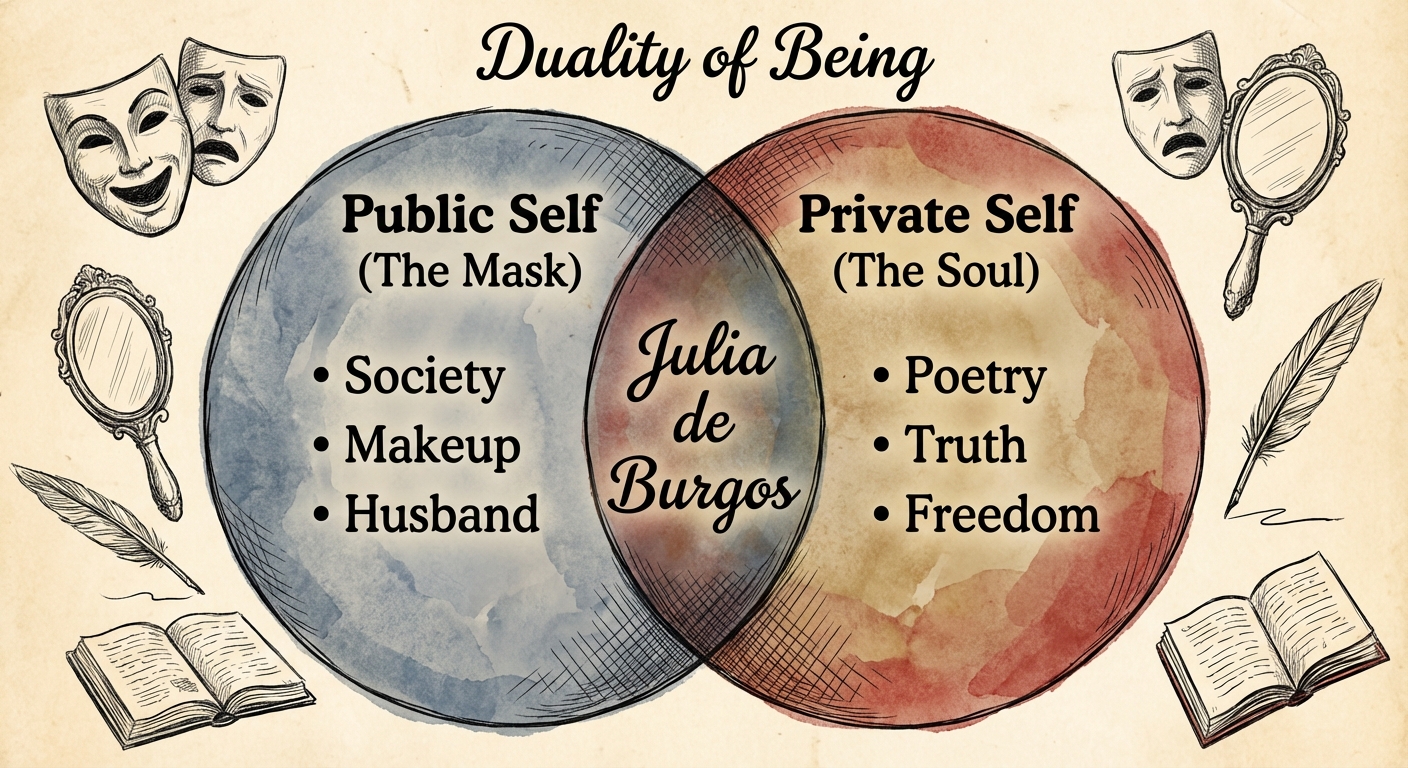
- Theme: La dualidad del ser (Public vs. Private Self).
- Structure: Fourteen lines mixed with free verse elements; highly rhetorical.
Analysis:
The poet speaks to herself using apostrophe ("Tú").
- "La Julia" (Ecarnation of society): The public figure, painted, hypocritical, belongs to her husband, slave to social norms.
- "Yo" (The poet): The private soul, raw, rebellious, belongs to no one, deeply connected to the people/masses.
Key Quote: "Tú eres fría muñeca de mentira social, y yo, viril destello de la humana verdad."
6.8 "Peso ancestral" – Alfonsina Storni
- Movements: Transition from Modernismo to Vanguardismo.
- Theme: Generational trauma and gender roles.
Synopsis:
The speaker addresses a man who says "men don't cry." She reflects on the immense weight (ancestral burden) of unshed tears that men have swallowed for centuries.
Analysis:
- Hyperbole: The tear is described as a poison so heavy the speaker cannot endure it.
- Perspective: It inverts the traditional view; usually, women are seen as weak for crying. Here, the man is pitied for the toxic burden of not crying.
- Pie quebrado: Storni uses a specific meter ($11, 11, 11, 5$) where the last line is short/broken, emphasizing the pain and heaviness.
Comparative Analysis Table
| Feature | La casa de Bernarda Alba | El hombre que se convirtió en perro |
|---|---|---|
| Theme | Repression by Tradition | Repression by Economy |
| Villain | Bernarda (Matriarchy/Society) | The System/Factory |
| Result | Physical Death (Adela) | Spiritual Death (César) |
| Symbol | The Cane (Authority) | The Dog Mask (Subservience) |
Common Mistakes & Pitfalls
- Confusing the "Julias": In A Julia de Burgos, students often forget which "Julia" is the speaker. Remember: The "Yo" is the internal, rebellious poet; the "Tú" is the fake socialite.
- Misidentifying Movements: Do not call Lorca a "Surrealist" in the strict sense (like Dalí). He uses surrealist imagery, but he belongs to the Generación del 27, which is a unique blend of tradition and avant-garde.
- Bernarda's Setting: Students often think the heat in Bernarda Alba is just weather. It is a literary device (Fallacy) representing sexual frustration. Do not ignore the setting.
- "Antoñito" vs. "Bernarda": Both are by Lorca, but Antoñito is about the marginalized Gypsy (social class/race), while Bernarda focuses on gender and moral reputation. Don't mix up the primary focus of oppression.
- Morejón's Politics: You cannot fully analyze Mujer negra without mentioning the Cuban Revolution and Communism at the end. The poem explicitly praises the result of the revolution ("el comunismo").
Mnemonic for Authors
- LORCA likes Gypsies and Women (Romancero Gitano, Bernarda Alba).
- NERUDA is Tired of Walking (Walking Around).
- GUILLÉN has Twins (Two grandfathers).
- STORNI feels the Stone (Peso/Weight).
- DRAGÚN becomes a Dog.