Redox Reactions
Define redox reactions:
Redox reactions are reactions between non-metals and metals or between non-metals and oxygen. In non-metals and metals it occurs when non-metals acts as an oxidizing agent and the metal acts as a reducing agent. In non-metals and oxygen it occurs when oxygen reacts as the oxidizing agent and the other non-metal, the reducing agent.
Define oxidation:
a process that occurs when atoms or groups of atoms lose electrons. The loss of electrons by an element in its free state
Define reduction:
The gain of electrons by an element in its free state.
OXIDATION | REDUCTION |
|---|---|
oxidation # increases | Oxidation # decreases |
gain of oxygen | loss of oxygen |
loss of hydrogen | gain of hydrogen |
loss of e- (- e-) | gain of e- (+ e-) |
rules for determining oxidation states of elements in compounds or ions
1) The oxidation number of each atom of an element in its free, uncombined state is zero.
2) The oxidation number of each monatomic ion in an ionic compound is the same as the charge.
3) The oxidation number of hydrogen in a compound or polyatomic ion is always + 1, except in metal hydrides where it is - 1.
4) The oxidation number of oxygen in a compound or polyatomic ion is always -2, except in peroxides where it is -1.
5) With the exception of hydrogen and oxygen, the oxidation number of elements in covalent compounds and polyatomic ions may vary. The oxidation number may appear in the name of the compound or ion.
6) The sum of the oxidation numbers of all the atom s o r ions in a compound is zero.
7) The sum of the oxidation numbers of all the atoms in a polyatomic ion is equal to the charge on the ion.
An oxidizing agent cause an element in its free state, or an element in a compound, to lose electrons.
A reducing agent causes an element in its free slate, or an electron in a compound, to gain electrons.
The reducing agent is reducing the other substance, so it will oxidize and gain electrons.
The oxidising agent will oxidise the other substance so it will be reduced and lose electrons.
negative - gain electrons
positive + lose electrons
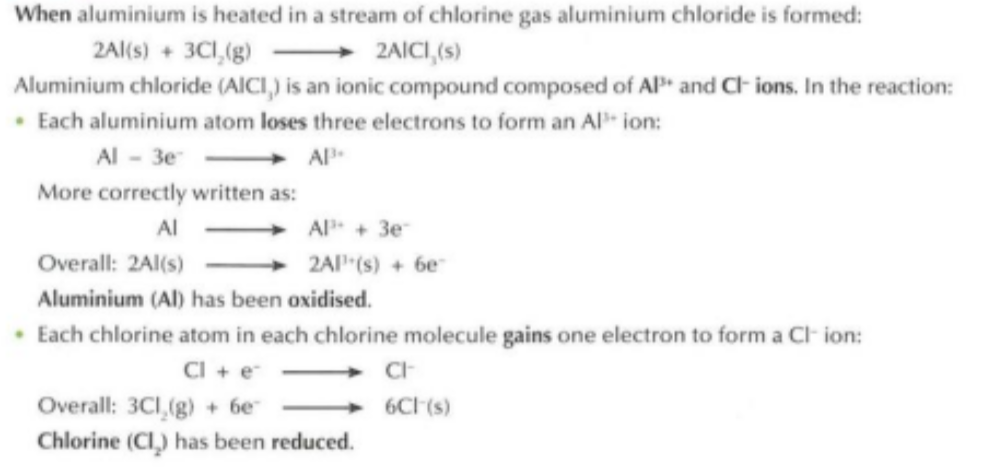
Using oxidation numbers to recognize redox reactions
• Write the balanced chemical equation for the reaction if it has not been given.
• Write the oxidation number of each element below it in brackets. The oxidation numbers of elements in polyatomic ions which remain unchanged during a reaction need not be determined.
• Decide which element shows an increase in oxidation number. This element has been oxidised.
• Decide which element shows a decrease in oxidation number. This element has been reduced. Note If the oxidation numbers of all elements remain unchanged, the reaction is not a redox reaction.
When an element loses an electron it get a positive charge hence you add to get it to its neutral or natural state.