Sacred Spaces & Silk Roads: West and Central Asia (500 BCE–1980 CE)
West and Central Asia (500 BCE–1980 CE)
1. Contextualization & Historical Background
This unit covers a vast geographic area linking the Mediterranean, the Near East, and Central Asia (modern-day Iran, Afghanistan, Uzbekistan, etc.).
Key Themes
- The Silk Road: A crucial network of trade routes that facilitated not just the exchange of commodities (silk, spices, ceramics) but also cultural, religious, and artistic ideas (Buddhism entering China, Islam spreading East/West).
- Religious Shifts: The transition from polytheistic/animist traditions to Buddhism (in Central Asia) and eventually the dominance of Islam.
- Dynastic Power: The rise of powerful caliphates (Umayyad, Abbasid) and empires (Ilkhanid, Timurid, Ottoman, Safavid) which spurred monumental architecture and book arts.
- Nomadic vs. Sedentary: The tension and blending between the nomadic cultures of the Central Asian steppes (textiles, portable metalwork) and the settled urban centers (mosques, palaces).
Understanding Islamic Art
Islamic art is the dominant force in this unit. It is strictly not a "style" but a cultural umbrella.
- Aniconism: The avoidance of figural imagery (humans/animals) in sacred contexts (Mosques, Qur'ans). Instead, artists focus on:
- Calligraphy: The status of written word (Arabic) as the divine revelation.
- Vegetal/Arabesque Motifs: Scrolling vines and flowers representing the infinite nature of God (Allah).
- Geometry: Tessellations and complex patterns reflecting divine order and logic.
- Figural Art: Crucial distinction—figures ARE permitted in secular (non-religious) art, such as private palaces (Alhambra) or book illustrations (Shahnama).
2. Pre-Islamic and Buddhist Art in Division
Before the arrival of Islam, the region was a crossroads for Hellenistic and Buddhist cultures.
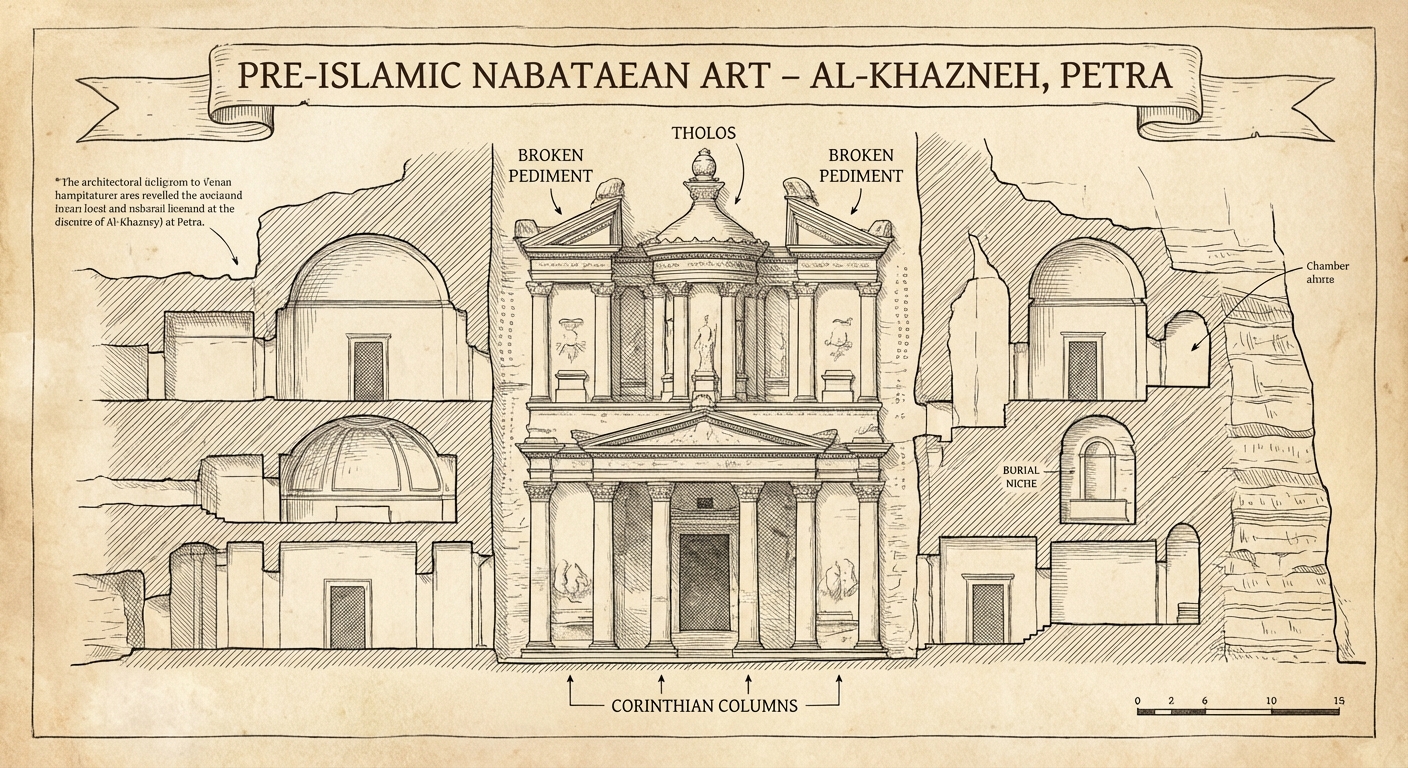
Petra: The Treasury and Great Temple
- Location: Jordan (Nabataean Ptolemaic/Roman)
- Date: c. 400 BCE–100 CE
- Material: Cut rock
- Concept: The Nabataeans were master traders who controlled incense routes. Petra is a "necropolis" (city of the dead) carved directly into rose-red sandstone cliffs.
- Visual Analysis:
- The Treasury (Al-Khazneh): Actually a tomb, not a treasury. Features a blend of Greek (corinthian columns, pediments), Egyptian (Isis figures), and Assyrian styles.
- The Great Temple: A massive complex with a theater, indicating Roman influence.
- Key Term: Syncretism (the blending of different cultures/religions). Petra is the ultimate example of Hellenistic style adapted by Near Eastern people.
Buddha of Bamiyan
- Location: Afghanistan (Gandharan)
- Date: c. 400–800 CE (Destroyed in 2001)
- Material: Cut rock with plaster and polychrome paint
- Form: Two massive high-relief buddhas (175 ft and 115 ft) carved into a cliff face. Originally painted and adorned with metal/gems to reflect light.
- Context: Located on the Silk Road. Pilgrims could circumambulate (walk around) the feet of the statues.
- Iconoclasm: Destroyed by the Taliban in 2001, an act of iconoclasm (breaking of images) due to their strict interpretation of Islam regarding idols.
3. Early Islamic Architecture: The Foundations
The Kaaba
- Location: Mecca, Saudi Arabia
- Date: Pre-Islamic monument; Rededicated by Muhammad in 631–632 CE
- Form: A cubic structure draped in a black silk and gold curtain called the Kiswa.
- Function: The holiest site in Islam; the distinct focal point of the Hajj (pilgrimage) and the direction (Qibla) to which all Muslims pray.
- Meaning: Muslims believe it was built by Ibrahim (Abraham) and Ishmael. Muhammad cleansed it of pagan idols, establishing monotheism.
The Dome of the Rock
- Location: Jerusalem
- Date: 691–692 CE (Umayyad)
- Form: Octagonal plan with a golden dome. Heavily influenced by Byzantine centrally-planned churches (like San Vitale).
- Decoration: The first use of Qur'anic inscriptions in architecture. Mosaics depict crowns and jewels (symbols of defeated empires: Byzantium and Sassanid Persia), but NO figures.
- Context:
- Not a Mosque: It is a shrine.
- Political Statement: Umayyad Caliph Abd al-Malik built it to rival the nearby Christian Church of the Holy Sepulcher, asserting the supremacy of Islam.
- Sacred Site: believed to be where Adam was created, where Abraham nearly sacrificed his son, and where Muhammad began his Night Journey to heaven.
4. The Persian Mosque Tradition
Great Mosque (Masjid-e Jameh)
- Location: Isfahan, Iran
- Date: c. 700 CE (with additions by Seljuks, Safavids, etc. through 20th century)
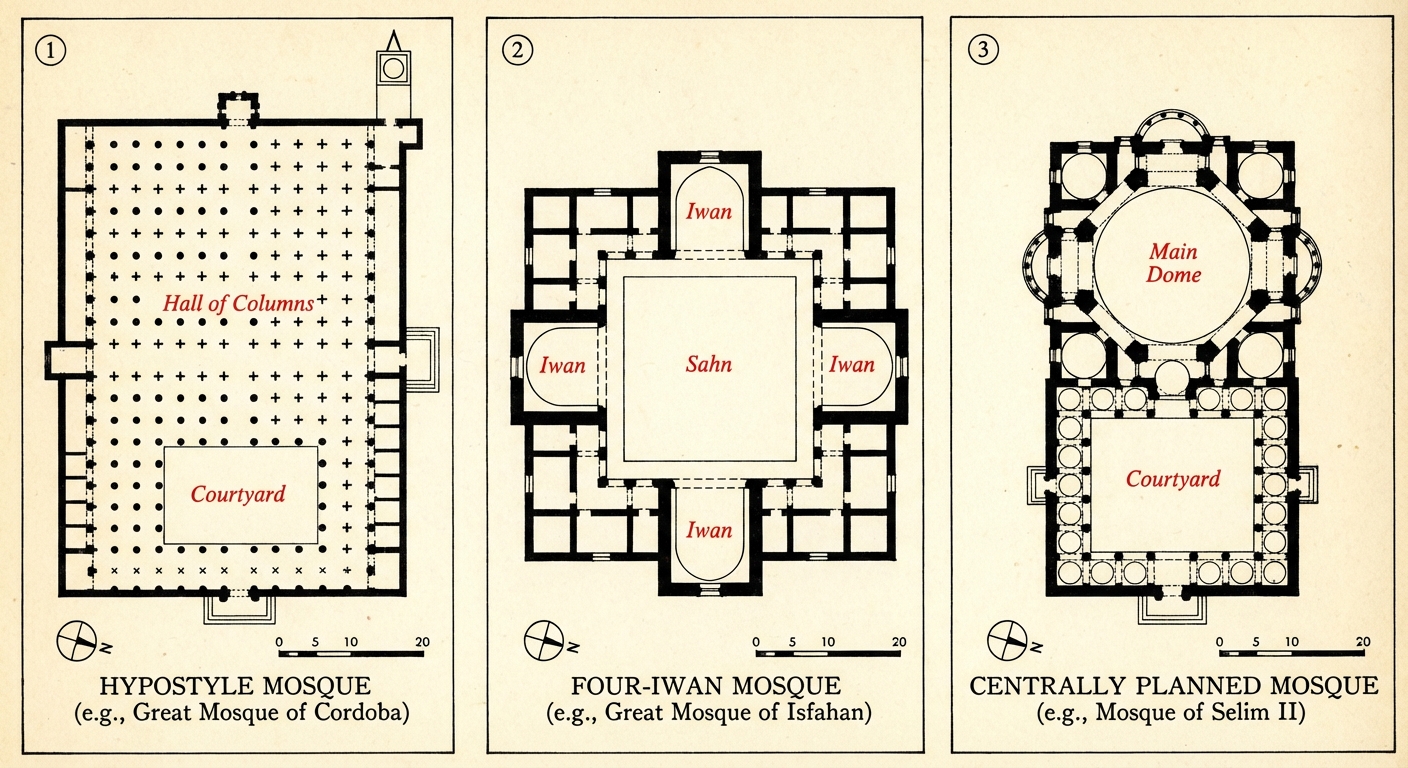
- Typology: The Four-Iwan Mosque.
- Iwan: A vaulted space that opens on one side to a courtyard.
- Qibla Iwan: The largest Iwan facing Mecca, flanked by minarets.
- Details: The mosque is a visual history of Persian architecture. It is integrated into the city fabric (bazaars connect to it).
- Decoration: Extensive use of Muqarnas (honeycomb-like stalactite vaulting) on the undersides of arches to diffuse light and hide structure.
5. Luxury Arts: Metal, Textiles, and Ivory
Basin (Baptistère de Saint Louis)
- Artist: Muhammad ibn al-Zain (Signed 6 times!)
- Material: Brass inlaid with gold and silver
- Date: c. 1320–1340 CE (Mamluk)
- Content:
- Figural Imagery: Shows hunting scenes, battles, Mamluk officials. The bottom features fish, eels, and crocodiles.
- Secular: Because it was a washing basin (not for a mosque), figures were permitted.
- Cross-Cultural Use: Originally made for Mamluk courtiers, it ended up in France and was used to baptize the royal children of France (including Louis XIII).
The Ardabil Carpet
- Date: 1539–1540 CE (Safavid)
- Material: Silk and wool
- Significance: One of the world's largest, oldest, and finest carpets (approx. 25 million knots).
- Design:
- A central golden sunburst (medallion) represents the inside of a dome.
- Two mosque lamps hang from the medallion. One is larger than the other to account for optical perspective (when viewed from the doorway, they appear equal).
- Function: Created as a matching pair for the shrine of Safi al-Din Ardabili (a Sufi saint).
Pyxis of al-Mughira
(Officially AP Unit 3 - Early Europe, but essential for Islamic Art context)
- Date: 968 CE (Umayyad Spain)
- Material: Ivory
- Form: A cylindrical container for aromatics.
- Content: Highly skilled carving showing pleasure activities (falconry, music).
- Politics: Gift to the Caliph's son. Contains political imagery warning against rival factions (e.g., lions attacking bulls).
6. The Art of the Book: Persian Miniatures & The Qur'an
Folio from a Qur’an
- Date: 8th–9th Century (Abbasid)
- Script: Kufic (early angular Arabic script).
- Form: Brown ink, gold on parchment. Wide page format.
- Significance: The calligraphy is the art. The geometric planning of the letters follows the Golden Ratio. Red dots indicate vowels (a later addition for clarity).
The Shahnama (Book of Kings)
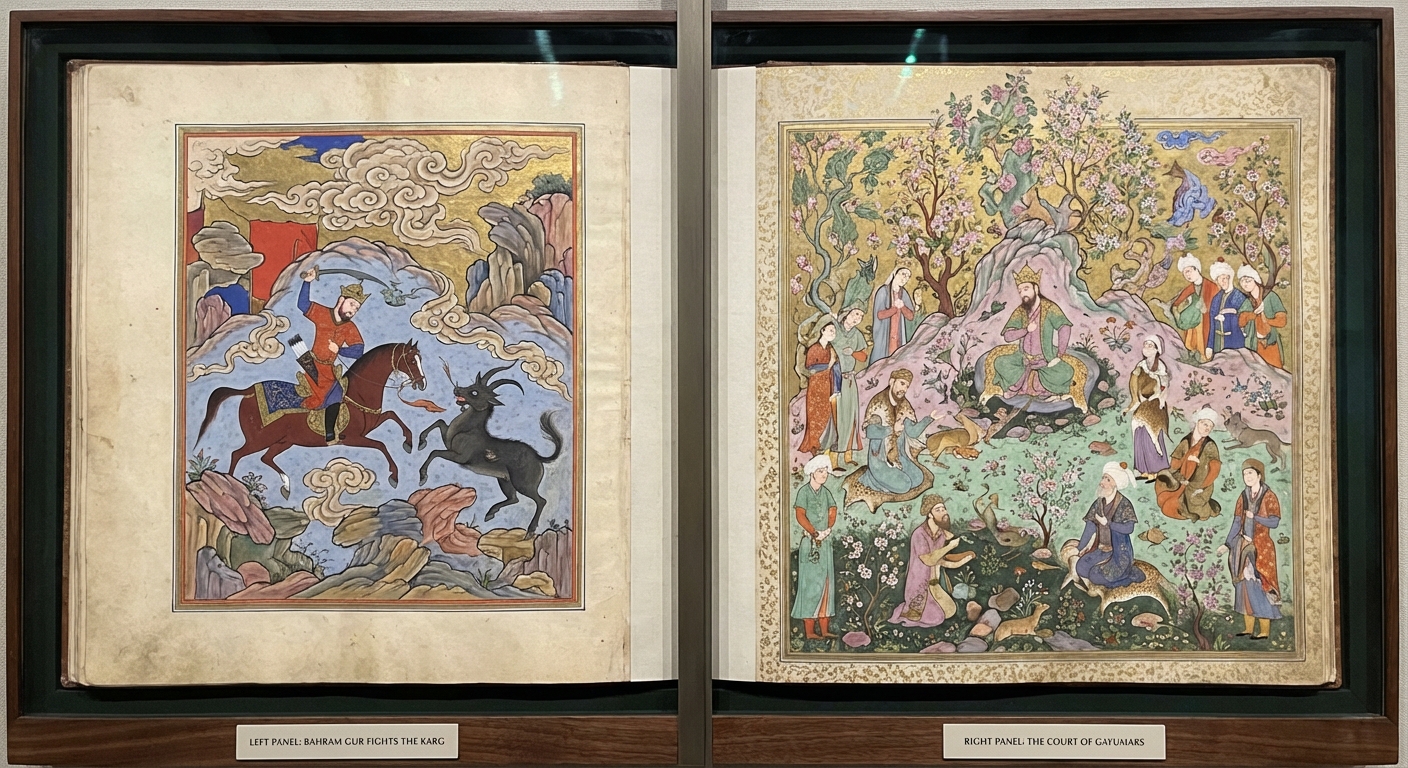
- Context: The Shahnama is the Persian national epic poem (pre-Islamic history/myth) written by Firdawsi. Illustrated copies were commissioned by Mongol and Safavid rulers to legitimize their rule.
1. Bahram Gur Fights the Karg (Ilkhanid Dynasty)
- Date: c. 1330–1340 CE
- Style: Heavy Chinese influence (result of Mongol rule).
- Landscape is similar to Chinese scroll painting.
- Bahram Gur wears European fabric.
- Story: King Bahram Gur defeats a horned wolf (Karg). Represents order conquering chaos.
2. The Court of Gayumars (Safavid Dynasty)
- Artist: Sultan Muhammad
- Date: 1522–1525 CE
- Style: The peak of Persian painting. Weightless, floating figures; vibrant, jewel-like colors; intricate details (fine squirrel-hair brushes).
- Content: Depicts the legendary first king, Gayumars, ruling from a mountaintop. Animals and humans live in harmony. The painting overflows the border.
7. Cross-Cultural Connections: Islamic Art in Europe & South Asia
Note: While often taught here, the AP Curriculum places these in Unit 3 (Spain) and Unit 8 (India).
The Alhambra (Unit 3)
- Location: Granada, Spain (Nasrid Dynasty)
- Concept: A "palace city." The last Muslim stronghold in Spain.
- Court of the Lions: Features a fountain with 12 lions (an unusual instance of freestanding sculpture in Islamic art).
- Hall of the Sisters: Famous for Muqarnas dome—5,000 carved stucco cells that catch light, symbolizing the dome of heaven.
Great Mosque of Córdoba (Unit 3)
- Location: Spain (Umayyad)
- Form: Massive hypostyle hall (forest of columns).
- Detail: Candy-cane striping on double-tiered arches (brick and stone). Reuse of Roman columns (spolia).
- Mihrab: An exquisitely decorated niche (gold tesserae) pointing to Mecca.
The Taj Mahal (Unit 8)
- Location: Agra, India (Mughal)
- Function: A mausoleum.
- Cross-Culturalism: Built by Shah Jahan. It blends Persian domes/iwan arches with Indian materials (white marble, red sandstone) and setting (gardens).
- Symbolism: Represents the Throne of God perched above the gardens of Paradise.
8. Common Mistakes & Pitfalls
"Arab" vs. "Muslim":
- Mistake: Using these interchangeably.
- Correction: "Arab" is an ethnicity/language group. "Muslim" is a follower of Islam. The Persians (Iranians), Turks, and Mughals (Indians) were Muslim but not Arab. They have distinct artistic styles.
The "Ban" on Figures:
- Mistake: Thinking Islam forbids ALL figural art.
- Correction: The ban is strict only in religious contexts (Mosques, Qur'ans). Secular objects (Basin), palaces (Alhambra), and books (Shahnama) often feature people and animals.
Dome of the Rock vs. Mosque:
- Mistake: Calling it a mosque.
- Correction: It is a shrine/monument. People circumambulate the rock; they do not hold congregational prayer services inside like they do in a mosque (e.g., Great Mosque of Isfahan).
Mosque Orientations:
- Mistake: Forgetting the specific terms.
- Correction: Remember the Qibla wall faces Mecca, and the Mihrab is the niche in that wall. The Minaret is the tower for the call to prayer.
Shahnama Context:
- Mistake: Thinking the Shahnama is a religious text.
- Correction: It is a secular epic poem about Persian kings and heroes, not Islamic theology.