BF Skinner
Definition (#f7aeae)
Important (#edcae9)
Extra (#fffe9d)
Reinforcement: Basis of behavior.
Respondent behavior: Response made to or elicited by environmental stimuli.
Conditioning: Substitution of 1 stimuli for another.
Reinforcement: act of strengthening a response by adding rewards and increasing the likelihood of response repetition.
Extinction: Process of eliminating a behavior by withholding reinforcement.
Operant behavior: Behavior emitted spontaneously or voluntarily that operates on the environment to change it.
Change in the consequences of a response will affect the rate at which the response occurs.
Skinner held that personality is a collection of operant patterns.
Schedules of reinforcement:
Patterns or rates of providing or withholding reinforcers
Reinforcement does not occur every time
Fixed interval: Reinforcer following a fixed amount of time after response.
Fixed ratio: Reinforcer following a fixed number of responses.
Variable interval: Reinforcer after unpredictable amount of time.
Variable ratio: Reinforcer after unpredictable number of responses.
Shaping behavior: Behavior that is expected to be displayed in time.
Successive approximation
Explanation of acquisition of complex behavior
Behavior will be reinforced only as it comes to approximate or approach the final desired behavior.
Superstitious behaviour:
Persistent behavior that has a coincidental and not functional relationship to the reinforcement it received.
Accidental reinforcement
Self-control of behavior:
Ability to exert control over variables that determine their behaviour.
Acting to alter the impact of external behaviour.
Stimulus avoidance: Removing oneself from an external variable
Self-administered satiation: Overdoing undesired behavior.
Aversive stimulation: Making negative consequences for oneself
Self-reinforcement: rewarding oneself.
Application of Operant Conditioning:
Behavior modification:
Therapy that applies principles of reinforcement for changing behavior.
Applicable in classrooms, clinics, businesses, and industries.
Punishment:
Application of aversive stimulus to decrease certain behavior.
Less effective than positive reinforcement
Token economy:
Tokens are exchanged for valued objects or privileges for desired behavior.
Reinforced behaviors revert to original state when the tokens are not provided.
Negative reinforcement:
Strengthening a response by removing an aversive stimulus.
Consequences are not as predictable as positive reinforcement.
Questions of Human Nature:
Deterministic
Emphasized on the influence of nurture
Focused on the past and the present
Stressed on uniqueness
Equilibrium and growth
Optimistic
Assessment:
Functional analysis: Approach to study behavior.
Assesses the frequency of a behavior, the situation it occurs in, and its associated reinforcers.
Approaches: Direct observation, Self-report, Physiological measurements
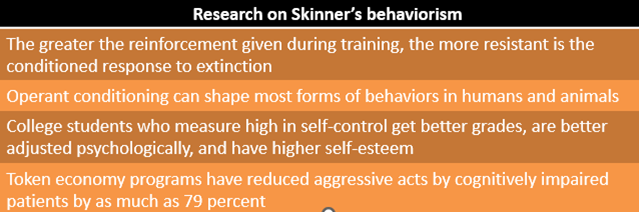
Research:
Intensive study of single subjects
Results of other experiments support Skinner’s ideas
Reflections:
Criticism:
Focuses on overt behavior and ignores uniquely human qualities.
Experiments were simple.
Usage of animals as subjects.
Instinctive drift: Substitution of instinctive behaviors for behaviors that had been reinforced.
Challenged by cognitive movement.
Contribution:
Skinner was a potent force in psychology.
Shaped the field more than any other individual.
His approach continues to be applied in laboratory, clinical, and organizational settings