Topic1 - Energy and the Environment
Energy consumption
What Albertans use fossil fuels for:
Coal: Electricity and power
54% of our electricity in Alberta comes from coal
Oil: Fuel(transportation)
Natural gas(mainly methane): Heating homes
Fossil fuels provide most of Alberta’s energy today
What do we use energy for?
Residential(heat and electricity)
Commercial
Transportation
Industry and manufacturing
Factors that affect a country’s energy consumption?
Geography: size of a country and climate(hot/cold)
Industries, GDP(Gross Domestic Product) and Energy Intensity: type of industry(fossil fuels, lumber, cars) and amount of export
Lifestyle and population: Standard of living
Technology: how much we use and the efficiency of energy conversion
Energy Efficiency
*Know how to calculate
To increase the efficiency of any device, we need to reduce the amount of waste energy and convert it to useful output energy
Machines cannot be 100% efficient
Solar Energy Sources
The sun is the ultimate energy source
most energy sources on earth are linked to the sun
When radiant solar energy is captures by producers, it is converted to and stored to as chemical potential energy in plants
Only 0.023% of the suns energy is used by plants for photosynthesis
1% is used to drive air currents
23% is used to drive the water cycle
How coal was formed
Fossil fuels are created by an indirect use of solar energy
Started with photosynthesis millions of years ago
Energy stored in plant’s was passed to animals when they were eaten
Plants and animals die
Lack of oxygen prevent decay and decomposition
Sediments compacted overtop as time passed
With the head of Earth’s core and pressure, coal, petroleum, and natural gas formed
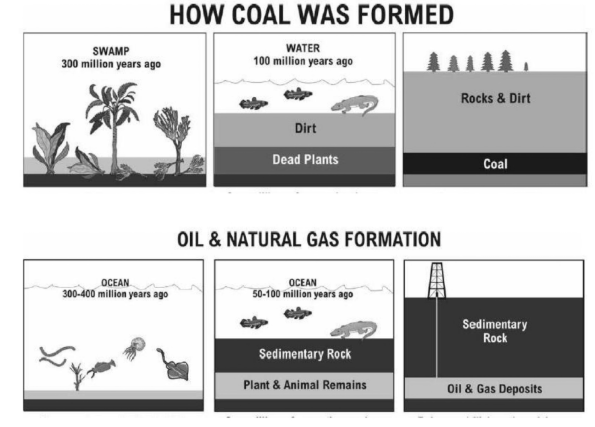
Harvesting Chemical Energy
Energy is stored in fossil fuels and can be released by combustion(burning)
Combustion reactions always uses O2(g) and produces CO2 and H2O(g) as products
Combustion is an exothermic reaction
The heat reaction is the energy absorbed or released during a chemical reaction
Energy of change of a reaction is represented by the symbol
Exothermic reaction release energy to the environment and are negative
Endothermic reaction absorb energy from the environment and are positive
Coal fired Generating Station
Steps in a coal-fired generating station:
Coal is crushed into a fine dust
The coal is burned in a boiler and the energy produced is used to heat water within a network of tubes
Water boils and turns into steam which turns a turbine
The turbine is connected to a generator which generates electricity
Pollutants released during the process:
Particulates
SOx
CO2
Heat
Radioactive particles
Mercury
Energy used in the process:
Solar
Chemical potential
Thermal
Kinetic
Electrical

Pros and Cons of Coal Fired Power Plants
Pros
Cheap and affordable
Coal is an abundant supply
But not forever
Reliable, with high energy yields(efficient)
Can be made cleaner by removing carbon and sulfur
Cons
Coal is a nonrenewable resource
Produces SOx, CO2, radioactive particulates, and mercury, heat
Environmental destruction
Global Warming
Production of CO2 = global warming
Cause | Effects | Solutions |
|
|
|