5.6 - Production Planning
Local and Global Supply Chain Process
Managing relations w/ all the other partners involved in the production process is known as supply chain management
Managing a supply chain involves:
Deciding what to produce yourself and what to buy from others
Choosing which suppliers to work with
Setting out the terms and conditions of the supplier relationships like penalty clauses for any delays
Deciding on the assurances from the suppliers on the operations
A business who wants to protect its brand + image has to be careful who it’s buying from
Deciding how much direct involvement to have w/ suppliers
Deciding on how centralized purchasing should be, like should all offices have to buy their supplies from a certain company or does it not matter
The Value of Managing the Supply Chain Process Effectively
Management of the supply chain will affect:
The extent to which suppliers meet the requirements of the business reliably
Costs of the business
Ability of the business to be flexible to customer requirements
Quality of supplies
Consumers’ perception of the ethics of the business
Sometimes, businesses will take control of their supply chain process by owning more of the stages in it
Vertical integration
Changing Supply Chain Process
Managers looking for the best value for money may be using suppliers thousands of miles away, and their suppliers will also be global
This can make the supply chain complex, in tracking who is involved
Tech developments are also changing the nature of the supply chain in certain industries
Customers can now access more products straight from the provider w/o many intermediaries
Managing supply chain has become more important since customers want to know how their products are being produced
Bc of this managers should be able to track back more of their supplies
An ethical business needs to be wary of their supply chain
Local vs Global Procurement
Some companies now choose to procure their supplies locally rather than globally
When procuring locally a business looks for supplier in the country of the operating borders instead of getting it from another company
Some businesses build a competitive advantage through promoting their locally sourced goods to attract consumers who are concerned either ab the carbon footprint associated w/ goods transported over long distances
Difference Between JIT and Just-in-Case (JIC)
A key aspect of operations management involves managing stocks
Depending on the business + conditions it faces, it might be beneficial to hold large amounts of stock, or it might be better to get deliveries of resources shortly before they’re needed
JIT Production
The principle of placing smaller, regular orders for resources, which are delivered just in time for them to be used
This reduces storage costs + waste
This method has been challenged through a variety of ‘supply shocks’ in the global supply chain
Including international trade wars, and COVID
Benefits of JIT | Limitations of JIT |
|---|---|
Improved cash flow and reduces costs - businesses can reduce costs by reducing their inventory, and can use the money for other operations | Reduced economies of scale - businesses will make smaller orders, reducing purchasing economies of scale |
Improved operations - employees know they need to be careful in operations since there’s no spare stock | High risk - production can halt if a small part of the supply chain breaks down, and any delivery delay is bad |
Increased capacity - w/ less storage space needed for stock, more space can be allocated to production | Reduced resilience - businesses may be unable to adapt to changes in the internal or external environment |
JIT needs:
Good supplier relationship
Reliable employees
A flexible workforce
JIC Production
Buffer stocks are additional quantities of inventory kept by a company in case of need
JIC stock control involves holding relatively large levels of buffer stocks so a business can keep operating when faced w/ unforseen events
This results in higher storage costs, but makes the business more resilient to disruptions
Benefits of JIC | Limitations of JIC |
|---|---|
Resilience - production can keep going for a time even w/ disruptions to supply chains | Less working capital - purchasing large quanitites of stock reduces liquidity, so less cash is available for operations |
Economies of scale - the business can order larger quantities of supples resulting in lower costs thru purchasing economies of scale | Higher storage costs - holding large quantities of stock is costly bc of space needs |
Less risk - business is less exposed to changes in the external environment like increases in resource costs | Waste - business may not be able to use all the large quantities of stock it purchased, leaving wasted resources |
Stock Control Charts
Easy way to monitor and analyse stock levels + better control costs
Records when stocks are delivered and when they’re sold, and it can then be used to make decisions ab when to order new stocks and in what quantities
Contains:
Max stock level: The total amount of inventory a company wants to hold
Buffer stock level: Stock held just in case there is an unexpected order or late delivery
Lead time: Time it takes a supplier to fulfil an order; the difference between when an order is placed and when it’s delivered
Reorder level: The point when new stock is ordered from a supplier
Reorder quantity: Amount of stock ordered from a suppliers
Operations Calculations
Operations managers need tools to track the performance of their departments
Productivity Rate
Measures the average efficiency of production and is expressed as a ratio of output to inputs in the production process
Formula is:
Total output/total input X 100
Labour Productivity
Measures the output per worker over a defined period of time
Formula is:
Total output/number of employees
Capital Productivity
Measures how efficiently a business utilizes its capital to generate output
The higher the capital productivity rate, the mroe efficient a business is at utilizing its fixed assets
Formula is:
Total output/capital input
Defect Rate
There’s a risk that pushing workers and capital to produce more can cause more mistakes, called product defects
Defect rate is the percentage of output that doesn’t meet expected quality standards
Formula is:
Defects/output tested X 100
Capacity Utilisation
Important for fixed costs
The percentage of a company’s total capacity that is currently being used
When these rates are higher, the average fixed costs will fall bc they’ll be divided by a larger output
Formula:
Actual output/productivity capacity X 100
Capacity = total ouput a company can produce using its current resources
High capacity utilisation means a company is using its resources efficiently, and should reduce average costs + increase profits
Downside is that workers/machines will be working flat out. raising stress levels of staff
Drop in quality
Costs to buy and Costs to make
Many quantitative and qualitative factors are considered when deciding whether to make or buy the products they sell
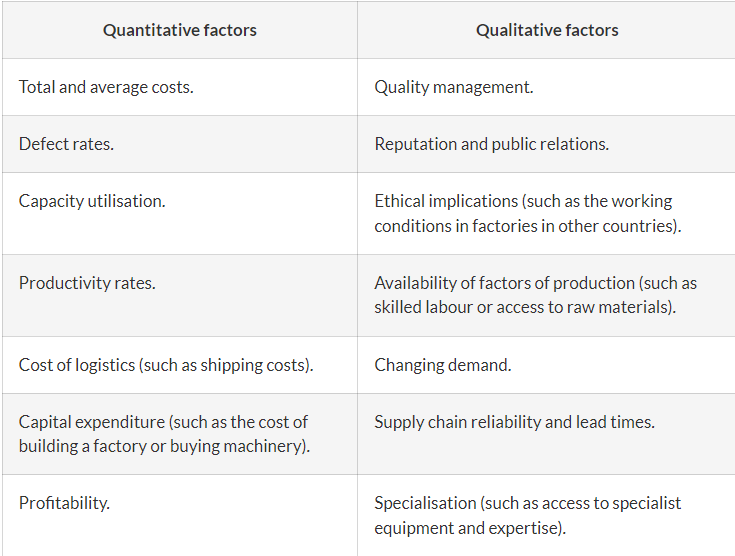
Businesses can calculate how much it’d cost to make the product inhouse and compare that to the cost of outsourcing production
Cost to make
The total cost of production if manufacturing is kept inhouse
Formula:
(Average variable costs x quantity) + fixed costs
Cost to buy
The total cost of subcontracting production to a supplier
Formula:
Price x quantity
Reasons to make
Quality and cost control thru vertical integration
More control over quality and costs
Protecting intellectual property
Meeting global and local responsibilities
Reasons to buy
Specialisation and expertise
Low costs bc of economies of scale
Lower fixed costs