Selective reabsorption
Adaptations of the proximal convoluted tubule
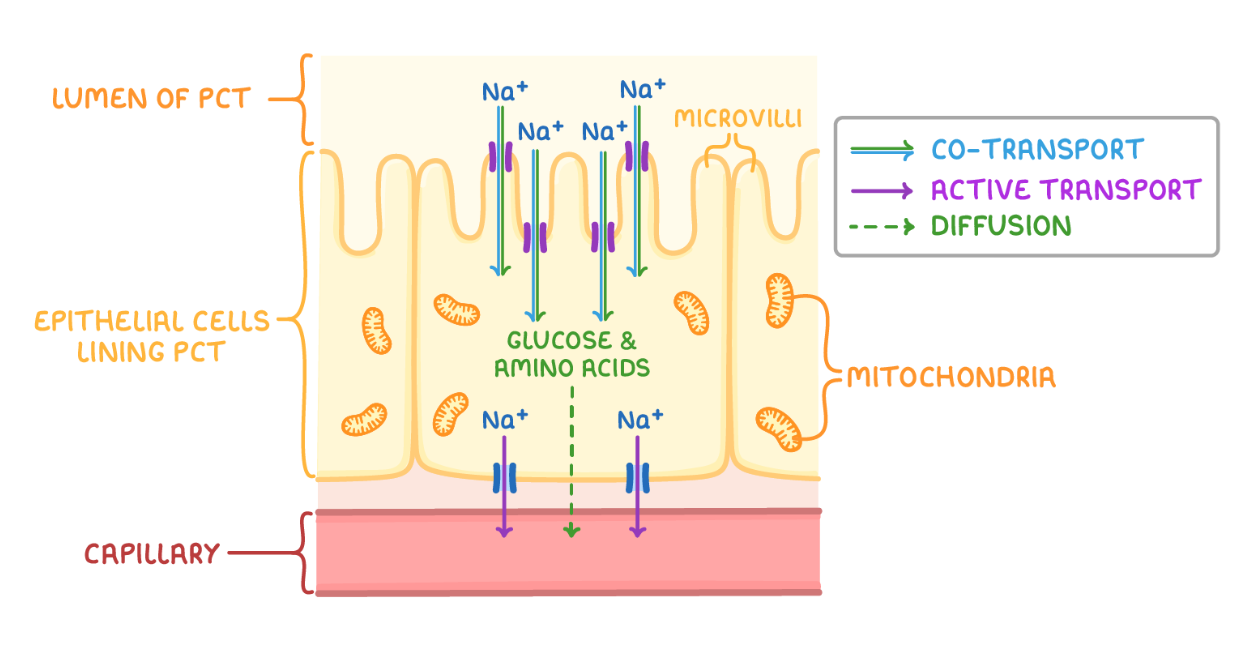
microvilli
Small, finger-like projections that greatly increase the surface area for reabsorbtion
Basal infoldings
These structures further increase the surface area for moving substances into surrounding blood capillaries
Numerous mitochondria
These organelles provide ATP for the active transport processes involved in reabsorption
Co transporter proteins in plasma membrane
Allow co transport of substances from filtrate into epithelial cells
Reabsorption in the proximal convoluted tubule
Na+ actively transported into blood capillaries
Reduces the Na+ concentration in the epithelial cells lining the PCT
Na+ moves from the PCT lumen into the epithelial cells, down its concentration gradient
Na+ is co transported with substances like glucose and amino acids into the epithelial cells
These reabsorbed molecules can then diffuse into blood capillaries
As water potential is increased in the cell water can move through into the blood via osmosis
Distal convoluted tubule function
reabsorption of any remaining useful substances
Primarily through active transport
The alteration of DCT membrane permeability to regulate further reabsorption of water and solutes
The regulation of blood pH by selectively reabsorbing certain ions