OpenStax Microbiology/Viruses
6.2 The Viral Life Cycle
The Life Cycle of Viruses w/ Prokaryote Hosts
Virulent phages typically lead to death of the cell through cell lysis
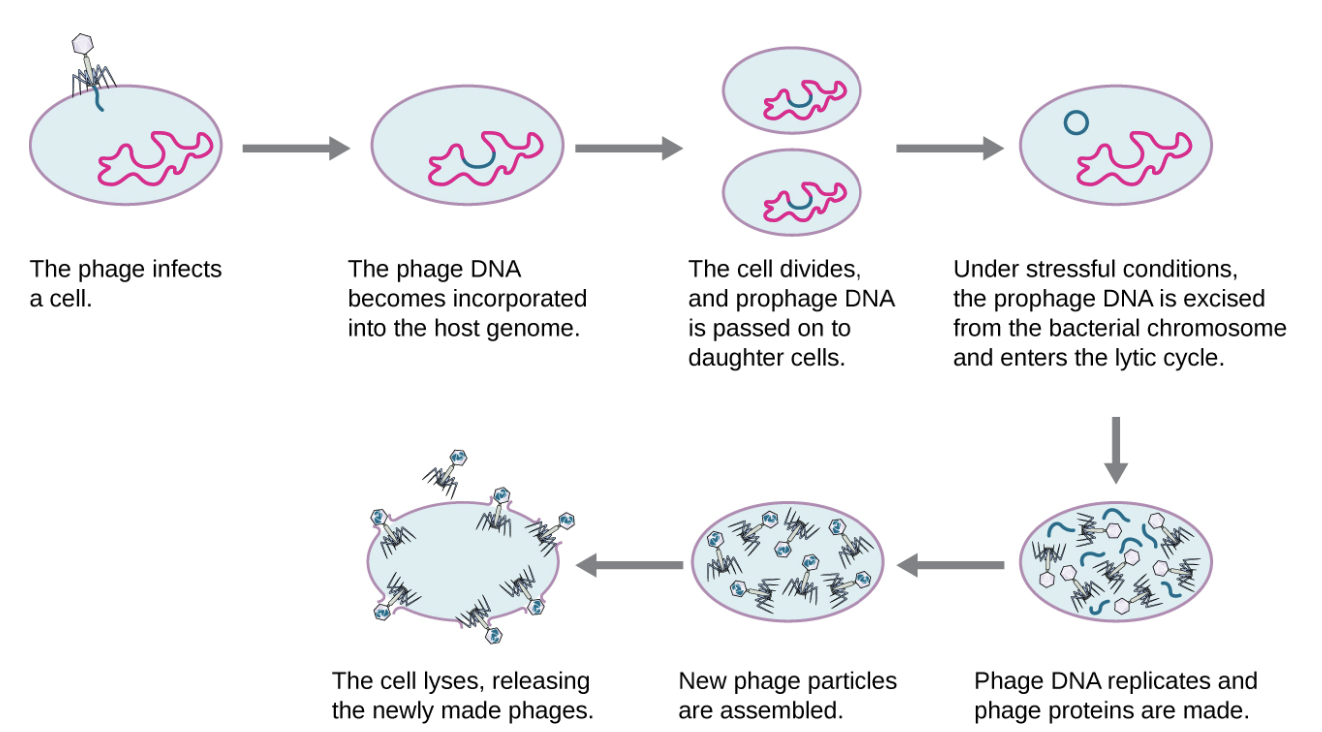
Temperate phages can become part of a host chromosome and are replicated with the cell genome until they are induced to make newly assembled viruses or progeny viruses
The Lysogenic Cycle
The phage genome also enters the cell through attachment & penetration
Instead of killing the host, the phage genome integrates into the bacterial chromosome and becomes part of the host
Prophage: The integrated phage genome
Lysogen: Bacterial host with prophage
As the bacterium replicated its chromosome, it also replicated the phage’s DNA and passes it on to new daughter cells during reproduction. The presence of the phage may alter the phenotype of bacterium, since it can bring in extra genes.
This is called lysogenic conversion or phage conversion
During lysogeny, the prophage will persist in the host chromosome until induction, which results in the excision of the viral genome from the host chromosome
After induction has occurred the temperate phage can proceed through lytic cycle and then undergo lysogeny in a newly infected cell
Transduction
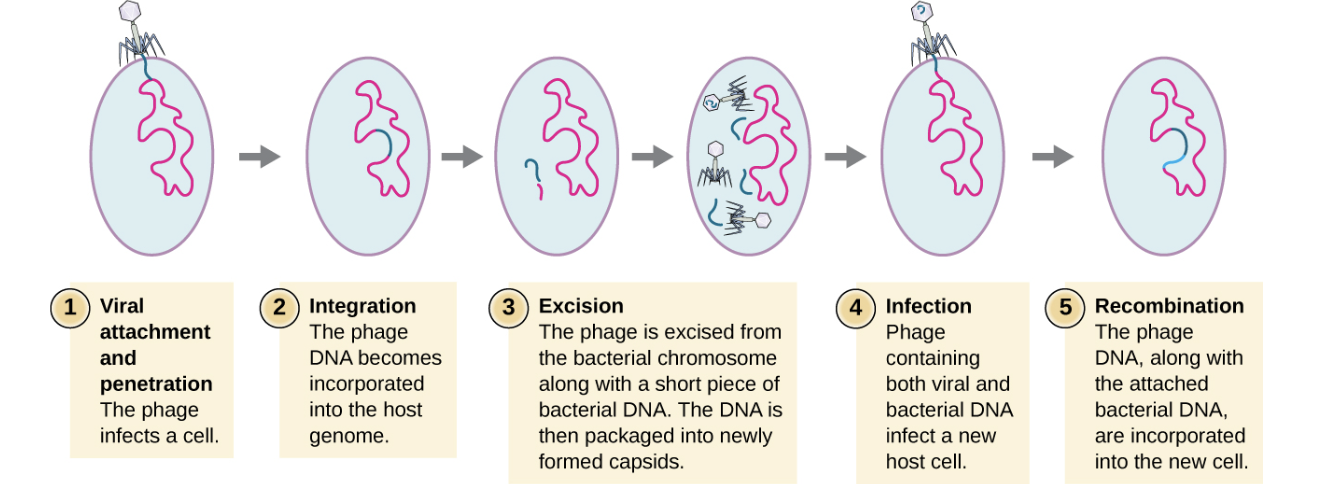
Occurs when a bacteriophage transfers bacterial DNA from one bacterium to another during sequential infections
Two Types
Generalized & specialized
Generalized: occurs when a random piece of bacterial chromosomal DNA is transferred by the phage during the lytic cycle
Specialized: occurs at the end of the lysogenic cycle, when the prophage is excised and the bacteriophage enters the lytic cycle.
Some conditions can stimulate the prophage to go into induction, casuing the phage to excise from the genome, enter lytic cucle, and produce new phages to leave host cells.
During excision from the host chromosome, a phage may occasionally remove some bacterial DNA near the site of viral integration. The phage and the host DNA from one end or both ends of the integration site are packaged w/in the capsid and are transferred to the new, infected host.
Life Cycle of Viruses with Animal Hosts
Similar to bacteriophages: attachment, penetration, biosynthesis, maturation, and release
Different: Mechanisms of penetration, nucleic-acid biosynthesis, and release differ btw bacterial and animal viruses
Animal viruses enter through endocytosis (engulfment of host cell) or through membrane fusion (viral envelope w/ the host cell membrane)
Many are host specific - they only infect a certain type of host; and most viruses only infect certain types of cells w/in tissues
This is tissue tropism
Viruses do not always express their genes using the normal flow of gnetic information - from DNA to RNA to protein. Some viruses have dsDNA or ssDNA or dsRNA or ssRNA genomes.
the nature of the genome determines how the genome is replicated & expressed as viral proteins
If the genome is ssDNA, host enzymes will be used to synthesize a second strand that is complementary to the genome strand, thus producing dsDNA.
dsDNA can now be replicated, transcribed, and translated similar to host DNA
If the viral genome is RNA, a different mechanism must be used.
Three types of RNA genome:
dsRNA, (+)ssRNA, or (-)ssRNA
If a virus has (+)ssRNA genome, it can be translated directly to make viral proteins, it acts like mRNA.
If a virus has (-)ssRNA genome, the host ribosomes cannot translate it until the (-)ssRNA replicated into (+)ssRNA by viral RNA-dependent RNA polymerase (RdRP)
RdRP is brought in by the virus and can be used to make (+)ssRNA from the ordinal (-)ssRNA.
Newly synthesized +ssRNA copies can be translated by cellular ribosomes
An alternative mechanism for viral nucleic acid synthesis is observed in the retrovirus, which are (+) ssRNA viruses
Undergo reverse transcription by reverse transcriptase
w/in each capsid that synthesizes a complementary ssDNA (cDNA)copy using (+)ssRNA genome as a template.
The ssDNA is then made into dsDNA, which can integrate into the host chromosome and become a permanent part
of the host.
The integrated viral genome is called a provirus.
The provirus will not undergo excision
Persistent Infections
occurs when a virus has not been completely cleared from the system
the virus may remain silent or undergo productive infection w/o seriously harming or killing the host
mechanism involved:
regulation of the viral
host gene expression
alteration of the host immune response
Two primary categories:
latent & chronic
Latent: Herpes, varicella, & EBV
Chronic: Hep. C & HIV
Latent Infection:
Not all animal viruses will undergo replication by the lytic cycle
these viruses are capable of hiding or being dormant insde the cell in a process called latency
The virus does not kill the nerve cells or continue replicating
Chronic Infection
disease w/ symptoms that are recurrent or persistent over a long time
maintains chronic persistence through:
interference w/ immune function
including preventing expression of viral antigens on the surface of infected cells
altering immune cell themselves
restricting expression of viral genes
rapidly changing viral antigens through mutation
Life Cycle of Viruses w/ Plant Hosts
enveloped or naked
RNA or DNA genome
single or 2xstranded
Most plant viruses do not have a DNA genome, majority are +ssRNA, which ascts like messenger RNA
have a narrow or broad host range
most are transmitted by contact
most viruses are considered biotrophic parasites
they have the ability to establish an infection w/o killing the host, similar to what is observed in the lysogenic cycle of bacteriophages
infection can be latent or can lead to lytic infection (cell death)
begins with penetration into cell
next, the virus is uncoated w/in cytoplasm of the cell when the capsid is removed
to cause systemic infection, the virus must enter the vascular system of the plant
Viral Growth Curve
Does not follow a sigmoidal curve
Eclipse phase: viruses bind and penetrate cells with no virions detected in the medium
Burst: occurs when virions are released from the lysed host cell at the same time
In a one-step multiplication curve for bacteriophage, the host cells lyse, releasing many viral particles to the medium, which leads to a very steep rise in viral titer (the number of virions per unit volume).