GOV REVIEW
Articles of Confederation (AOC)
Temporary Government: The Articles were the nation's first attempt at a governing framework, created after the First and Second Continental Congresses.
Ratification: Required approval by all 13 states. Ratified, it established a "firm league of friendship" but was more of an alliance than a true national government.
Limited Powers of Congress:
Unicameral body (one house)
Powers included initiating war, borrowing money, and settling disputes, but Congress had no executive or judicial branches and lacked authority to tax, regulate trade, or enforce laws.
Congress could only amend the AOC with unanimous consent from all 13 state legislatures.
States' Powers: The states had most of the power, such as protecting life and property.
Weaknesses:
The inability to tax or regulate commerce between states led to economic and political problems, especially after the Revolutionary War.
Many states made unauthorized foreign agreements, established their own military forces, and taxed each other, causing inflation and crisis.
Shays' Rebellion (1786):
Daniel Shays led this revolt in response to worsening economic conditions, with farmers losing land due to unpaid taxes. It demonstrated the AOC's inability to maintain order, leading to calls for a stronger national government.
Towards a Stronger National Government
Annapolis Convention (1786):
Organized by Maryland and Virginia to resolve trade disputes.
Led to a call for a broader Constitutional Convention to revise the Articles, with Alexander Hamilton and James Madison as key proponents.
The Philadelphia Constitutional Convention (1787)
Purpose: Originally convened to revise the AOC but instead drafted a new Constitution.
Delegates/Framers: 55 representatives from 12 states attended. Key figures included George Washington, James Madison, Benjamin Franklin, and Alexander Hamilton.
Virginia Plan: Proposed by Edmund Randolph and based on Madison's ideas. It advocated for a strong national government with a bicameral legislature (House and Senate based on population), a powerful executive, and judiciary.
New Jersey Plan: Introduced by William Paterson to protect small states' interests. Called for equal state representation in a unicameral Congress.
Connecticut Compromise: Combined both plans, establishing a bicameral Congress: equal representation in the Senate and population-based representation in the House.
Three-Fifths Compromise: Slaves counted as 3/5ths of a person for both representation and taxation purposes, benefiting Southern states.
Commerce and Slave Trade Compromise: Congress was forbidden from taxing exports and could not interfere with the slave trade for 20 years.
Unicameral (single house) vs bicameral (two house) legislative branch
Created the Electoral College: composed of elected officials from each state based on population (each given 2 votes + 1 vote per member of House of Representatives) with a total of 538 electors
Finalization of the Constitution:
Signed on September 17, 1787, by 39 delegates.
Introduced principles like popular sovereignty, limited government, separation of powers, and checks and balances.
Federalists vs. Anti-Federalists
Federalists:
Led by James Madison and Alexander Hamilton, they supported the Constitution and advocated for a strong central government.
Federalist Papers: 85 essays written under the name "Publius" defending the Constitution.
Anti-Federalists:
Opposed the Constitution, fearing it would create a central government too powerful (like a monarchy) and criticized the absence of a Bill of Rights.
Bill of Rights:
In response to Anti-Federalist concerns, the Federalists promised to add the Bill of Rights after ratification to protect individual liberties.
Ratification:
The Constitution required 9 STATES to ratify. It was ratified by New Hampshire on June 21, 1788, marking the official adoption.
Key states like Virginia and New York were contested but eventually ratified.
George Washington was unanimously elected as the first president.
Foundations of the U.S. Constitution
Bicameral Legislature:
Congress has two houses: Senate (equal representation) and House of Representatives (population-based).
Executive Branch (Article II):
Establishes the President as the commander-in-chief, with powers to make treaties, veto laws, and ensure laws are faithfully executed.
Judicial Branch (Article III):
Established a Supreme Court and allowed Congress to create inferior courts.
Core Principles of the Constitution:
Popular Sovereignty: Government power comes from the people.
Limited Government: Government can only exercise powers granted by the Constitution. the people give the power; known as constitutionalism
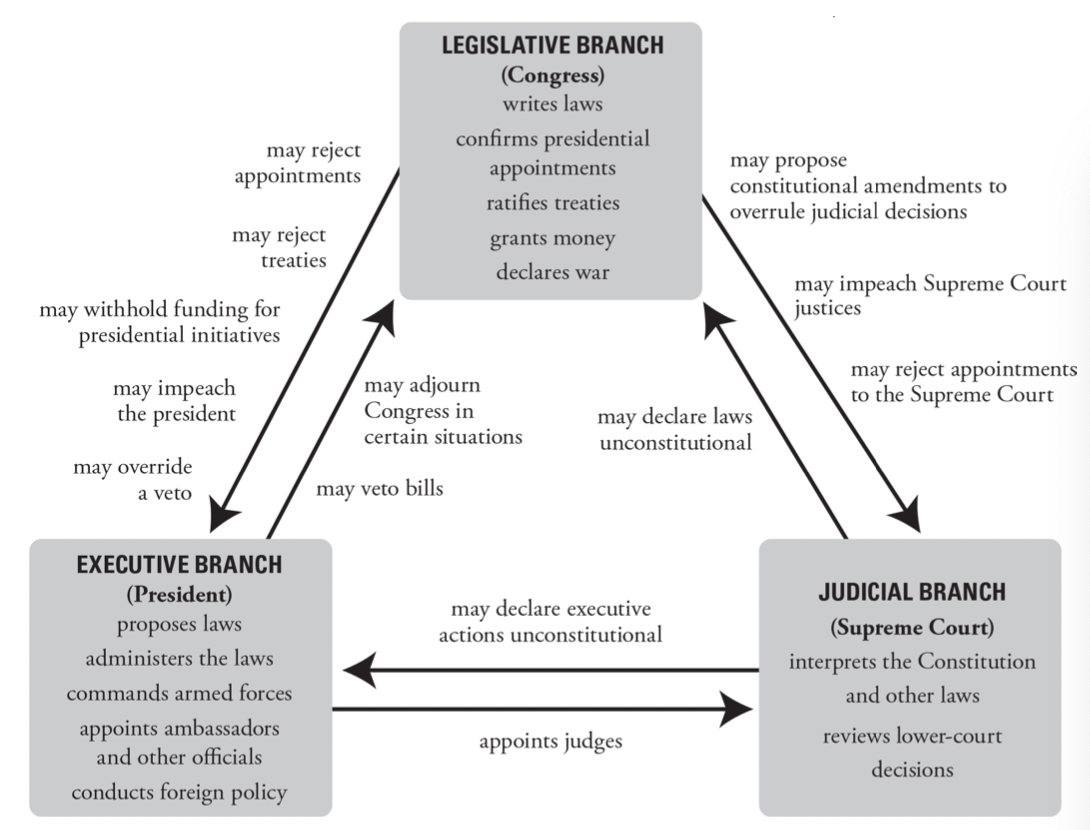
Separation of Powers: Divides government into legislative, executive, and judicial branches.
Checks and Balances: Each branch has the power to limit the others.
Judicial Review: Courts can declare government actions unconstitutional.
Federalism: Divides power between national and state governments
order
limited government
republicanism
theory of government that emphasizes the participation of citizens for the common good of the community.
checks and balances
federalism
seperation of power
popular sovereignty
Articles meaning
Preamble: States the purpose of the constitution
Articles 1-3 describes the three branches of government- congress, presidency, and federal court system (L,E,J)
Article 4 addresses the relationship between states and the federal government
Article 5 describes how to amend the constitution
Article 6 declares the constitution the SUPREME LAW, national debts, oath of office
Article 7 provided for ratification
Federalism: The Division of Powers
Delegated Powers: Powers granted to the national government.
Expressed Powers: Explicitly written in the Constitution (e.g., collect taxes, regulate commerce).
Implied Powers: Powers not written but implied (e.g., regulate labor relations).
Inherent Powers: Powers naturally belonging to any sovereign state (e.g., control immigration).
Reserved Powers: Powers reserved to the states (e.g., licensing professionals).
Exclusive Powers: Powers only the federal government can exercise (e.g., coining money, making treaties).
Concurrent Powers: Shared powers between the national and state governments (e.g., taxing, law enforcement).
Supremacy Clause: Declares that the Constitution and federal laws are the "supreme law of the land," taking precedence over state laws.
Key Supreme Court Cases:
McCulloch v. Maryland (1819): Established federal authority over states by declaring that states cannot tax federal institutions.
Fletcher v. Peck (1810): The first case where the Supreme Court declared a state law unconstitutional. the supreme court struck down a STATE law unconstitutional.
Marbury v. Madison (1803): the U.S. Supreme Court first declared an act of Congress unconstitutional, thus establishing the doctrine of judicial review