T17: Gases
What do we already know about gasses ?
gasses are the least dense out of solids/gasses/liquid
gasses are in constant translational motion
gasses can also experience vibrational and rotational motion
gasses have very weak INTERmolecular forces
gasses having weak intermolecular forces is the reason we have to cool gasses in order to store them as liquids. we have to lower their kinetic energy so that the intermolecular forces become stronger in comparison
The Ideal Gas is the model we use to study all gases. Any gas can behave “ideally” at certain temperature and pressure. these are the four laws that explain the behaviours of an ideal gas
gas molecules have no volume of their own
we assume this because the size of the gas molecules is so much smaller than the size of the container in which they are
gas molecules move in a straight line, and when they collide with each other, they do not lose ANY energy
gas molecules experience NO intermolecular forces, neither attracting nor repelling each other, so an idea gas CANNOT condense into a liquid
the average kinetic energy (KE = ½mv2) of an ideal gas is directly proportional to its temperature in Kelvin
increase in temperature → increase in speed → increase in KE
NOTE: gas particles behave ideally at higher temperatures and lower pressures. if we compress them or cool them, they become less and less ideal, and can eventually condense
All of the gaseous elements behave ideally at room temperature and pressure.
There are four variables that indicate the state of a gas:
pressure (P)
pressure is the force of a particle in a certain area
the pressure of a gas is due to its particles’ collisions with the wall, NOT its particles’ collisions with each other. consider…
how many collusions there are (frequency)
how hard the collisions are (magnitude of the force)
two different particles travelling at the same speed, the HEAVIER particle exerts more force
when we are considering heaviness of a particle, we need to look at molar mass
two similar particles travelling at different speed, the FASTER particle exerts more force
we assume the pressure of the gas particles is uniform throughout even if we are only finding the force on a specific area
considerations:
the force of a single particle on the wall (f = ma)
hardness: the average force of the hits for ALL the particles that hit the wall
pressure of the system depends on the average hardness of all hits and the frequency at which they occur in an interval
pressure = (force of collisions) x (number of collisions)
pressure = force/area
in units of atm
1 atm = 760 mmHg = 760 Torr (MEMORISE)
1 atm = 101 Kilo Pascal
1 Pa = N/m2
volume (V)
1 cm3 = 1 mL
number of moles (n → indicates the amount of moles)
remember that one mole = 6.022 × 10²³ particles
moles = mass/molar mass
temperature (T)
in units of Kelvin
K = *C + 273
More on pressure:
we know pressure is based on the HARDNESS and the FREQUENCY of collisions. we need to be able to predict changes in pressure as a result of isolating and changing the…
number of particles in the system
volume of the system
temperature of the system
Change of volume:
DECREASE volume → INCREASE pressure
INCREASE volume → DECREASE pressure
Pressure is INVERSELY PROPORTIONAL to volume
Change of temperature
INCREASE temperature → INCREASE pressure
DECREASE temperature → DECREASE pressure
Pressure is DIRECTLY PROPORTIONAL to temperature. NOTE: temperature MUST be expressed in K
Change in number of moles/particles
INCREASE in number of moles → INCREASE pressure
DECREASE number of moles → DECREASE pressure
Pressure is DIRECTLY PROPORTIONAL to the number of moles
Pressure, volume, Temperature, and number of moles can be related by the ideal gas law:
PV = nRT
which can also be arranged to isolate…
P = nRT/V; V = nRT/P; n = PV/RT; R = PV/nT; T = PV/nR
Note the units:
pressure (atm)
volume (L)
n (numer of moles)
temperature (K, which is *C +273)
R: Gas constant = 0.082 L-atm/mol-K
We can also use PVnRT to isolate different compound variables such as…
molar volume = RT/P
molar mass: mRT/PV
mass: P*Molar mass*V/RT
density = (P/RT) x Molar mass
Density depends largely on molar mass if Pressure and temperature are constant
1 mole of ANY ideal gas at STP will have a fixed volume of 22.4 L
STP = 1 atm and 273 K
two different kinds of gas law problems
single state gas law problem, where we’re given the variables and have to determine a single certain variable, or a compound variable
double state problems, where we consider a state of changing conditions
in these problems, we divide PVnRT by itself and cancel out/remove all the variables that do not change
We set up double state problems like this:
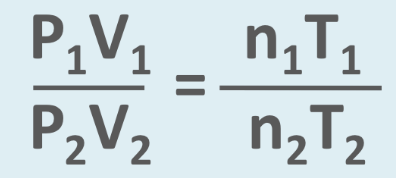
NOTE: this ratio works with ANY unit of pressure or volume, but temperature still MUST ALWAYS be in K
now let’s link kinetic energy to temperature. remember, KE = ½ mv2
In a gas, each particle has a speed and a kinetic energy. But we have to represent the KE of a whole system. In order to determine KE for the whole system we have to find the average KE:
KEaverage = add all individual KE/total number of particles
this can be simplified to
KEAVE = ½ m (v12 + v22 + v32 + v42 + …) / Ntotal
To simplify further, we use a value called Vrms. Vrms is the average speed of all the gas molecules in the container, which means it represents this part: (v12 + v22 + v32 + v42 + …) / Ntotal. We can ultimately simplify the equation for average of KE as follows.
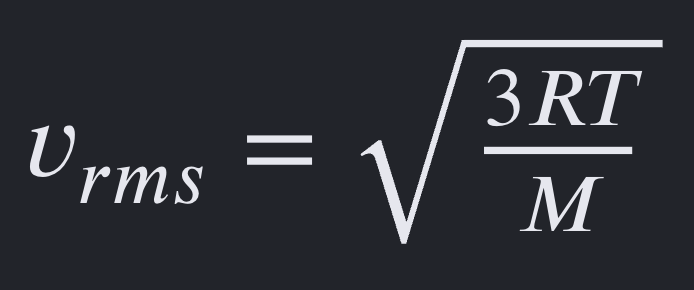
The average kinetic energy for a single particle is:
KEave (single particle) = ½ m (vrms2)
The average kinetic energy for one mole of gas particles is:
KEave (1 mole) = ½ x 6.022E23 x mvrms2
The average kinetic energy of a gas is:
KEave = ½ x Mw x Vrms2
Note: Mw = molar mass
The average molar KE of a gaseous system is related to both the average speed of the gas AND the internal temperature of the gas:
KEmolar = 3/2 RT
KEmolar is directly proportional to temperature, which means the if multiple gasses are at the same temperature, they will have the same KEmolar. Note that if the pressure is increased/decreased, the KEave molar will stay the same AS LONG as the temperature stays the same.
We can use KE to give us information about velocity by combining the KEave and KEmolar equations. The average speed of a gas depends on both the temperature (K) and the molar mass. It is expressed in the equation below:

in this equation, R has different units than the R from before, although it represents the exact same value.
R = 8.314 J/mol-K
In order to compare velocities of the system under two different conditions, we have to set up this equation as a double state problem, see below:
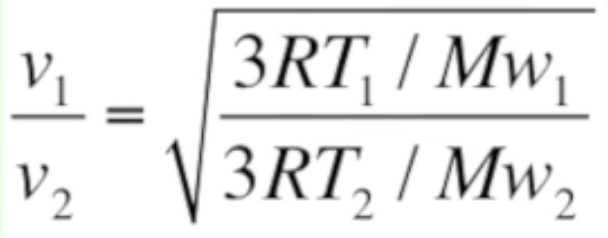
Trends:
If the temperature is constant between the changes, 3, R, and T cancel out. This leaves us with velocity and molar mass only. This shows that, when temperature is constant, velocity depends solely on the molar mass of the gas, allowing us to draw the conclusion that: at the same temperature, heavier particles move more slowly than lighter particles.
If the mass of the particles is constant between the changes, then 3, r, and m cancel out. This leaves us with velocity and temperature, which allows us to draw the conclusion that: if the masses are constant, the particles that are moving at greater speeds are at higher temperatures
Diffusion: movement of gasses from high concentration → low concentration
Effusion: diffusion through a hole (eg. gas leaking out of a balloon)
Diffusion and effusion typically occur at a fixed temperature, and so the ratio of speed is equal to the inverse square of the molar mass, which re-illustrates the idea that: smaller particles diffuse and effuse quicker than heavier particles. The rate of diffusion is described as such:
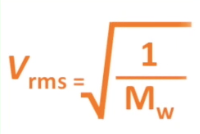
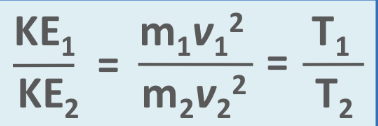
Equation that relates KE, m, v, and T in double state form: