1.7 - raspberry plc. case study
Raspberry ltd is a long-established company that prepares, packs and sells fresh fruit and fruit related products. Recently the company decided to introduce a range of healthy smoothies and set up a new division – the Healthy Drink Division. Raspberry ltd has a well-established incremental budgeting process for all divisions. Annual divisional budgets are set centrally by the company’s head office.
The Healthy Drink division was set up two years ago. It produces high quality smoothies and juice cleanse products using high quality, organic fruit. Most of the fruits are home grown but some exotic fruits are imported. The cost of ingredients imported represents 30% of the division’s cost of sales. The division sells the products to small cafes, gyms and organic shops. Aiming to offer a customized service, the product range changes frequently according to consumer demands, and the availability and price of ingredients. Due to the nature of the products, the company holds minimal inventory. Recently, the company started selling directly to customers via its website leading to increased sales.
Healthy Drink divisional managers, who are appraised on the financial performance of their own division, have complained about the length of time that the budgeting process takes and that the performance of their division could have been better, but was constrained by the budgets which were set for them. Also, there was a significant increase in the number of late deliveries and customer complains.
As the division’s Finance manager, you have obtained the division’s current incremental budget and the division’s Quarter 1 actual results and a summary of key expectations for the division’s costs and revenues for the rest of the fiscal year.
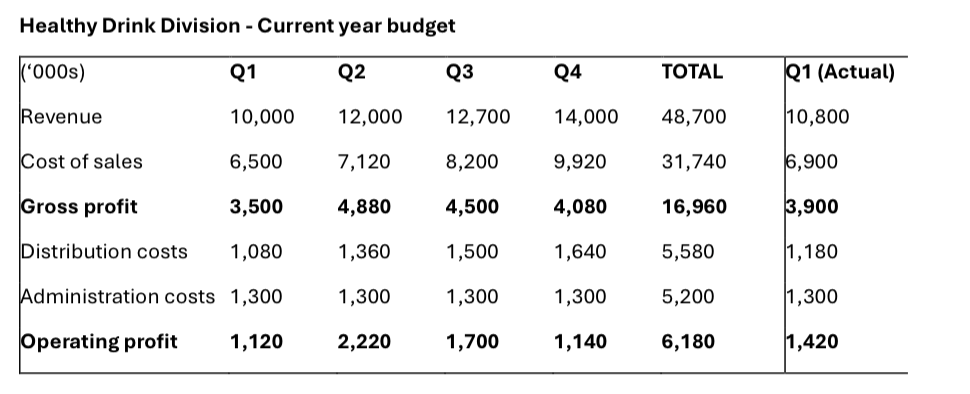
Notes:
Sales volumes are expected to be 4% higher each quarter than forecast in the current budget.
Average selling price per unit is expected to increase by 5% from the beginning of Q3.
The exchange rate used for the imported fruit is predicted to change at the beginning of Q2 to £1.00 (home currency) buys $1.50. The current year budget was prepared with a different exchange rate where £1.00 has been equivalent to $1.40.
A programme of overhead cost reductions will start and savings of 2% from the budgeted administration costs are expected from the beginning of Q2. Q3 administration costs are expected to be a further 2% lower than in Q2, with a further 2% saving in Q4 over the Q3 costs.
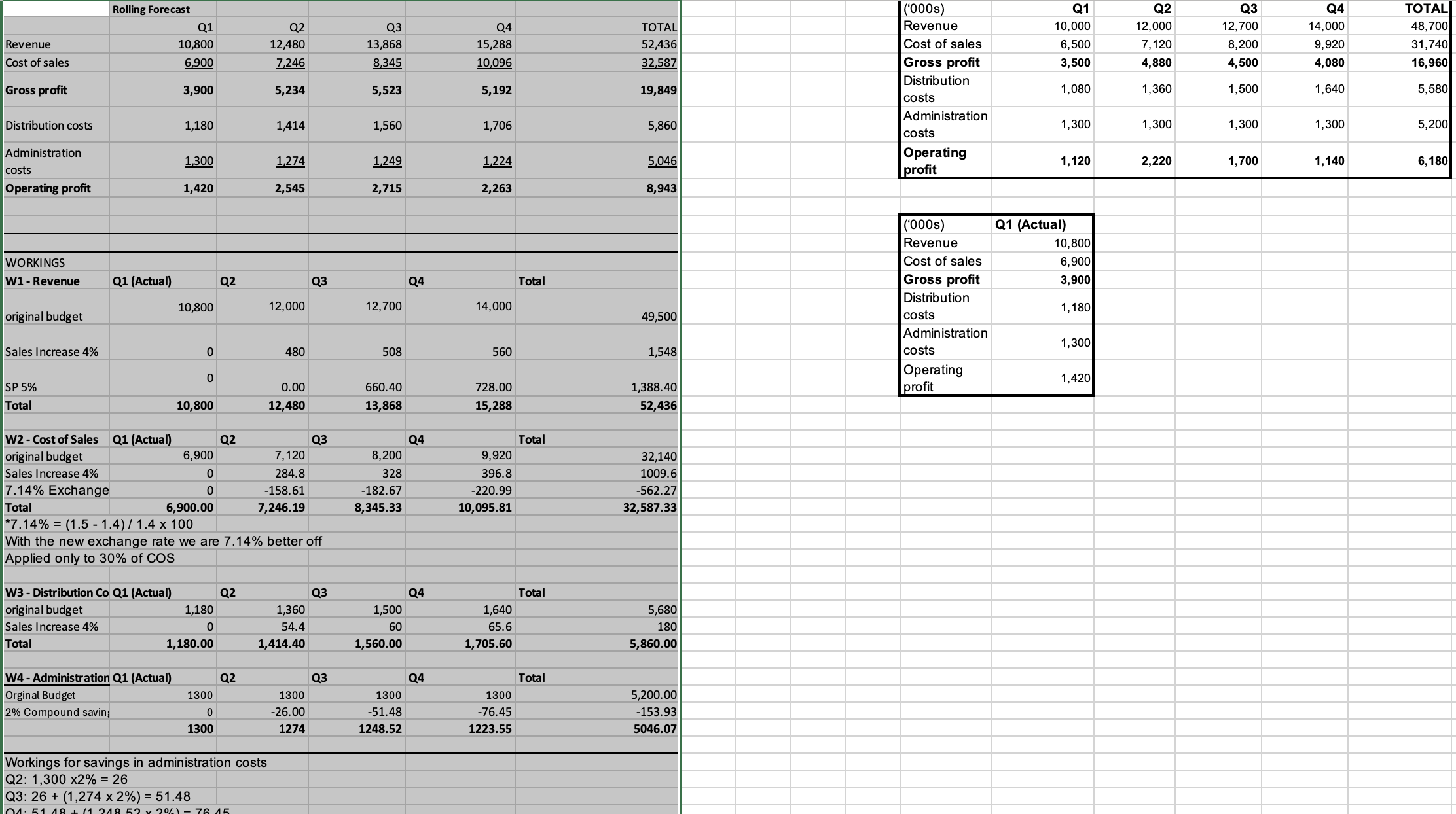
REQUIRED: a. Using the data in the appendices, recalculate for the Healthy drink division the budget to the end of the current year and briefly comment on the overall impact of this on the expected operating profit for the year. Show all your workings
breaking down given information
company overview:
raspberry ltd prepares and sells fresh fruit and related products. it launched a new division, healthy drink division, focusing on smoothies and juice cleanse products
ingredients:
70% locally sourced
30% imported [exposed to exchange rate fluctuations]
challenges:
budgeting process constraints leading to poor divisional performance
operational issues like late deliveries and customer complaints
current year budget [planned vs. Q1 actual]:
e.g. revenue Q1 budget: 10,000 vs. actual 10,800
adjustments needed based on growth assumptions and exchange rate changes
key adjustments required:
sales growth - 4% vol. increase quarterly
price increase - 5% increase from Q3 onward
exchange rate change - affects 30% of costs; new rate [£1 = $1.50 vs. $1.40 initially]
admin costs reduction - 2% quarterly from Q2, compounded
recalculating budget with assumptions
revenue adjustments:
base revenue from Q1 actual: £10,800.
increase:
4% volume growth per quarter.
add 5% price growth from Q3 onward
cost of sales adjustments:
base: £6,500 (Q1 Budgeted).
adjustments:
4% volume growth impacts total costs.
7.14% reduction for imported costs due to exchange rate change (30% of costs affected).
[1.5 - 1.4]/1.4 = 0.0714 × 100 = 7.14%
distribution costs:
increase:
4% per quarter due to volume growth
admin costs:
reductions:
2% savings starting Q2, compounded each quarter
workings
Q2 revenue:
Budget = £12,000 (base).
Increase: 4% of £12,000 = £480.
Revised Q2 Revenue = £12,000 + £480 = £12,480.
Q3 revenue:
Base = £12,700.
Volume Increase = 4% of £12,700 = £508.
Price Increase = 5% of (£12,700 + £508) = £660.4.
Revised Q3 Revenue = £12,700 + £508 + £660.4 = £13,868.4.
Q4 revenue:
Base = £14,000.
Volume Increase = 4% of £14,000 = £560.
Price Increase = 5% of (£14,000 + £560) = £728.
Revised Q4 Revenue = £14,000 + £560 + £728 = £15,288.
cost of sales adjustments:
Volume Impact:
Q2: £7,120 + 4% = £7,246.19.
Q3: £8,200 + 4% = £8,345.33.
Exchange Rate Impact (7.14% reduction on 30% of costs):
Q2 Adjustment: -£158.61.
Q3 Adjustment: -£182.67.
administration costs:
Q2 Reduction = £1,300 - (2% × £1,300) = £1,274.
Q3 Reduction = £1,274 - (2% × £1,274) = £1,248.52.
Q4 Reduction = £1,248.52 - (2% × £1,248.52) = £1,223.55.
final impact
adjusted operating profit for the year shows an increase due to higher revenue and cost savings, despite higher distribution costs
part b - evaluation of traditional/incremental budgeting and rolling forecast
issues with traditional/incremental budgeting:
Role Conflict: Different interests among stakeholders can lead to misalignment.
Budget Bias & Gaming: Managers might manipulate figures to benefit their division.
Tunnel Vision & Sub-Optimization: Focus on individual targets rather than overall objectives.
Myopia: Emphasis on short-term performance over long-term growth.
Encourages Average Performance: Fixed targets can lead to complacency.
Centralized Control/Stifles Creativity: Limits local decision-making and innovation.
Interdependence of Budgets: One department's performance depends on another's.
Controllability Problem: Managers may be held accountable for factors outside their control.
Time-Consuming & Expensive: Preparing detailed annual budgets takes significant resources.
advantages of rolling forecast:
Less Detailed: Focuses on critical variables rather than excessive detail.
No Fixed End Date: Continuous updating ensures relevance.
Resource Drivers Analysis: Helps understand the relationship between inputs and outputs.
Adaptable to Market Changes: Adjusts quickly to dynamic environments.
Less Manipulation: No fixed targets to game.
Avoids "Spend It or Lose It" Mindset: Promotes efficiency and long-term planning.
why rolling forecast suit healthy drink division:
Fast-Paced Environment: Incremental budgets become outdated quickly in this setting.
Growth Opportunities: Rolling forecasts allow budgets to scale with growth.
Customer & Manager Complaints: Constraints of incremental budgeting may be causing inefficiencies.
Lack of Market Knowledge: As a new division, Healthy Drink requires frequent updates to reflect evolving market conditions.
Recommendation: Rolling forecasts should replace incremental budgeting for flexibility and relevance.
part c - recommendation for market division budgeting
challenges with incremental budgeting for marketing division:
Skepticism from Other Divisions: Managers are doubtful about the value of marketing.
No Spending Justification: Incremental budgeting doesn’t require marketing to justify expenses, leading to potential inefficiencies.
Unjustifiable Spending: Risks of unnecessary or excessive expenditures.
recommendation: zero based budgeting:
Definition: Requires justification of all expenses starting from zero for each budgeting period.
Why Suitable for Marketing:
Unique Campaigns: Marketing campaigns are often project-based and require specific planning.
Controlled Costs: ZBB ensures only necessary expenditures are approved.
Accountability: Forces the department to align spending with measurable objectives.
Key Benefits:
Encourages efficient allocation of resources.
Builds trust and transparency with other divisions by justifying all costs.
summary:
Healthy Drink Division: Transition to rolling forecasts to handle its dynamic growth and market volatility.
Marketing Division: Implement zero-based budgeting to ensure transparency, cost control, and alignment with organizational goals.