Forces
Contact and non-contact forces
A force is a push or pull that acts on an object due to its interaction with another object
Force is a vector quantity, and is measured in newtons
A contact force is when two objects are physically touching
Friction, air resistance, tension and normal contact force
Normal contact force (reaction force) is the idea that there is an equal and opposite force from an object opposing its weight
A non-contact force doesn’t require objects to be touching, and has fields of influence
Gravitational, magnetic and electrostatic
The strength of the force depends on the distance from the object
Scalar and vector quantities
Scalars are physical quantities that only have a magnitude (size)
Speed, distance, mass, temperature, time, etc.
Vectors have both magnitude and direction
Velocity, displacement, acceleration, force, momentum, etc.
Arrows represent the direction of the force, and the size of the arrow represents the magnitude
Can be negative (-4km east = 4km west)
Free body diagrams and resultant force
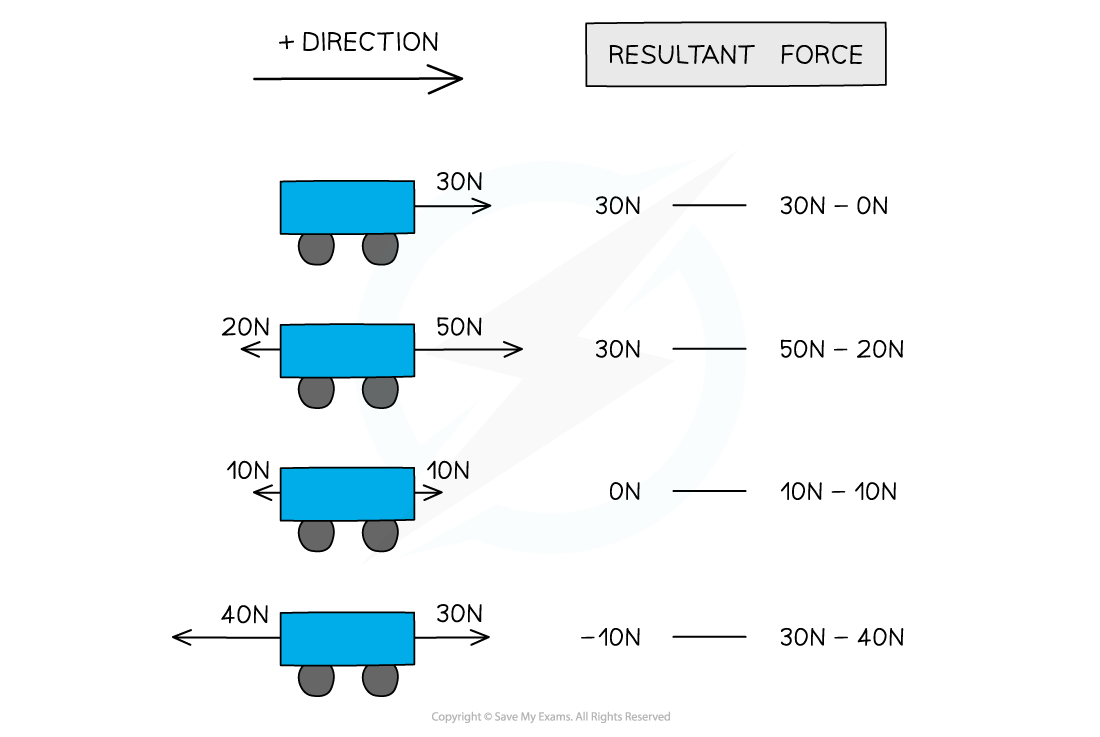
Resultant force is the overall force and it direction that is acting on an object
Equilibrium is when there is no overall resultant force on an object (either stationary or travelling at a constant speed)
Elasticity, spring constant and Hooke’s law
When a force is applied to an object, it compresses, stretches or bends
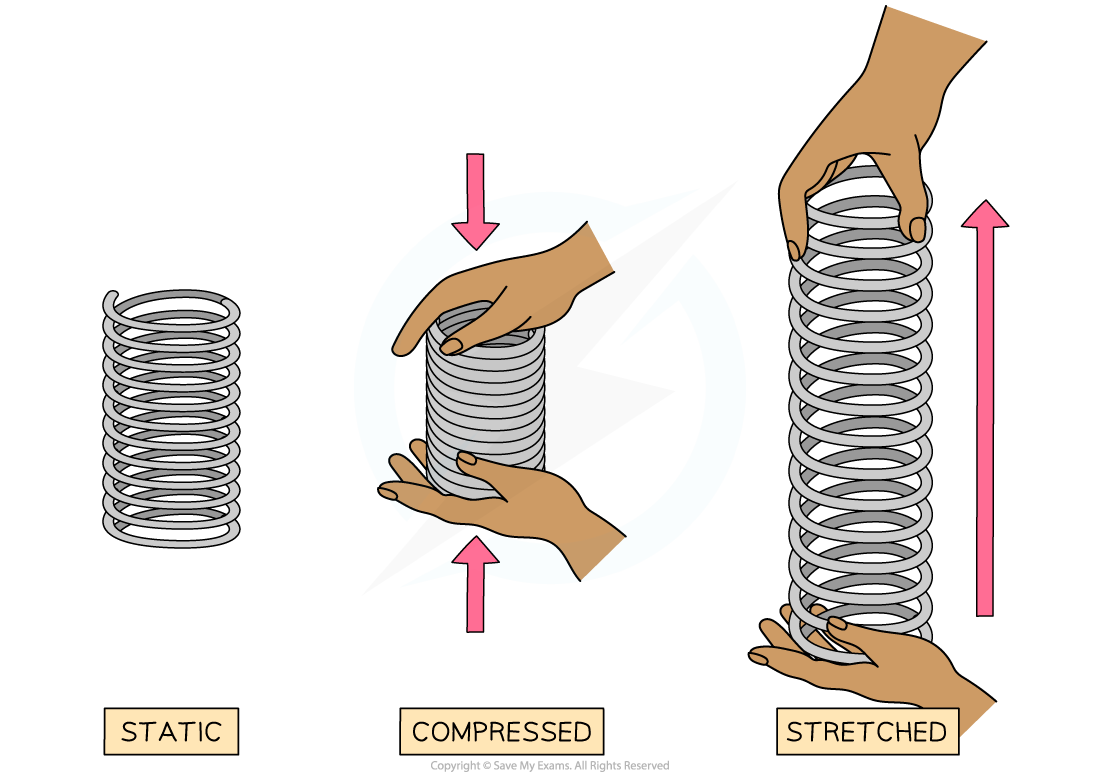
More than one force has to be applied for an object to stay stationary
Elastic deformation is the idea that after a force has been applied to an object, it returns to its original shape
Inelastic deformation (plastic deformation) is the idea that after a force has been applied to an object, the object doesn’t return to its original shape
Extension is the increase in length of a spring when stretched
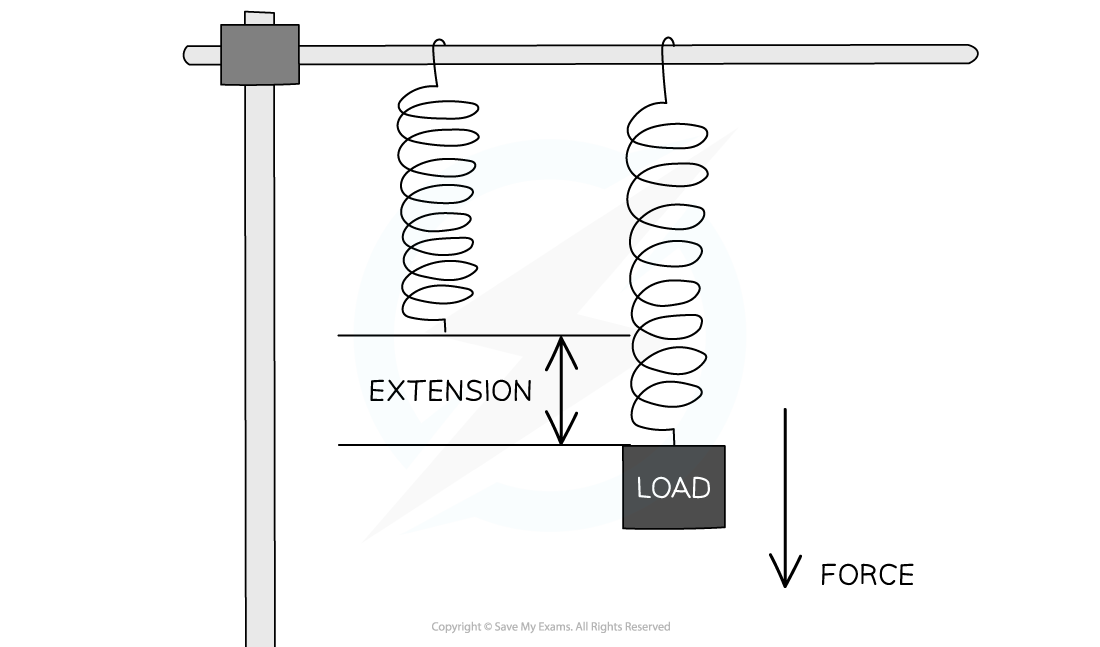
The spring at its natural length has no force acting on it, but when a weight is added it extends
There is still a normal force acting opposite from the support
As we increase the force, the extension increases proportionally as long as the limit of proportionality isn’t reached - Hooke’s law
F∝e or F=ke
Force is directly proportionate to extension, and is dependent on the spring constant of the object
Spring constant is how many newtons it would take to stretch an object by 1m
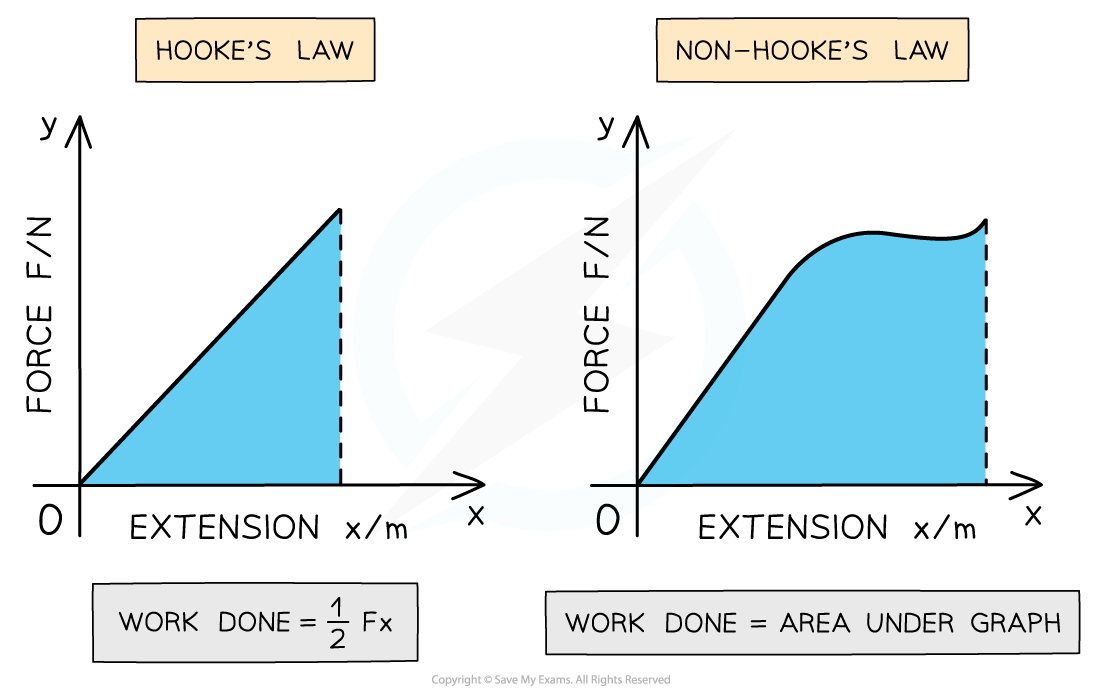
Once the limit of proportionality/elastic limit is reached, Hooke’s law no longer applies, an inelastic deformation has occurred
Elastic potential energy
F=ke
K is spring constant, and a lower spring constant means higher elasticity
Ee=½ke2
Elastic potential energy is the energy transferred to an object that is stretched
Area under a force/extension graph is equal to the energy transferred, and the gradient of the straight line, where Hooke’s law applies, is equal to the spring constant
Moments
A moment is the rotational or turning effect of a force
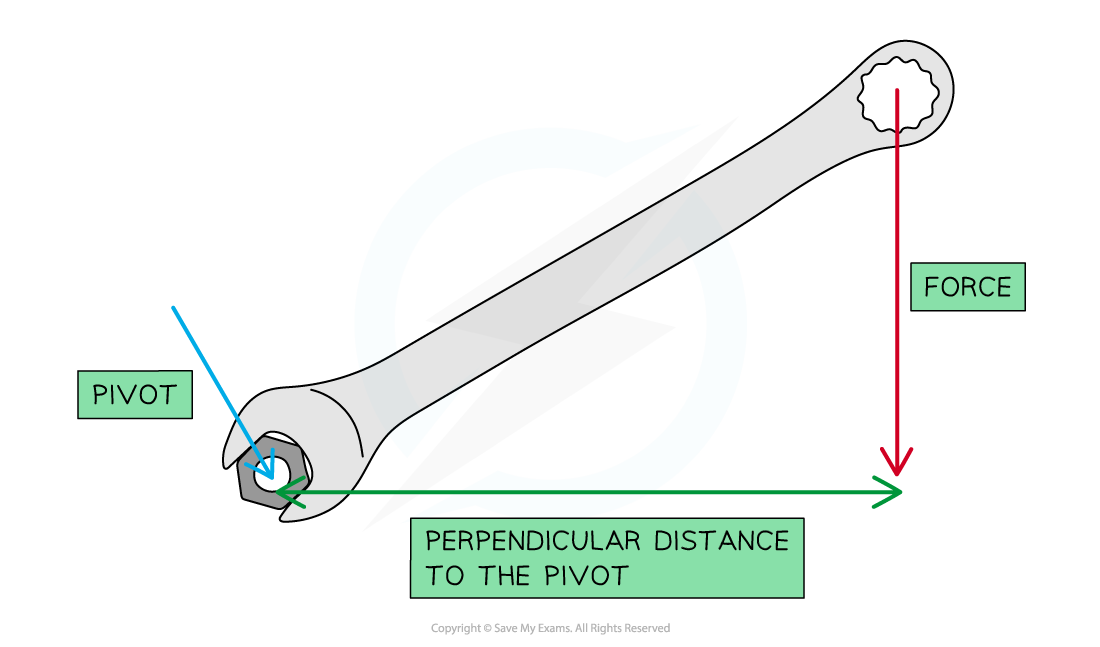
M=Fd
Moment (Nm) = Force (N) x distance (m)
A larger distance and greater force creates a greater moment
When there is more than one moment, there is both an anticlockwise moment and a clockwise moment
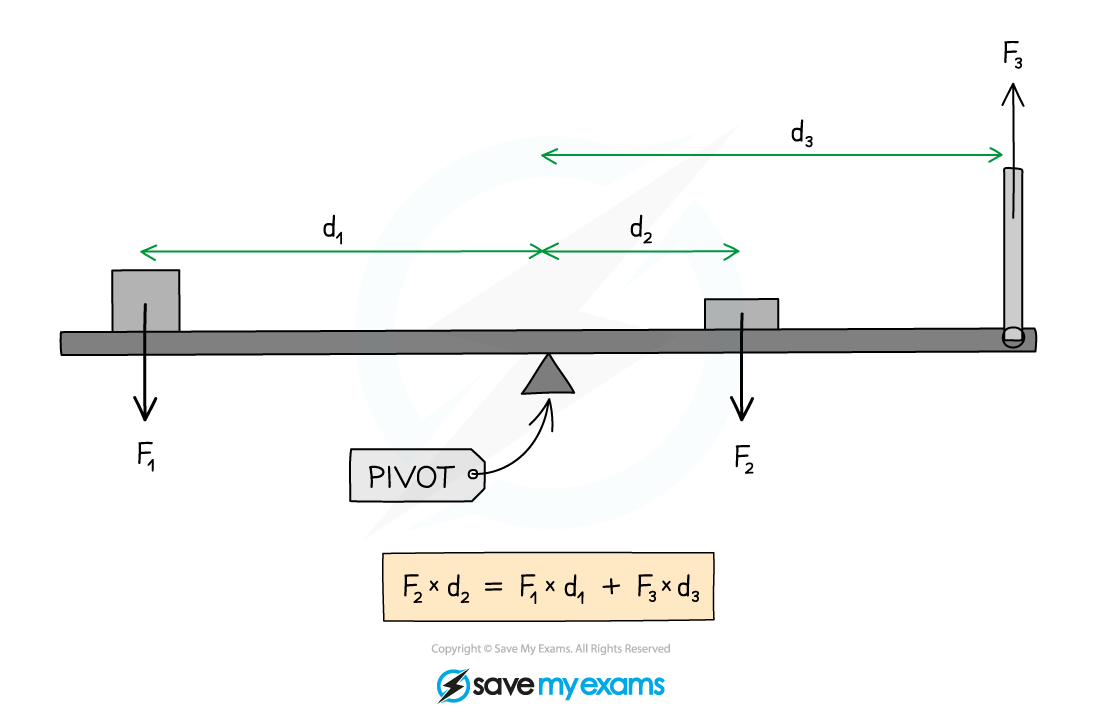
There’s an anticlockwise moment on the left and a clockwise moment around the right
If the clockwise moment equals the anticlockwise moment, there is no overall moment
Different distance can balance different weights (force)
Levers transmit the turning effect of a force
The input force transmits to the output force
If the forces are on opposites sides of a pivot, they will act in different directions
If the forces are both on the same side of the pivot, they will act in the same direction
The output force is generally closer to the pivot, so it is able to create a larger output force with a small input force
Gears transmit turning effects
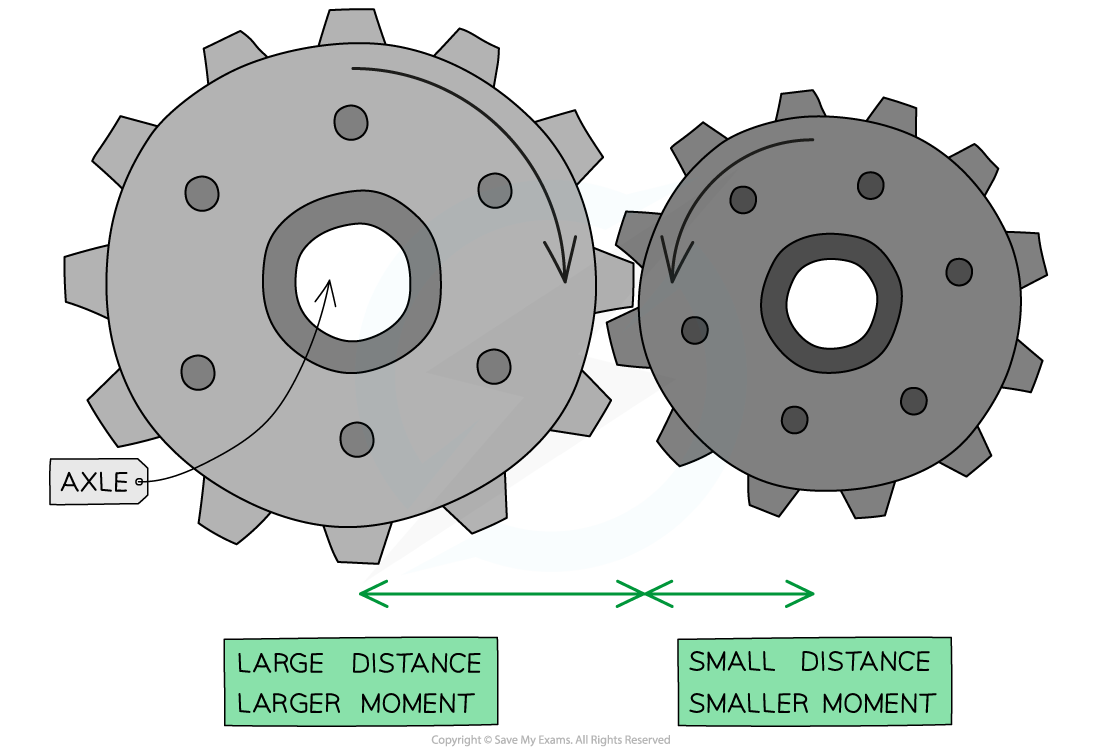
A is connected to an engine and turns clockwise, which causes B to rotate anticlockwise
Gears turn in opposite directions
Different sizes of gears change the size of the turning effect/moment
A has a larger radius, so a larger turning force
B turns faster than A as it has a small radius
The overall work done on each side is equal as B turns faster than A, which is balanced by A having a greater turning effect/moment
The ratio of the turning effect of the two gears is proportional to the ratio of the radius of the two gears
Pressure
Pressure is the force per unit of area
P=F/a
Pressure (Pa) = Force (N) / area (m)
Pressure in a fluid is creates by collisions between particles and surroundings
In gases, particles collide with a wall and other particles, which creates pressure (a force applied to an area)
In liquids, particles collide with walls and the air at the surface
Pressure in a solid is created by collisions between two solid objects
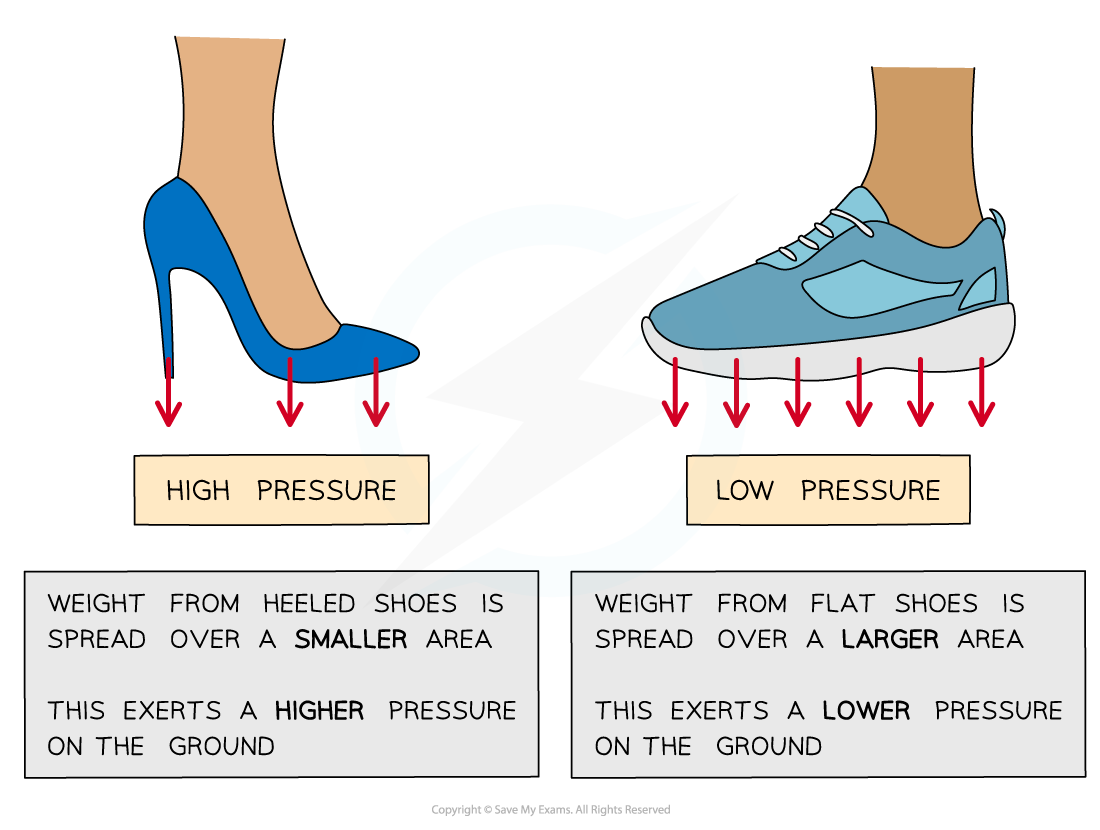
We aways use the perpendicular force
The component that is at right angles to the surface its colliding with
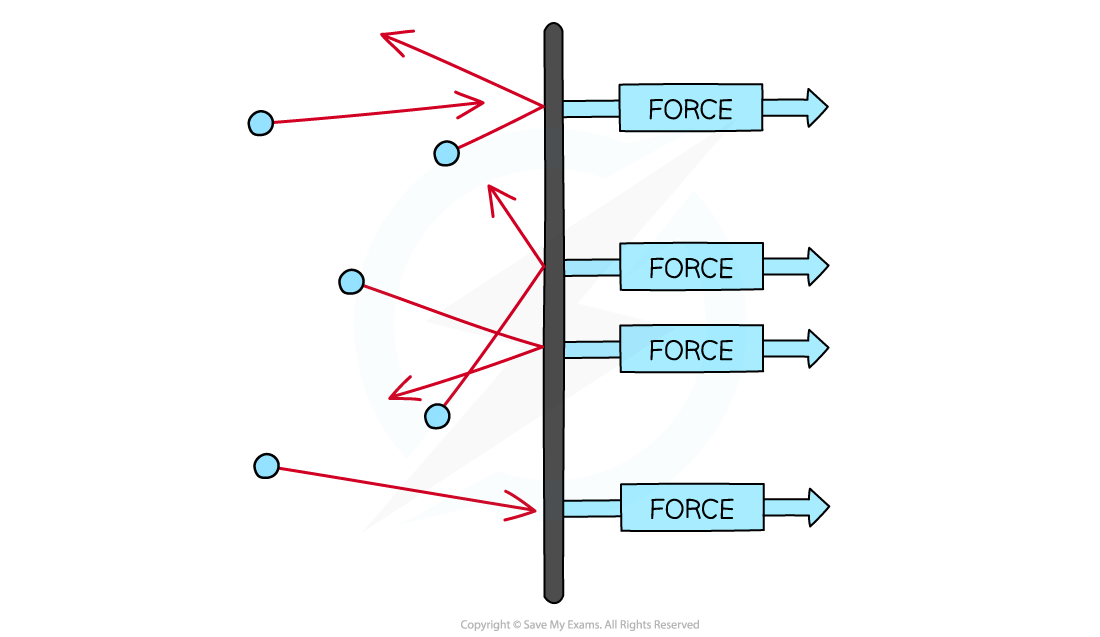
If it is at a right angle, the entire force will generate pressure on the wall
If it is at an angle, only a small part of the force will generate pressure as the force is split into two parts, and only one collides with the wall
Liquid pressure and upthrust
Pressure in liquids
The deeper an object, the greater the weight of the water, so there is higher pressure
The density of the liquid depends on the number of particles - denser = more pressure, as more particles colliding with the object
Gravitational field strength also impacts the pressure of liquids - a larger gravitational field strength, a larger weight (gfs x mass), so higher pressure
P=h g
Pressure (Pa) = depth (m) x density (kg/m3) x gravitational field strength (N/kg)
Whether an object sinks or floats, depends on the pressure
The bottom of an object is deeper than the top, so there is a larger upwards force that downward force
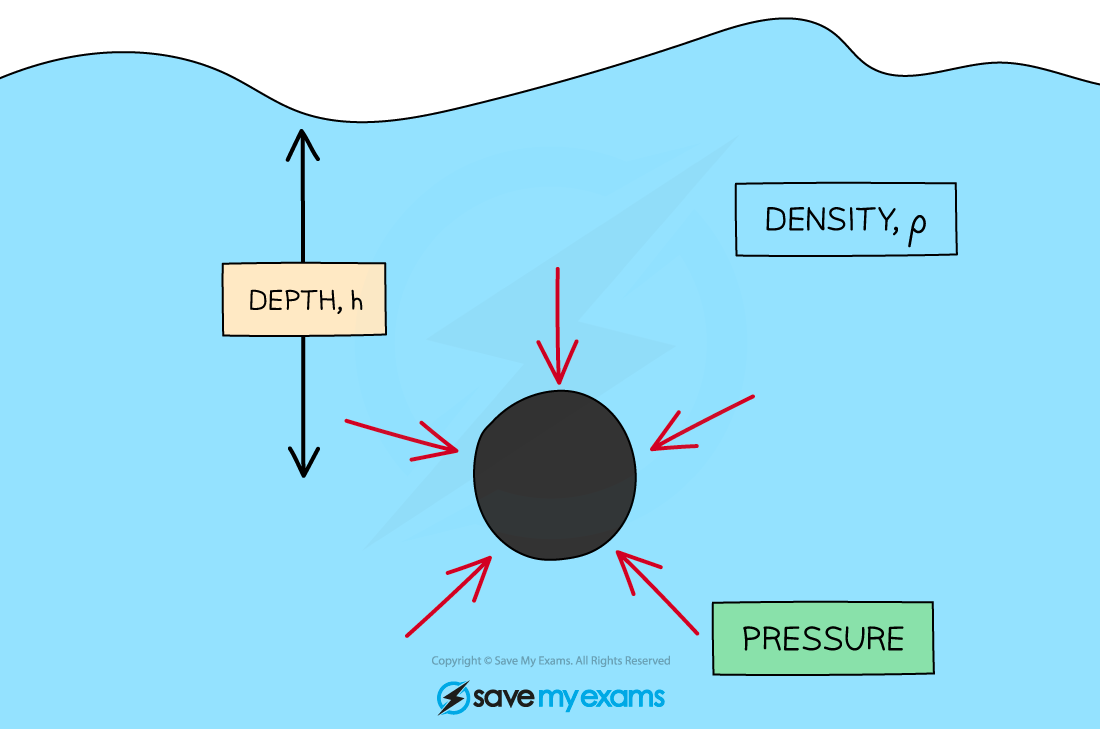
This creates a resultant force upwards (upthrust)
All submerged items have upthrust, so whether they float or sink depends on their weight (downward force)
If the upthrust is greater than the weight, it floats
If the weight is greater than the upthrust, it sinks
If an object is more dense than the liquid, it sinks
Atmospheric pressure
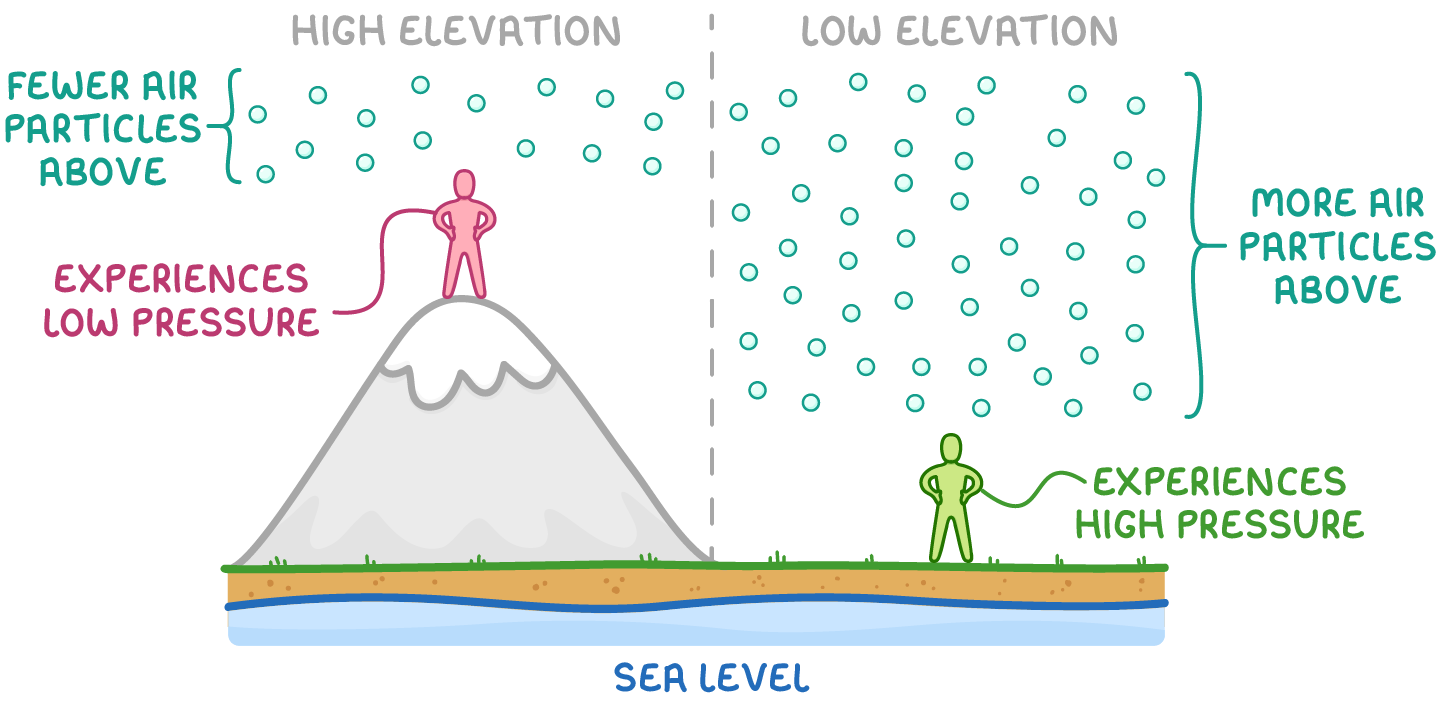
The closer to the surface, the higher the pressure as there are more particles creating weight, as well as more collisions with the surface creating pressure
At sea level, there are all the particles above it, which creates weight and therefore pressure
Speed, velocity, distance and displacement
Speed is a scalar quantity
For example, 4 m/s
Velocity is a vector quantity
For example, 6 m/s east
Distance is a scalar quantity
For example, 10m
Displacement is a vector quantity
For example, 40m east

Speed = distance/time, so no direction
Velocity = displacement/time, so has direction
Real life speeds
1.5m/s - walking
3m/s - running
6m/s - cycling
25m/s - cars
55m/s - trains
250m/s - planes
330m/s - sound waves in air
0 → 55m/s - wind (affected by temp, pressure and structures)
Acceleration
Acceleration is the rate of change of velocity
a = △v/t
Acceleration(m/s2) = change in velocity(m/s) / time(s)
It shows average velocity over time
A vector quantity, so can be negative
2as = v2 - u2
2 X acceleration x distance = final velocity squared - initial velocity squared
Initial velocity is 0 if from stationary
Distance/time graphs
Distance/time graphs are used to represent the distance travelled over time
Gradient = speed (d/t)
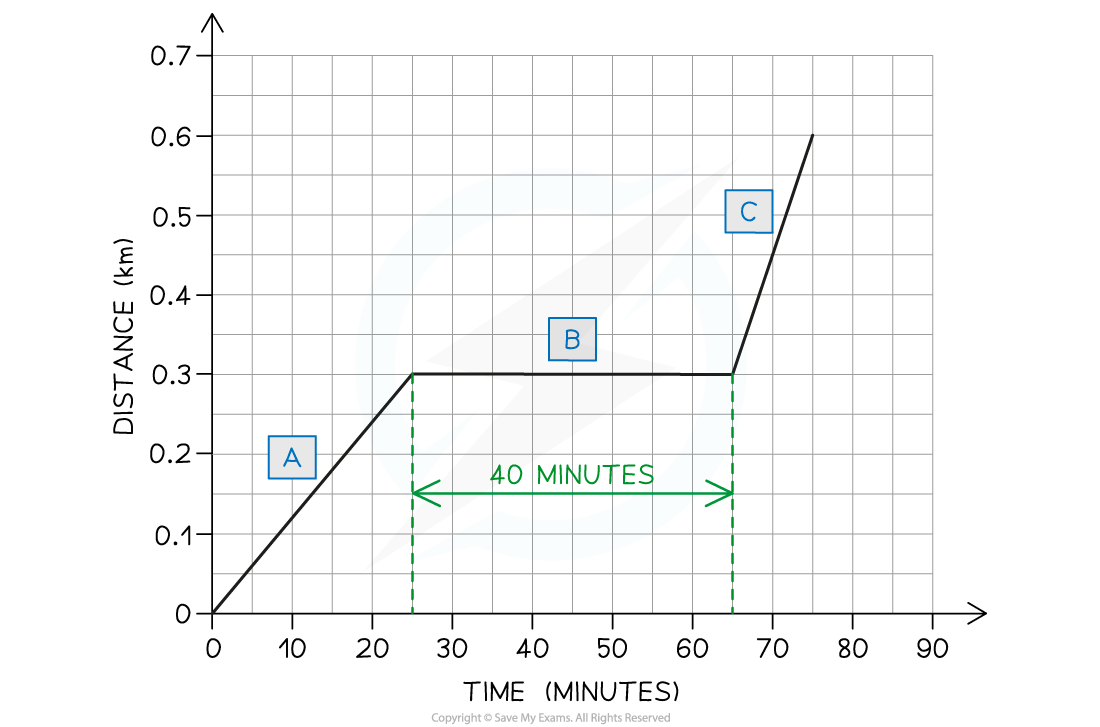
A shows a constant speed
B shows where the object is stationary
C shows an increase in speed, so the object has accelerated
To find a speed at a specific point, use a tangent of a line
Velocity/time graphs
Velocity/time graphs show speed at any time
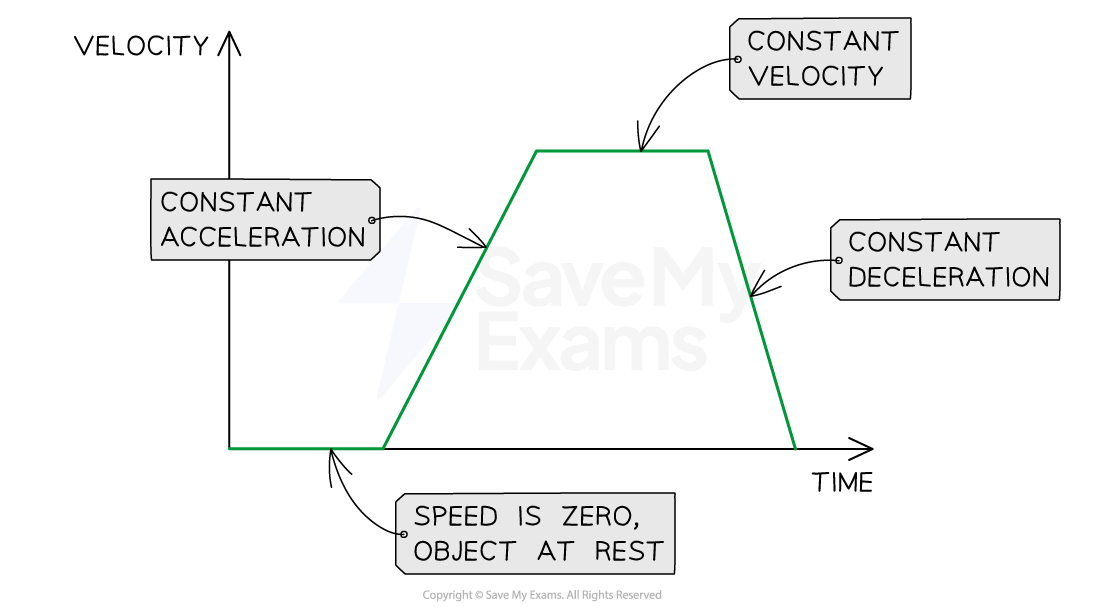
The area under the graph equals the total distance travelled over time (m/s x s = m)
For curved sections, estimate the number of squares covered
The gradient equals acceleration
Terminal velocity
Terminal velocity is the point where a falling objects reaches a constant speed, with no acceleration
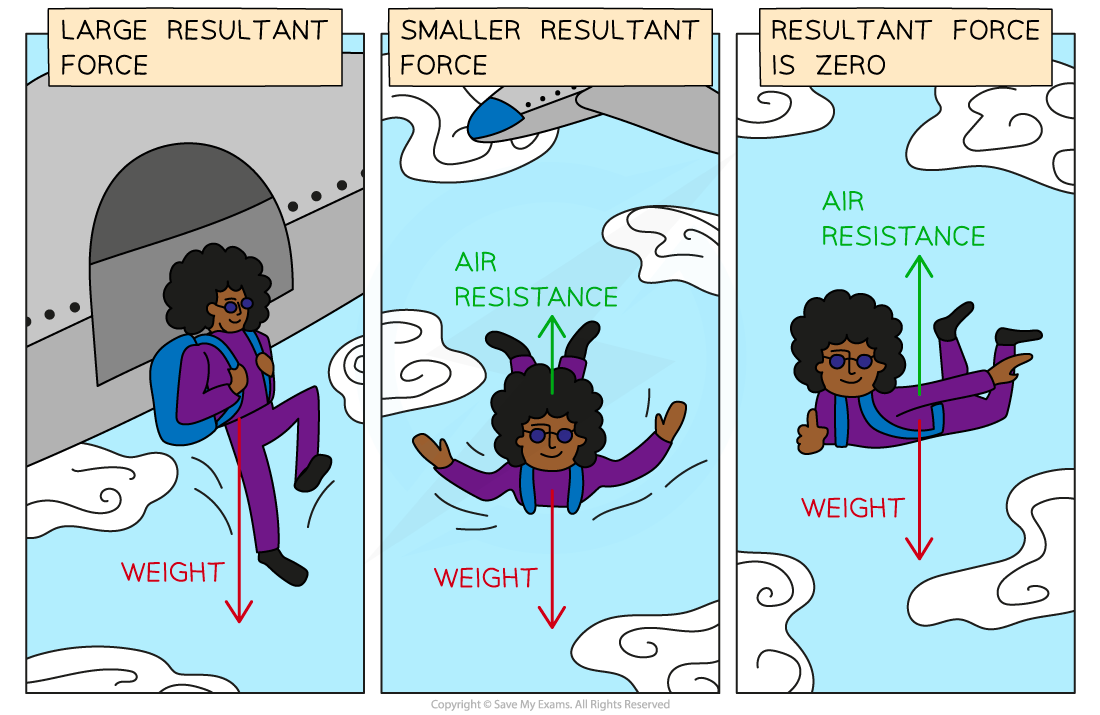
At first, there is a split second when an object is stationary before it begins to fall
The object has mass, and is in a gravitational field so experiences a downwards force of weight
This is the only force that acts, so the resultant force is down and the object begins to fall, accelerating downwards
The object continues to accelerate, but as it continues to fall it begins to experience air resistance
This is an opposite force to weight, so lowers the resultant force downward
The object still falls, but it’s acceleration decreases
Air resistance is due to the air particles colliding with the person , so slows them down
The size of air resistance depends on the surface area and their velocity (faster = more collisions)
As they continue to fall, the air resistance increases due to the higher velocity
The resultant force downwards is much smaller
Eventually, the air resistance will balance out the weight and the resultant force will be 0
Here the velocity no longer changes - terminal velocity has been reached
If they open their parachute, the surface area increases so air resistance is higher
They will decelerate until resultant force becomes 0 again
A new terminal velocity has been reached, that was lower than before
Newton’s first and second law
Newton’s first law says that a resultant force is required to change the motion of an object
It will continue at a constant speed or remain stationary unless there is another force
Newton’s second law says that if an object has a resultant force acting on it, the object will accelerate until the forces acting change
If it was stationary, it starts to move
If it was moving, and the force acts in that same direction, it will speed up
If it was moving, and the force acts in the opposite direction, it would slow down or stop before changing direction
It could result in a change in direction without a change in speed
Change in velocity / change in time = acceleration, so only direction has to change
Like with orbits (la moon…)
Called circular motion
Direction is always changing as the gravitational pull acts perpendicular to the moon’s motion and speed is constant - acceleration
Newton’s second law also states that the size of the resultant force is directly proportional to the acceleration it causes
F=ma, so if mass is constant Fa
Inertia is the tendency for the motion of an object to remain unchanged
Basically Newton’s 1st law - stationary or constant unless another force
Inertial mass is how difficult it is to change an object’s velocity
Inertial mass = force / acceleration (F=ma)
A large mass would require a larger force to change it’s velocity (small acceleration)
Newton’s third law
Newton’s third law says when two different objects interact, the forces they exert on each other are equal (magnitude) and opposite (direction)
If there was a box and a person pushing it, either the box could move or the person could (bounce back)
If the box has a lower mass, it would move
If the box was heavier, the person would be pushed back
If the box was medium mass, the person would be pushed back and the box would move forward
F=ma → a=F/m - for an object to accelerate and move, there needs to be a high force or small mass
Stopping distances
Stopping distance is the minimum distance required to stop a vehicle in an emergency
Stopping distance = thinking distance + braking distance
Thinking distance is how far the car travels during the driver’s reaction time
Between seeing the hazard and starting to brake
This depends on speed and reaction times
Faster speed equals longer distance
Reaction times depend on tiredness, drunkenness, drugs and distractions present
Braking distance is the distance taken to stop under a braking force
This depends on speed, mass, condition of brakes and traction
Condition of brakes - if they are worn or faulty, they won’t slow the car and it will travel further
Traction is affected by ice/wet (less friction) and bald tires (can’t grip road), so the car travels further
Thinking distance increases proportionally with speed
Braking distances increases more the faster it is
Speed x2 = time x4
Speed x3 = time x9
Momentum
= m x v
Momentum(kgm/s) = mass(kg) x velocity(m/s)
Momentum is a measure of how difficult it is to stop a moving object
A vector quantity (has direction)
Conversation of momentum says that in a closed system, the total momentum before an event is equal to the total momentum after an event
If a gun was fired from stationary, momentum would have to be 0 after
The gun moves back - recoil
If a force is applied to a moving object, it accelerates, so its momentum is increased
The force applied can be calculated with force = change in momentum/time
A greater time equals a lower force, so less damage
This is why cars’ safety features increase the time taken for impact or decrease speed, therefore decreasing force
Crumple zones, seat belts (slightly stretchy so slower) and air bags (more time, so lower momentum)
DONE!!