24- estuaries
Evolution of Estuaries
Estuaries are ephemeral over geological time . They are:
▪ Influenced by glaciation
▪ Constantly modified by sediment deposition
▪ Relatively young
▪ Most existing estuaries formed during the Holocene caused by the flooding of river-eroded and glacially scoured valleys, begun when the sea level began to rise 10,000–12,000 years ago.
This is what NW Europe was like at the start of the Holocene (approx. 12000 years ago).
The change from this to the current state has involved the creation of a LOT of estuary!
Classification – 4 Topography Types
Most popular classification system uses topography (i.e. a consequence of their formation):
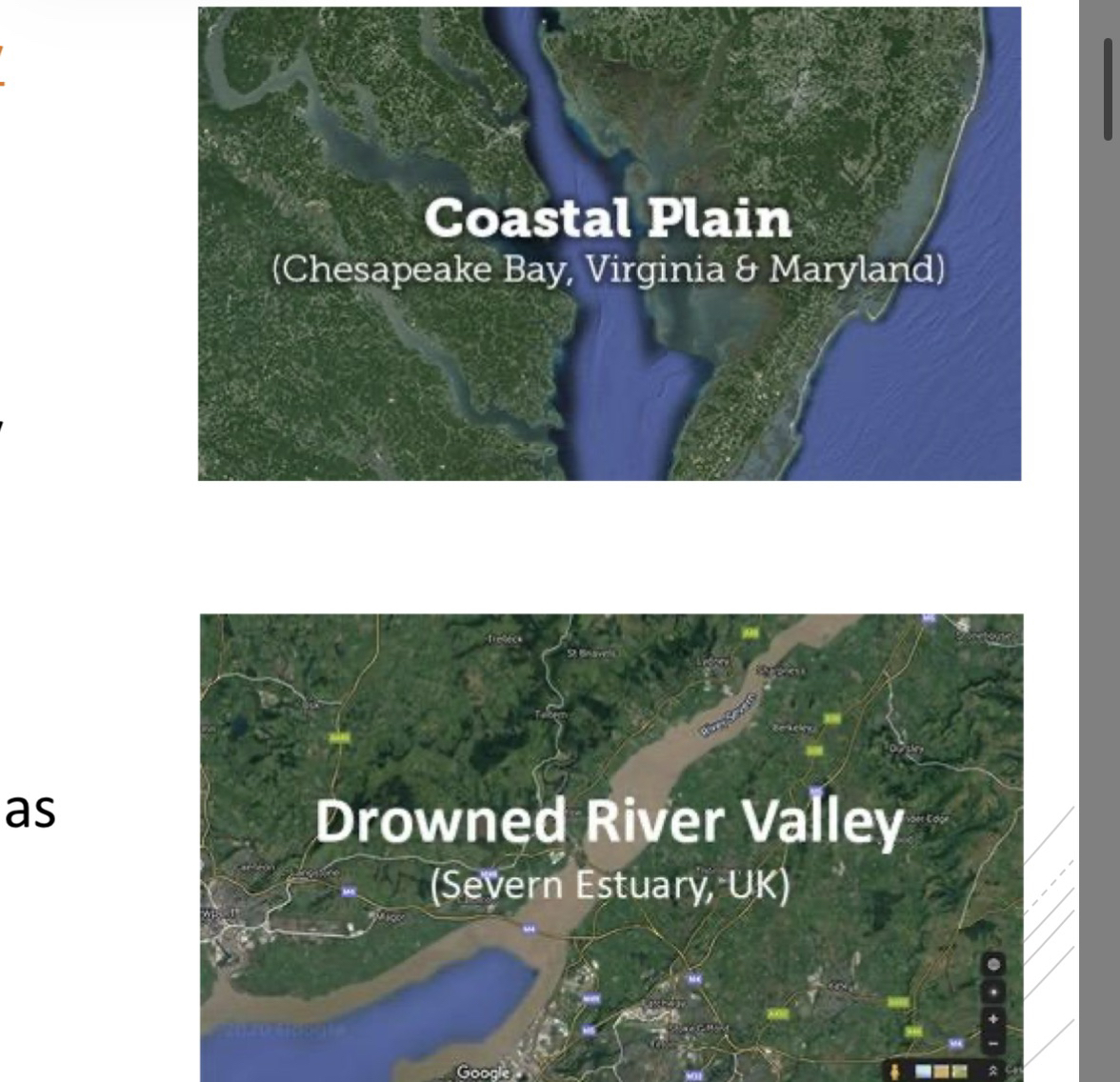
1.Coastal Plain estuaries. Includes fjord estuaries.
2. Drowned river valleys. Topography of the estuary similar to that of a river valley.
3. Tectonic estuaries (land sinking).
4. Bar-built / lagoon type. Deposition of sediment has kept pace with rising sea levels
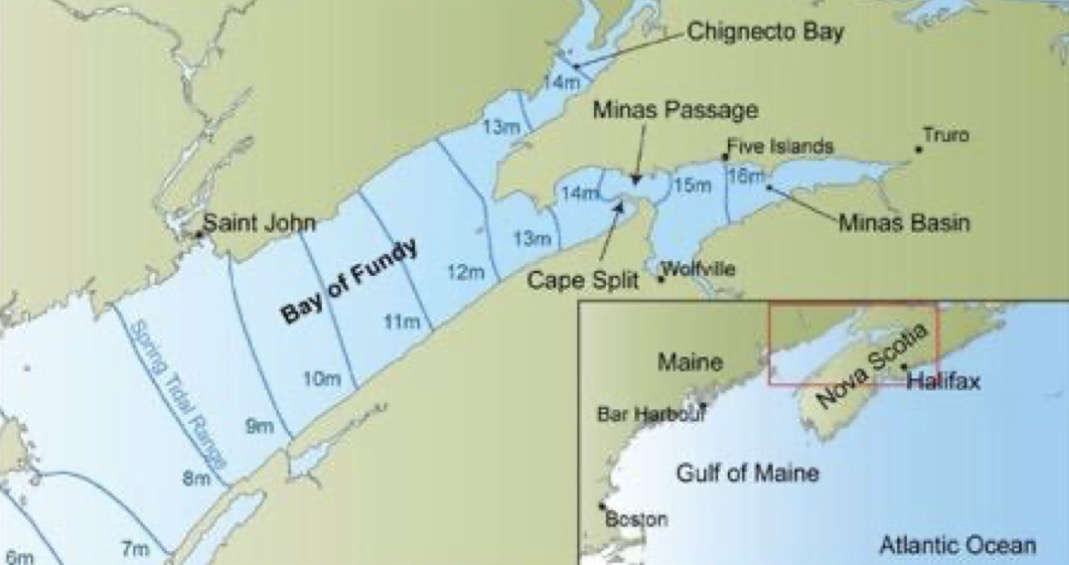
Tidal Range inc. Bay of Fundy
Vary from <1 metre to >10 metres. Global average is 3.3 metres.
Urban encroachment and flood defence can artificially change the tidal range .
Tides influence several physico-chemical parameters: estuaries probably most ecologically ‘stressful’ habitat.
e.g. Bay of Fundy: highest global tidal range: 13 metres. Caused by tidal resonance:
tide excites one of ocean’s resonant modes. 100 km3 flows in/out of bay in 12 1/2 hour tidal cycle: 2x total global river flow in the same time!
Salinity
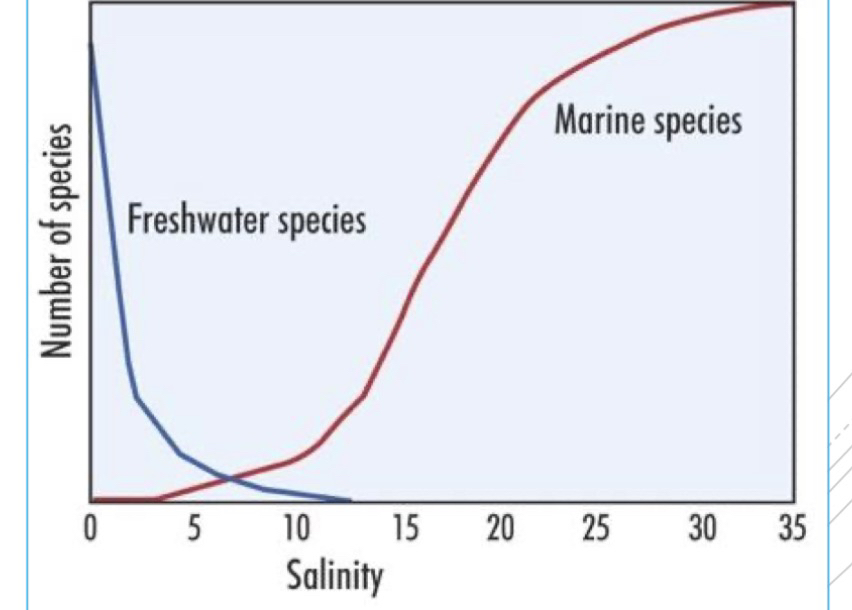
Usually the dominant variable influencing estuarine organisms:
organisms need to be able to cope with various salinity concentrations and fluctuations.
Practical Salinity Units (PSU) = dissolved compounds per kg of water.
-Mean seawater
PSU = 35.5. Dead Sea PSU: 342+!
Estuarine organisms and Salinity:
Marine → Marine, but can tolerate salinity changes well.
True estuarine (7 to 10 salinity)
Freshwater
The Wash, Southeast England
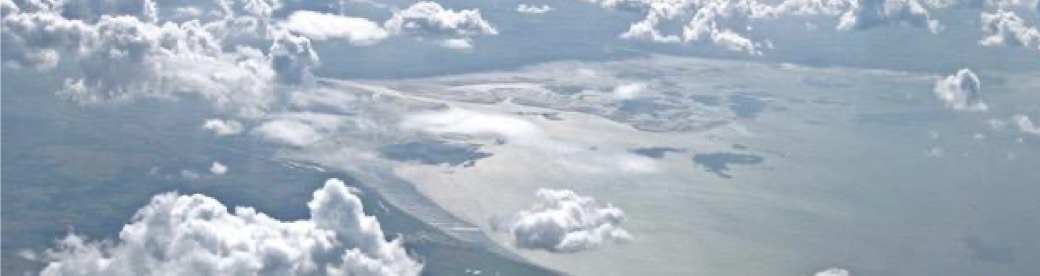
A globally important mudflat estuary: a 620 km2 SSSI between Norfolk and Lincolnshire.
Can be 14 Mars bars of energy (3000 kcal) per m3 of mud: vast energy resource for many species of wading birds.
Estuaries are areas of Sedimentation
In much of an estuary there are no points of attachment for sessile organisms.
- Organisms intolerant of mechanical disturbance couldn’t survive .
- The fine particles can clog delicate feeding and respiratory structures .
- The sediment makes locomotion difficult .
—-—
In some conditions, sediments are more important in determining the composition of the community than salinity.
Continual mixing of seawater and freshwater provides high levels of nutrients in water
column and sediment: estuaries are among most productive global natural habitats.
Human Impacts
22 of 32 largest global cities (early 1990s) were located on estuaries! Few major estuaries are free from human influence.
Issues include:
- toxic pollution
- eutrophication - can cause hypoxia and resulting ‘dead zones’
- overfishing
- temperature (e.g. discharge of warm water from power stations)
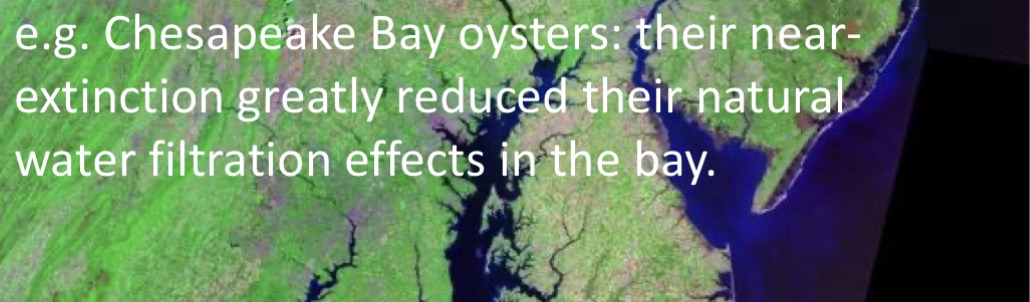
e.g. Chesapeake Bay oysters:
their near- extinction greatly reduced their natural water filtration effects in the bay.
Estuaries are thus most anthropogenically degraded habitat type on earth.
Estuarine Organisms
Head: dominated by freshwater organisms:
--most freshwater taxa represented.
Majority of common estuarine organisms are of marine origin, e.g. polychaetes, nematodes, bivalve molluscs, crustaceans and fish.
Plants poorly represented below high tide mark. Benthic diatoms and ephemeral green algae can colonise the mud flats. Seagrass beds usually the only large standing biomass of plants, and are restricted to the outer estuarine regions.
—
Estuarine Organisms
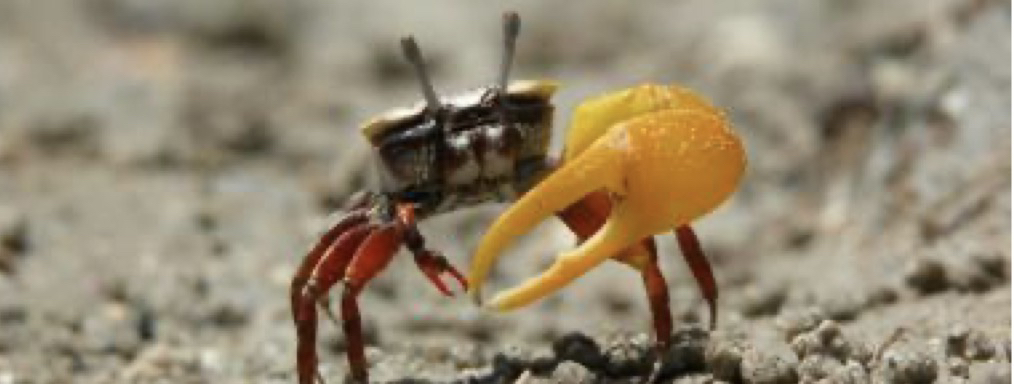
Inc. mudskippers and fiddler crabs. Both are burrowing animals.
Male banana fiddler crabs wave a giant yellow claw to impress females. Most attractive if waving out of sync with others. But everyone trying to be out of sync causes almost perfect synchrony!
Mudskippers dig blind-ended tunnels for their young and deliver fresh air to them.
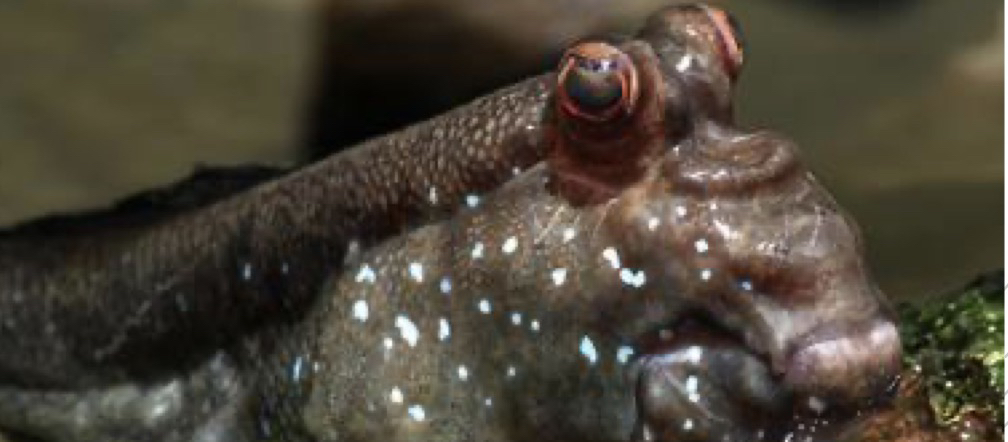
Mudskippers! ☺
23 species worldwide. Usually brown (presumably for camouflage) but males can have bright spots.
Pectoral fins similar to limbs: allow the mudskipper to crawl around and even climb long-hanging plants.
Can "skip" across muddy surfaces (hence their name) and can leap up to 60 centimetres (24 in) by laterally flexing and pushing with their tails.
Spend up to ¾ of their lives on land.
Can breathe on land using water trapped inside large gill chambers. Can also absorb O2 from lining of mouth and throat.
P. schlosseri: the Giant Mudskipper
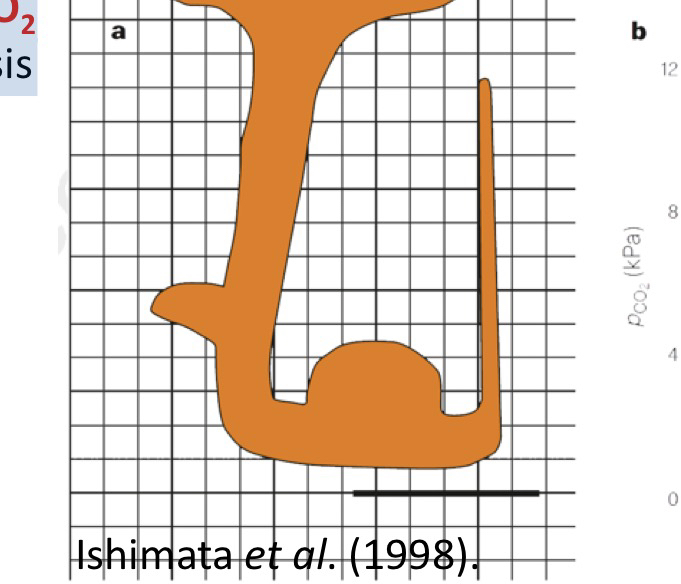
Several mudskipper species are known to provision their burrows with air, inc. P. schlosseri, which can reach 27cm in length.
Their burrows reach 125cm deep, with O2 levels varying from zero to 80% of levels in air-equilibrated water at the surface.
An inverse relationship between O2 and CO2 levels,
supports hypothesis that at least one parent is provisioning air to the burrow.
Presumably the lowest O2 and highest CO2 levels found are borderline lethal for developing eggs/larvae.
Estuarine Organisms
Many fish spawn in estuaries, inc. Pacific herring, surfperch, flounders, and other flatfish.
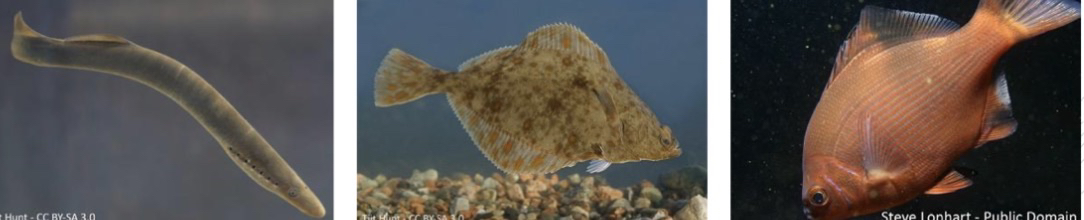
Anadromous (migrating upstream) salmon, trout and lampreys swim through estuaries every year.
Case Study:
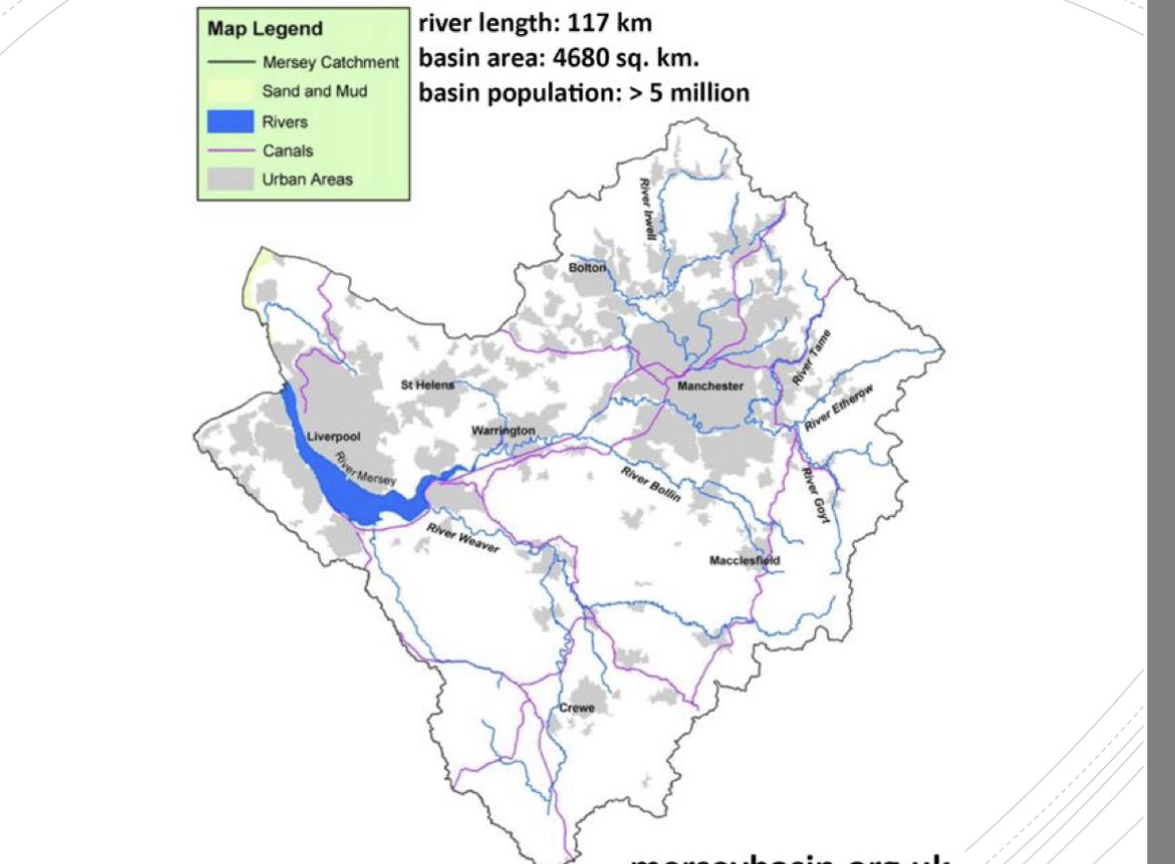
The Mersey River
Mersey Estuary
5030 hectare SPA = Special Protection Area:
important numbers of migratory birds species. inc. subtidal and intertidal marine areas, and land not influenced by tides.
Marine part of the SPA is European
Marine Site (EMS), see down
Parts of the estuary are also Ramsar and SSSI sites.
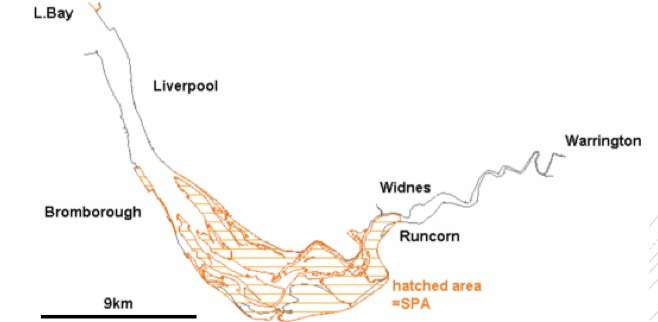
One of largest estuaries in UK. Estuary is 46 km in length.
Width varies and precise path changes from year to year.
The Mersey Estuary was/still is a major trade route.
Manchester Ship canal, 58km long, was opened in 1894.
In upper estuary main input is Mersey river. In inner (lower) estuary main input is Manchester Ship canal.
Mersey Estuary
- Upper and lower estuary fringed with urban and industrial development.
Latter includes Liverpool and “The Narrows”: straight, narrow channel up to 30m deep.
- Mid-estuary (the European Marine Site) has more rural shores, 2nd highest tidal range in UK (approx. 10 metres).
Strong tides result in deep channels and sandbanks.
Tidal activity means river water will never be clear, but could be unpolluted.
Also means that pollution can be stirred up from estuary bottom & returned into water column (see below).
Plant Diversity and Saltmarsh
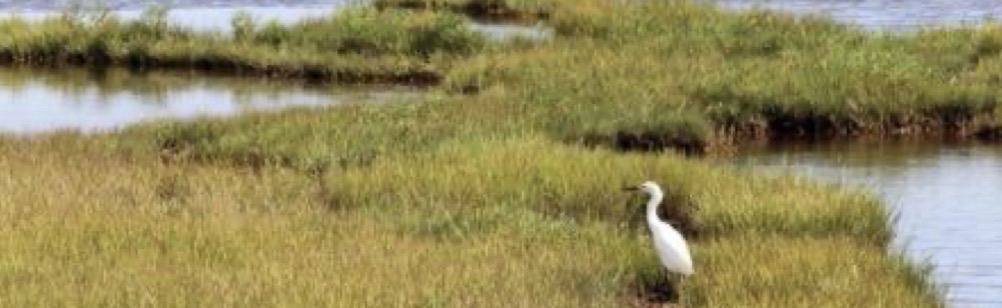
Saltmarsh and extensive sandflats and mudflats near head of estuary.
Areas of brackish marsh, too.
Hale Marsh is one of the largest.
Much of Mersey saltmarsh is relatively poor in floral diversity. Long-established ungrazed marsh has high diversity.
Saltmarshes are are flooded and drained by saltwater: marshy because soil may be composed of deep mud and peat.
Peat: decomposing plant matter often several feet thick. Usually waterlogged, root-filled, and spongy.
A carbon sink when waterlogged, a carbon source when dry.
Saltmarsh Communities
Over 1500 black-tailed godwits regularly roost on Hale Marsh.
Also dunlin, teal, golden plovers, lapwings, avocets, curlews, redshank, greenshank, Canada geese, cormorants, little egrets, Bewick and Whooper swans.
Many of estuary’s birds and fish feed on the high density of benthic invertebrates (potentially up to 3000 kcal/m3 – see above).
Fish Communities
Fish abundant in Mersey until 18th / 19th centuries:
Mersey once had an important commercial fishery.
By mid 20th century fishing activity severely reduced due to industrial development and pollution.
Abundant/diverse fish populations are indicator of good water quality: salmonids especially need high O2 levels.
2002: 26 Atlantic salmon caught in Mersey: wonderful news. Also sea trout, brown trout, dace,
European river lamprey (Annex II of the EU Habitats Directive). Common eel, flounder, sea lamprey also migrate through the estuary.
Over 40 fish species have been recorded in the Mersey.
Pollution & Cleanup – 19th Century
In 1848 Newlands wrote to Liverpool City Council:
“The whole of the sewage is still thrown into the river, much of it, indeed into the basins, and all of it at such points as to act very prejudicially on the health of the town. It becomes therefore a consideration of vital importance how to relieve the river from its pollution.”
Designed and implemented world‘s 1st integrated sewer- age system beginning 1848 (10 years before London). 231 km of innovative egg-shaped sewers built by 1869!
Before sewers built, life expectancy in Liverpool was 19 years (and as low as 15 for some groups of labourers!) It had more than doubled when Newlands retired.
Pollution & Cleanup – 20th & 21st Century
Major modern efforts re. these problems began 1975.
25-year management plan began 1985.
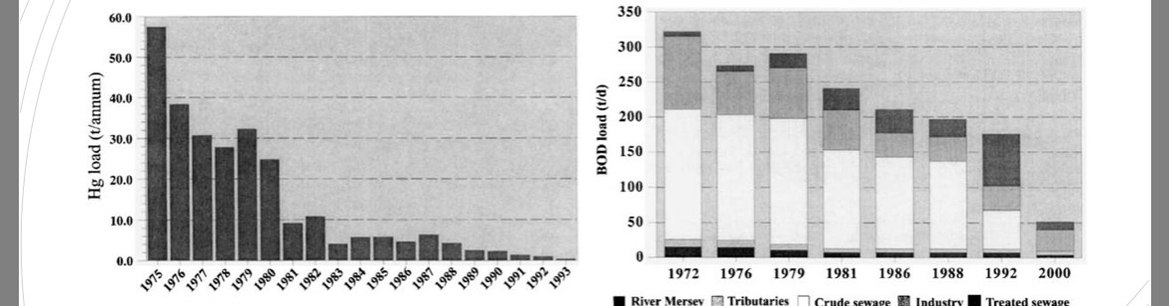
PAH (polycyclic aromatic hydrocarbons) and PCB (polychlorinated biphenyls) levels intermediate compared to similarly impacted UK estuaries, e.g. Humber, Thames, Tyne & Tees.
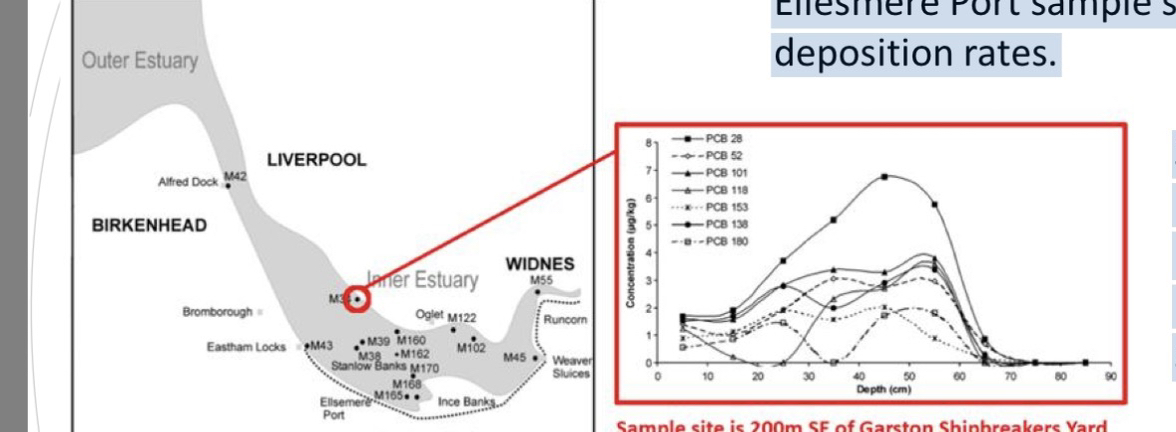
Remixing & resuspension of pollution a problem: an Ellesmere Port sample showed little change in PCB deposition rates.
Some of this due to the remarkably powerful tides, but many benthic organisms bring toxins back to the surface.
Mersey Estuary: Summary
Proper investment very well rewarded. £1 to 1.5 billion spent on cleanup from 1985 onwards (£3.0 to £4.5 billion today). << £100 per person / per year in Mersey catchment.*
A wonderful haven for wildlife, and many valuable lessons have been learnt.
Laborious clean up must continue: many persistent toxins remain in estuary.
*The UK government may well spend 20 times that on the first HS2 rail line, which supercedes an existing Birmingham - London service that already averages 127km/h.