Nursing Research
Introduction
Research outcome is EBP (Evidenced based practice)
Purpose: Basic research (no solution) and applied research (provides solution)
Research Ethical Principles
Beneficence - Doing good, caring, compassion
Non-maleficence - Do no harm (any nursing with a risk of harm is nonmaleficence)
Right: to freedom from harm (both beneficence and nonmaleficence)
Justice - Fairness, equal distribution of resources (physical or human). Know your prioritization
Right: to fair treatment
Autonomy - Voluntary decision making
Right: to self determination
Veracity - Honesty, truth telling, truthfulness, and complete information
Right: to full disclosure
Confidentiality - Protect medical data
Right: to privacy
Fidelity - Loyalty and faithfulness
Note: Anonimity - Data not linked to any person (Not considered as ethical principle)
Nuremberg Code “Eugenics”
First code; Informed consent is required
Declaration of Helsinki
Vulnerable population should receive special protection
Pediatric, Elderly, pregnant, PDL
BON Resolution No. 220 Series of 2004 "PRESERVE HEALTH AT ALL COST"
Criteria for informed consent (VICS)
VOLUNTARY: Autonomy
INFORMED, Fully understood: Veracity
COMPETENT (all of these criteria 3/3) :
Of legal age (18 years old and above)
Not under the influence of any substance
Coherent
SIGNATURE (PATIENT; WITNESS)
WITNESS: Ensure the validity if signature; Ensure the understanding of the patient
It is not our task to explain the surgery, our task is to confirm the understanding.
Basic Concept
Bias (Must be low for accurate results)
Something that causes error
Higher bias causes less accurate results
Validity
You measure what you intend to measure. Identify the relationship between IV and DV. “How confident are you that the IV is the real cause of DV?”
Internal Validity - Whether or not there is really a causal relationship between two variables.
Threats to Internal Validity (Must be high for accurate results)
Selection Bias - to eliminate, use randomization
Maturation - caused by physiologic changer over time; to eliminate, use CG (e.g. SSD use on control group)
Instrumentation change - inaccurate reading of instruments used; to eliminate, replace equipment (defective pulse ox)
External Validity (Generalizability)
How generalizable the findings are
Reliability
Same setting, same results, consistency of instruments
Blinding
Disguising information to prevent bias
Single blind - hindi alam ni subject kung ano ang matatanggap na treatment (medication or placebo effect)
Double blind - Parehas hindi alam ni subjects and researchers kung anong matatanggap
Third Party - Neutral
Research Design (Qualitative Vs. Quantitative)
Architectural backbone of the study “Blue Print”
Overall plan for obtaining answers
Tend to be highly structured and controlled
Qualitative Research Design
Use of inductive reasoning and triangulation
In depth study. Human experiences
Data collected is narrative; no statistics
Data collection is interview (semi-structured)
Structured - most formal
Semi-structured - most preferred (follow up questions are allowed)
Unstructured - has the most freedom
Phenomenological
Lived experiences of a person
Ends with data saturation (no info obtained)
Interview semi-structured
Ethnographical
Studies culture or tribe
Immersion (habitat)
Grounded Theory
Social process and psychological stages about a particular event
It will start with your own theory if you are not satisfied with existing theories
Case Study
Generates in depth understanding
Historical
Phenomenon at a particular part of time in the past
Quantitative Research Design
Use of deductive reasoning

Experimental
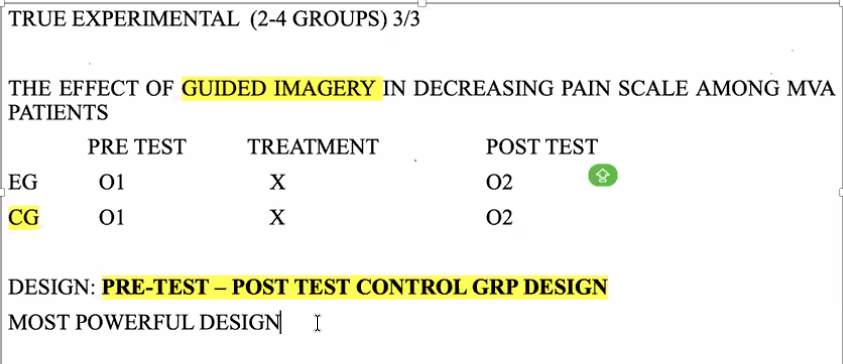
There is manipulation or administration of independent variable
Beneficial (Medications, Massage, Music therapy)
Strongest Design
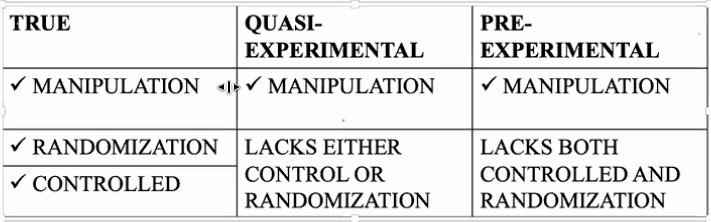
Three elements: Manipulation, Randomization, and Control
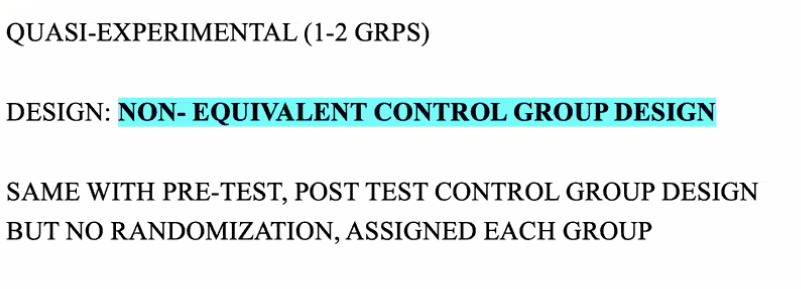
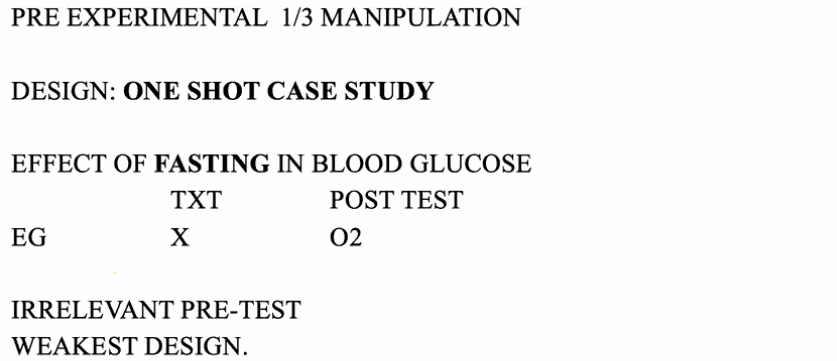
Three types: True, Quasi-experimental, Pre-experimental
Non-Experimental
There is no manipulation
Harmful (smoking)
Unethical
Three types: Descriptive, Descriptive correlational, Descriptive comparative
Descriptive (observational research)
Weakest
Gather characteristics, occurrence, or prevalence
Number, gender, age range
Descriptive correlational
Relationships of variables that co-exist
Positive correlation - directly proportional (both increase/decrease)
Negative correlation - inversely proportional (one either increase or decrease)
Descriptive comparative
Cause and effect of variables (without manipulation) by comparing two groups
Research Design According to Timeline
Prospective Approach
Longitudinal data collection (months to years)
Present to Future - What will happen in the future? (through waiting)
Long term
Threat: Mortality or Drop out
Retrospective Approach
Cross sectional data collection
Future to Past - What happened in the past? (through interview)
Short term
Threat: Recall bias
Types of Sampling Technique


Data Collection Method
Types of Research Instruments
Questionnaire - most common
Interview - online, face to face, telephone, or email
Observation - participant vs non-participant / Covert (covered or hidden) vs Overt (obvious or Hawthorne)
Records
Delphi Technique - invitation of experts to critic your instrument
Biophysiologic measure
In vivo (inside) - No extraction involved e.g. BP, temp, and o2
In vitro (outside) - Extraction involved e.g. blood chem and urinalysis
Chapter 4
Statistics