Albert Bandura
Definition (#f7aeae)
Important (#edcae9)
Extra (#fffe9d)
Approach:
Observational Learning: Learning by observing other people’s behavior. Influenced by cognitive processes.
Proposed that people learn through vicarious reinforcement.
Vicarious reinforcement:Observing the behavior of others and the consequences of that behavior. (indirect behavior)
Modelling:
Observing the behavior of a model and repeating the behavior.
Demonstrated through Bobo doll study.
Other modelling studies:
Children’s behavior reflect their parents’ behavior.
Verbal modeling can induce behaviors.
Disinhibition: Weakening of inhibitions by observing the behavior of the model.
Society models affect type of behavior.
Characteristics:
Characteristics of model:
Similarity to us
Age & sex
Status
Type of behavior displayed
Size and weight.
Characteristics of observer:
Age & attributes
Rewards consequences of behavior:
Affects the extent of modelling.
Prevails over characteristics of models and observers.
Observational Learning Processes:
Attentional Processes | Developing cognitive processes & perceptual skills to pay sufficient attention to a model and perceiving the model accurately to imitate behavior. |
Retentions Processes | Retaining the model’s behavior so we can imitate or repeat it later on; cognitive processes are used to form mental images and verbal descriptions for the behavior. |
Production Processes | Translating mental images or verbal symbolic representations of the model’s behavior by physically producing responses and receiving feedback on the accuracy. |
Incentive & Motivational processes | Perceiving the model’s behavior leads to a reward and thus expecting that the learning and performance will give similar consequences. |
Processes & Reinforcement:
Incentive & Motivational Processes:
Incentive to learn is influenced by the anticipation or reinforcement.
Reinforcement is not always necessary.
Self-reinforcement:
Set of cognitive processes and structure concerned with thought and perceptions.
Administering rewards or punishments to oneself based on personal standards.
Failure to meet unrealistic standards causes emotional punishment and destructive behavior.
Past behavior may become a reference point for evaluating present behavior and an incentive for better performance in the future.
Self-efficacy:
Self-Efficacy | Source of information |
Feeling of adequacy, efficiency & competence in coping with life | Performance attainment: Prior achievement of failures. |
Low self-efficacy leads to feeling helplessness, giving up & self doubt. | Vicarious experiences: Seeing others successful performance or failures. |
People with higher self-efficacy believe that they can overcome obstacles, preserve, have reduced fear of failure and increased analytical thinking. | Verbal Persuasion: Reminding people of their abilities. |
Physiological and emotional arousal: Being calm and composed can lead to higher self-efficacy. |
Increasing self-efficacy:
Exposing people to success experiences by arranging reachable goals.
Exposing people to appropriate models who perform successfully.
Providing verbal persuasion.
Strengthening physiological arousal through proper diet, stress reduction and exercise.
Developmental stages of self-efficacy:
Childhood:
Infants tro and exercise greater influence over their physical & social environments.
Parental influences diminishes over time.
Adolescence:
Success depends on the level of self-efficacy formed in early years.
Involves coping with new demands.
Adulthood:
Involves adjusting to new experiences.
People reevaluate their careers, family and social lives.
Old age:
Reassessments are difficult.
Low self-efficacy affects physical and mental functioning.
Behavior Modification:
Behavior Modification:
Goal: To modify learn behavior considered undesirable by society.
Forms of behavior therapy used for fears and phobia:
Modelling
Guided participation
Covert modelling
Anxiety can be treated through modelling.
Used to treat fear of medical treatment & test anxiety.
Ethical issues:
Clients are manipulated, exploited and controlled without their consent.
Advantages:
Complex behaviors are seen wholly.
Saves time & money.
Can be used with groups.
Effective with phobias, obsessive-compulsive disorder and sexual dysfunction.
Human Nature:
Reciprocal determinism:
Behavior is controlled by:
The individual, through cognitive processes
The environment, through external social stimulus events
Past and present focus
Emphasis is placed on uniqueness
Growth process
Optimistic
Assessments:
Focused on cognitive variables and overt behavior.
Techniques:
DIrect observation
Self-report inventories
Physiological measurements
Research on Theory:
Favored well-controlled laboratory investigations.
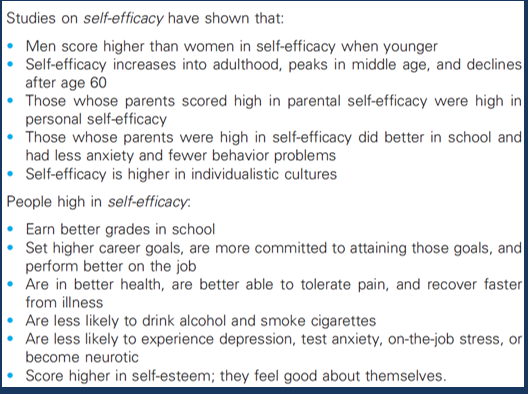
Self-efficacy
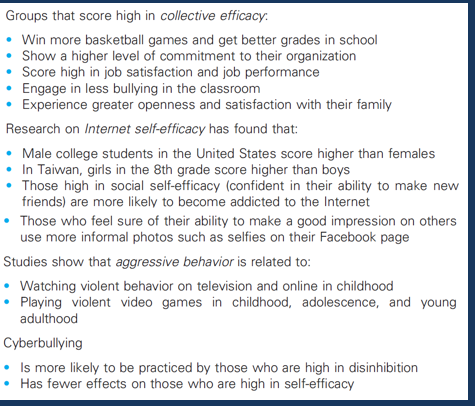
Collective efficacy
Self-efficacy and the internet
Relationship between aggressive behavior and online violence
Research on Self-Efficacy:
Research on Bandura’s Ideas:
Reflections:
Criticism:
Focuses on overt behavior and ignores human aspects of personality.
Treats only symptoms and not the cause.
Contributions:
Objective and amenable to laboratory methods.
Provides great amount of empirical support.
Observational learning and behavior modifications are pragmatic & functional.
Use of role models can be applied to problems.