Public acts of worship
2 main Jewish groups: Orthodox & Reform
Jews are expected to pray 3 times a day(morning, noon, evening).
Orthodox (traditional) | Reform (progressive) |
strictly following the laws in the Torah as Moses was given the Torah by God and should be followed closely | individual choice in deciding how to worship and practice the faith as the Torah was inspired by God but written by humans so it can be adapted for modern times |
men and women should have different roles, all rabbis are male | men and women should be able to undertake the same roles, women can become rabbis |
Public Worship
synagogue
Services are led by a rabbi (Jewish leader/teacher), a cantor (leads/chants prayers), or a member of the congregation.
Orthodox services | Reform services |
daily services at the synagogue | no daily services, focus on shabbat and festivals |
services in Hebrew | services in Hebrew and country’s language |
men and women sit separately | men and women sit together |
men always cover their head with skull caps. married women cover their heads with a hat or scarf | most men wear a skull cap some women wear a skull cap or hat |
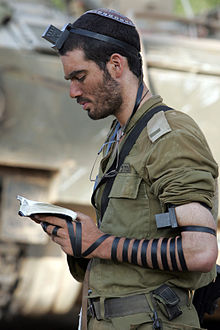
Orthodox men often wear a tallit and tefillin when they prayer. Weekday services in the synagogue consist of a number of prayers including the Amidah which is a central prayer.
During morning prayers Orthodox Jewish men wear a tallit, and on weekdays they wear a tefillin as well.
Tallit - prayer shawl made of wool/silk, has long tassels attached to each corner
The shawl reminds them that they obey God’s word whenever they wear it, the tassels represent the mitzvot
Tefillin - pair of small leather boxes containing extracts of the Torah, one for the forehead and the other on the upper arm in line with the heart