Utilization Planning and Training Phases
Utilization Planning and Annual Training Plan
Utilization planning involves reviewing the annual training plan over a year.
Three primary phases:
Prep phase (preparatory phase).
Competition phase.
Transition phase.
The duration of the prep phase and the number/length of transition phases depend on the seasonality of the sport and the time between competition phases.
Preparation Phase
Even if the prep phase isn't long, durations are relative within the preparation phase.
General preparation occurs during the off-season.
Goals for the off-season:
Increase muscle mass.
Increase strength.
Increase aerobic capacity.
General preparation involves general strength training to create a new foundation.
General vs. Specific Preparation
General Prep: Not generic in the sense that is not as important. But the point is to create a new foundation.
If increasing strength: focus on multi-joint (maybe single-joint) strength exercises (bench press, squats, deadlifts) with heavier loads.
If increasing muscle mass: higher volume of general/foundational exercises (single and multi-joint) to increase lean mass, creating a foundation for more specific movement patterns.
Transition from strength/mass gains to applying it in a sport-specific manner (planes of movement emphasis).
Consider lateral movement, acceleration, deceleration, rate of force development, and unilateral force requirements.
Transition from squats to single-leg strength/stability for acceleration/deceleration, moving towards the rule of specificity.
Injury risk reduction preparation.
Train rate of force development to reduce injury risk at higher demands.
Transition Phase
A transition phase can be inserted between specific prep and competition (one week of a deload, reducing frequency, intensity, and duration, acting as active recovery).
After recovery, athletes are ready for reactive ability and open drill scenarios in competition.
Post-competition, a transition/recovery period leads back into the prep phase.
Off-season to pre-season to competition, then post-competition recovery before starting over.
Cycles Within General Prep
General prep can include different cycles.
A training block (e.g., one month) may focus on progressive overload.
Another block (e.g., two weeks) might change the stimulus (strength to power).
Multiple cycles can occur within a single phase, depending on time and stimuli needed for competition readiness.
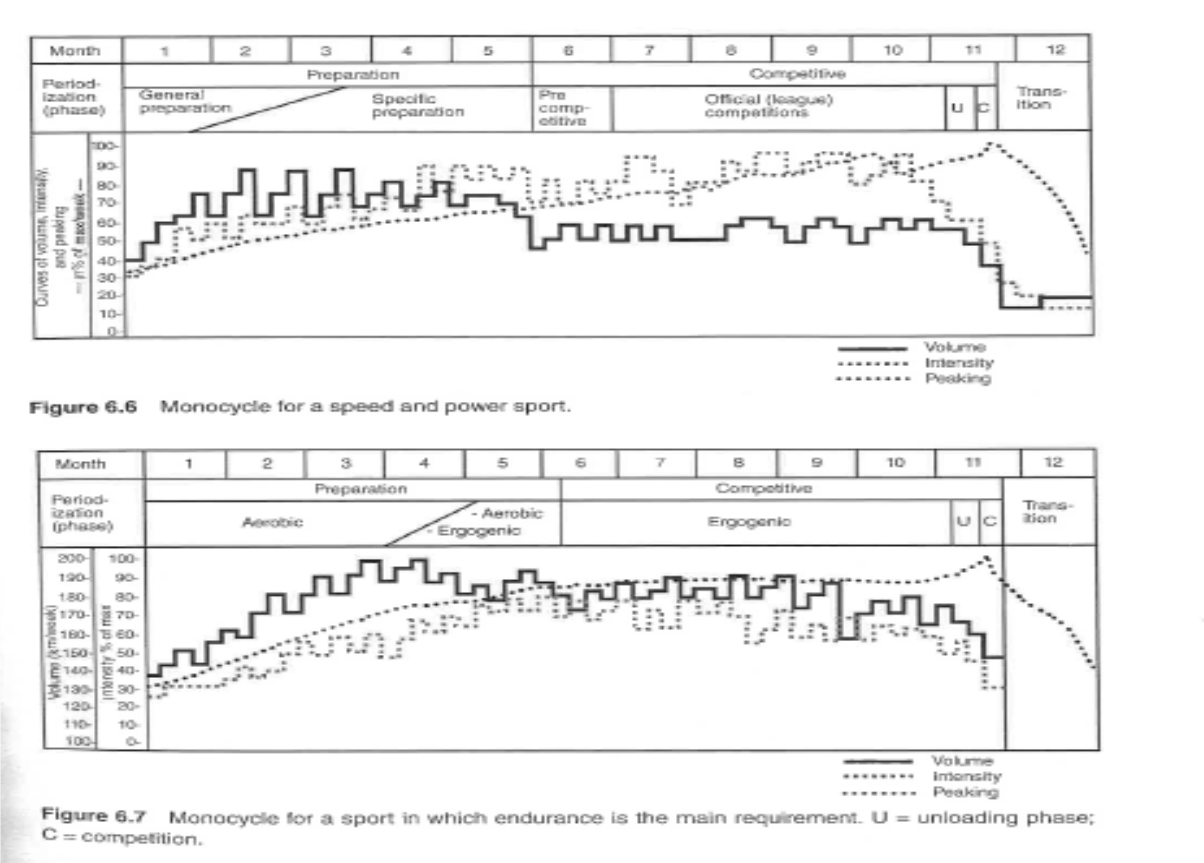
Monocycle: One competition period throughout the year (prep base, competition/in-season, postseason transition).
Bicycles and Tricycles
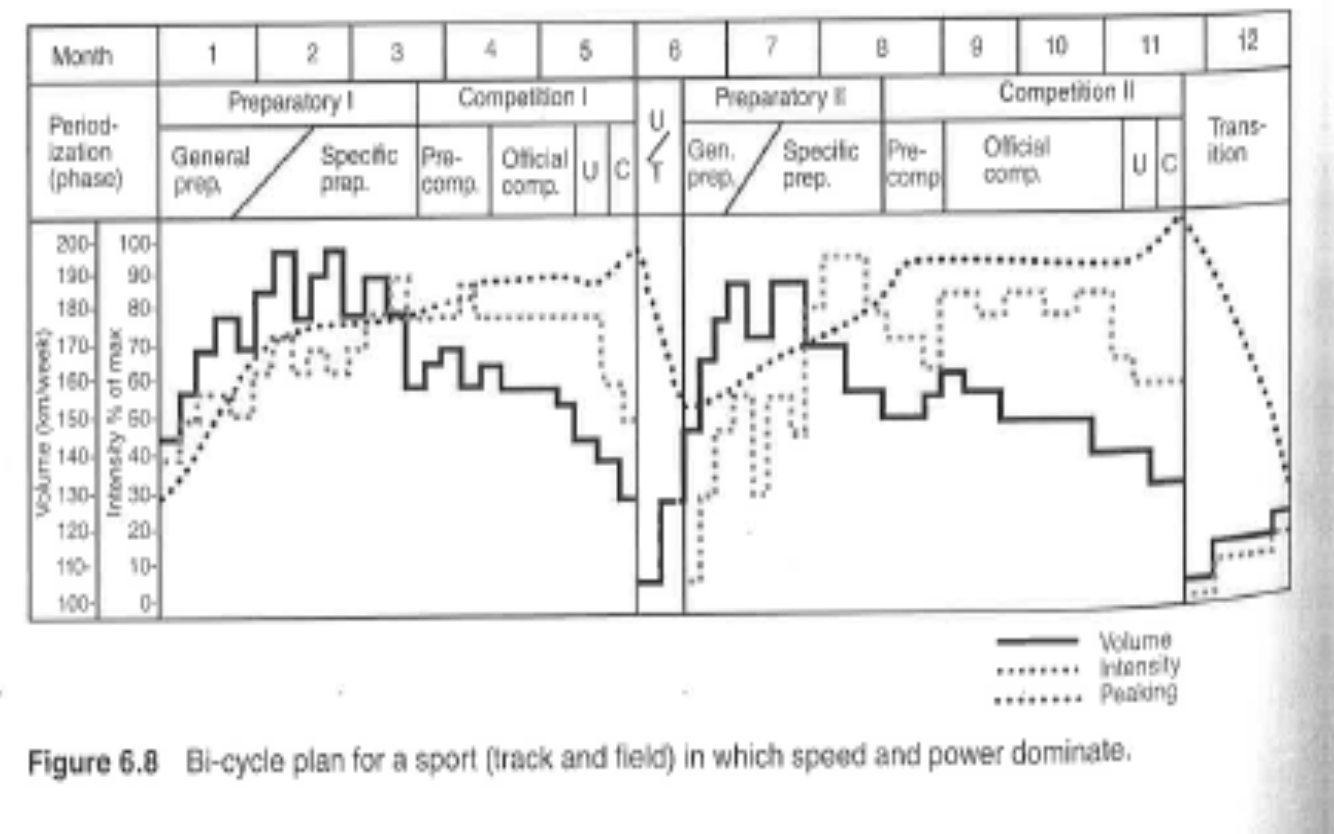
Bicycle Plan (Two Competition Phases)
Two competition phases inherently shorten prep time.
Prep time might not be symmetrical (e.g., three months for season one, one month for season two).
Example: Track (indoor/outdoor), spring ball.
Season B (second season) is a continuum of competitions or skill development from Season A (primary season).
Post Season A, the prep phase (going into Season B) focuses on what attributes should be trained that were weak in Season A.
Track example (100m outdoor to 60m indoor): Focus on acceleration training since the 60m requires more rapid acceleration.
Physical demands dictate the prep phase; with limited time (e.g., one month), general prep might be skipped if it was covered in the first prep phase.
With multiple seasons, phases become tighter and require modification.
Volume increase means intensity decreases.
Periodization manages stress (fatigue) for optimal peaking and recovery.
Volume and intensity
Volume (solid bars), intensity (dots), peaking (linear dotted line).
Manage fatigue, which is essentially stress management.
How much stress can be given while still recovering in an appropriate timeframe?
Prep phase (five months): General prep blends into specific prep and pre-competition (preseason), leading into the competition phase.
Programming
Speed/power: Mobility, flexibility, hypertrophy, anatomical adaptation, maximum strength, and power conversion.
Endurance: Building aerobic capacity (zone one, zone two) and increasing oxidative capacity, transitioning to anaerobic efforts (above lactate threshold, tempo, zone four, five).
Treat training the same way, just the programming based off of energy systems, rate of force development, and absolute force production; the stimulus is just a different way of how we're creating the appropriate stimulus.
Breaking Down the Prep Phase
Mobility, flexibility, hypertrophy, anatomical adaptation, maximum strength, convert to power, preserve max strength and power (competition).
Figure skating: Focus on range of motion, stability, upper/lower body integration, proprioception, etc.
Needs analysis determines required stimulus and periodization via progressive overloading to maximize performance.
Bicycles
Two competitions, two prep periods, and potentially two transition periods.
Prep phases are shorter.
Shorter general prep into specific prep in second prep, roughly 50/50 in the first prep phase.
After competition, the transition leads to a second, shorter prep phase with less emphasis (if any) on general prep.
Multi-Sport Athletes
Football in the fall, baseball in the spring.
Assess stimuli from the football prep and competition phases (consider position played).
Determine required new stimuli for baseball based on the position.
Prioritize what they didn't get (beneficial for injury risk reduction or movement) over what they already have a foundation in.
Example: More transverse plane rotational movement for baseball (throwing, swinging) compared to football's lateral movement, linear acceleration/deceleration, and change of direction.
Previously filled buckets will need less emphasis.
The least filled buckets should get prioritized.
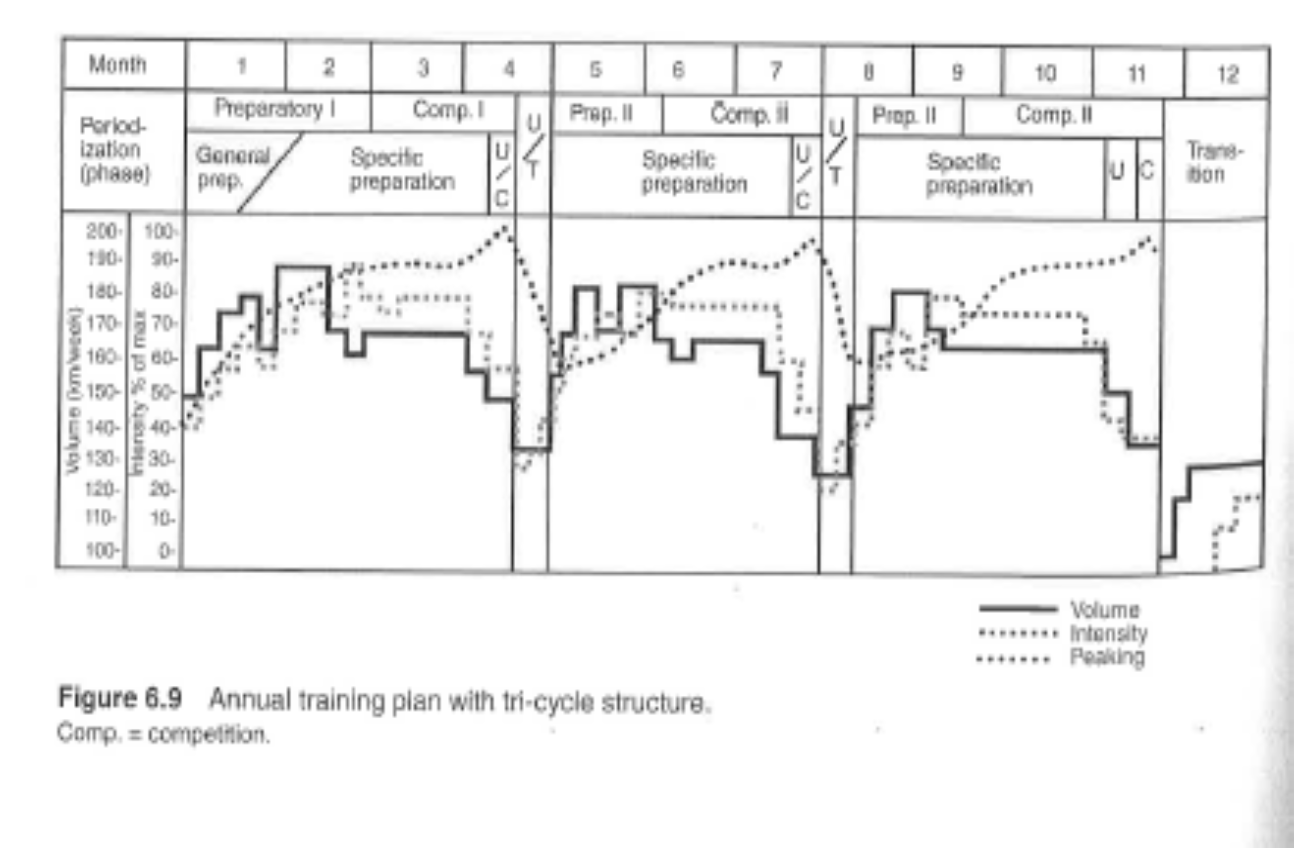
Tricycle Plan (Three Competition Periods)
May or may not have a prep phase, depending on competition duration.
Tennis or MMA examples.
MMA Example
MMA fighter with three fights per year.
Needs analysis: Opponent's fighting style (striker, grappler).
Conditioning for a grappler: High-intensity, multiple muscles, isometric training (clinch work), eccentric strength.
Conditioning for a striker: Training may be more specific to striking principles.
Consider VO2 max and anaerobic endurance requirements.
Cutting Weight
During weight cutting (40 pounds before a fight): Very low volume, high stimulus.
Maintain neuromotor patterns with submaximal percentages.
Lighter plyometrics to maintain rate of force development.
Address dehydration concerns and limit volume to prevent overheating.
Manipulation of Stimuli
Middle/high school soccer player (fall, indoor, spring seasons).
Fall (11v11 on a bigger field): Focus on aerobic capacity for longer distances.
Indoor (6v6 on a smaller field): Focus on short acceleration/deceleration.
Spring (back outside): Improve anaerobic endurance and longer sprints, potentially increasing aerobic capacity.
Identify the most important stimuli for short prep phases.
Strength Coaching
Understanding the sport's physiological demands is key, even without having played it.
Generate stimuli to peak performance and manage fatigue.
Micro, Meso, Macrocycles
Terms used interchangeably to describe subphasing an annual training plan.
Annual plan broken into prep, competition; within prep, general and specific prep; within general prep, weekly sessions with specific purposes.
Start with the big picture and bring it down to the details, considering progressive overload and stimulus requirements.
Weekly Plans
Two-a-days are multiple sessions in a single day.
Energy demands (practice type: sprints vs. distance) influence weight training emphasis.
Adjust stimulus percentage based on fatigue from practice to prevent injury and excessive fatigue.
Adapt to the head coach's plan; know what athletes are (and aren't) getting in practice, determining stimulus and training volume.
Coach wants numbers, not necessarily specificity of the sport.
Misconceptions of Strength Training
A coach wants metrics to demonstrate that their program is working.
Strength coach needs numbers to demonstrate program effectiveness, estimate injury risk.
Improvement in weightlifting doesn't automatically translate to better athletic performance.
Need to measure the most appropriate improvements (that translate to the athletes movement/position).
Decision-making and spatial awareness are developed by actually playing the sport.
Plateaus
Back strength may limit squat strength; single-leg strength can improve acceleration.
Increasing acceleration leads to improved field/court performance.
Understanding plateaus, finding new stimulus for continued improvement.
Two and Three a Day Plans
Fly-ins (plyos) in the morning, main practice in the afternoon, strength training in the evening.
Plyos in the morning prior to main training to train biometrics.
Shock Cycles
Not shock therapy.
High-intensity or high-volume demand days to supercompensate stimulus.
Followed by active rest days.
Consecutive days of supermaximal overload.
Training the body to manage consecutive and high fatigue over time (tournaments or double headers)."
Potential injury risk because of fatigue, so train accordingly.
Peridisation and Competition
Things to think about: sport type, testing, specific demands, goals, timing and more.
Different Types of Peridisation
Linear Peridisation
Linear Periodization (Conventional)
Emphasizes base training with lower intensity and high volume.
Gradually ramps up volume first, then switches to building intensity while reducing volume closer to competition.
Traditional approach involving progressive overloading in four-week cycles with active rest/deload weeks.
Reversed Linear Periodization
Ramps up intensity first during the prep phase while keeping volume down.
As competition nears, it brings intensity down slightly and increases volume.
Suitable for scenarios like transitioning from a 100m to 60m track runner or an Ironman to Olympic distance triathlete, clearing someone after an injury, focusing on stability and force.
Adapts the periodized model of stimulus, keeping in mind what is required for what phase.
Undulating Periodization
Incorporates frequent changes in volume and intensity.
Might involve alternating hypertrophy training (more sets/reps, lower intensity) with high-intensity strength or power days (85-90% RM, low reps).
Can adjust depending on training session of training duration.
Professional Integration
Sports scientist, athletic trainer, physical therapist, sports med doc, sports nutritionist, and sports psychologist.
These individuals integrate their own periodization into the training session.
Sports psychologist: mental delivery will be focused during phases.
Sports dietitians: periodized calorie requirements of athletes.