Thermal Physics
Temperature - A measure of the average Kinetic Energy of particles within a substance
Thermal Energy - the total sum of the randomly distributed kinetic energy of all the particles in a substance
Heat - the transfer of thermal energy from a region of higher temperature to a region of lower temperature
Internal Energy - the sum of the randomly distributed kinetic and potential energies of the atoms within the substance
The tea cup
The swimming pool
Since temperature means the average kinetic energy of the particles, the tea is hotter so the average kinetic energy of the particles is higher. The swimming pool contains a larger amount of water so its total thermal energy is higher since there’s more particles
They have the same temperature
The large iron block has a higher thermal energy
This is because there are more iron particles in the block so the total thermal energy is higher
Heat flows from the hot coffee to the spoon
Because the spoon is a good conductor of heat and the coffee was hotter
When the heat transfer stops you can say the temperatures are the same
An object cannot contain heat because heat is the transfer of thermal energy so its not a physical quantity to contain
thermal energy has increased
yes
the temperature has increased
The kettle transfers energy to the water as heat. This increases the thermal energy of the water, which causes its temperature to increase
The objects both eventually reach the same temperature
object a loses thermal energy as it cools, object b gains thermal energy
heat transfers from the hotter object of object a until they both reach the same temperature
Sample Y
Sample Y
Sample Y has faster-moving particles at 400 K and therefore a higher average molecular kinetic energy than Sample X.
An iceberg can contain more thermal energy than a cup of boiling water despite its temperature because thermal energy is the total sum of the kinetic energy of the particles and the ice berg has a significantly higher mass than the cup of water so will have a higher thermal energy.
During a change of state, heat can be supplied without a temperature increase because the energy is used to overcome the bonds between the particles rather than increase their average kinetic energy.
if block B has a lower specific heat capacity, it needs less energy to increase its temperature, so it rises more.
the cup of water
the water tank is more likely to have a higher thermal energy as it has more mass
Temperature measures the average kinetic energy of the particles, but total thermal energy also depends on the mass.
All thermometers agree at a fixed points: the melting and boiling point of pure water
The sensitivity of the thermometer depends on how narrow the capillary tube is as well as the expansion of the thermometric substance.
Absolute zero is the lowest possible temperature at which substances have minimum internal energy
The particles vibrate about a fixed point which causes the minimum potential energy, but they cannot collide so there’s zero pressure at absolute zero
For a, the net transfer of thermal energy would be from object A to B. For b, there would be no net transfer because the objects have the same temperature. For c, there would be a net transfer of thermal energy from object B to A
273 Kelvin, 310 Kelvin, 152.5 Kelvin
-273 Celsius, -73 Celsius, 77 Celsius
0K is the absolute lowest temperature
There would be a net transfer of thermal energy from the metal block to the water as the temperature of the metal block is 300K which is 27 Celsius and that is greater than the temperature of the water. The transfer of thermal energy causes the temperature of the block to decrease and the temperature of the water to increase.
It is sensible to omit the unit for the core temperature of a star because the differences between Kelvin and Celsius are negligible at extremely high temperatures
Because there would be a net transfer of thermal energy from the cup of water to the thermometer. This reduces the temperature of the water and the net flow stops when the thermometer and the water are at the same temperature.

Absolute Zero
As the temperature decreases:
Atoms and molecules move more slowly
Vibrations within solids become smaller
The kinetic energy of particles approaches its minimum value
Near absolute zero, particles have almost no random thermal motion. However, according to quantum mechanics, they do not become completely motionless
For an ideal gas:
Average Kinetic Energy
Where:
Boltzmann constant
temperature in Kelvin
Quantum Phenomenon near Absolute Zero
When matter is cooled to temperatures very close to absolute zero, unusual quantum effects become observable:
Superconductivity
Superfluidity
Bose Einstein Condensates (BEC)
Superconductivity
certain materials lose all electrical resistance
electric currents can flow without energy loss
Superfluidity
some liquids (such as helium-4) flow with zero viscosity
they can climb container walls and exhibit other unusual behaviours
Bose Einstein Condensates
large numbers of atoms occupy the same quantum state
matters behaves like a single giant quantum wave
Cooling a gas to extremely low temperatures
in a dilute gas:
at higher temperatures, atoms behave as separate particles
each atom has its own position and momentum
as temperature approaches absolute zero:
atomic speeds decrease dramatically
their associated quantum wavelengths increase
Solids, Liquids and Gases
diameter of an atom
Structure:
Spacing, Ordering, Motion, Intermolecular Forces
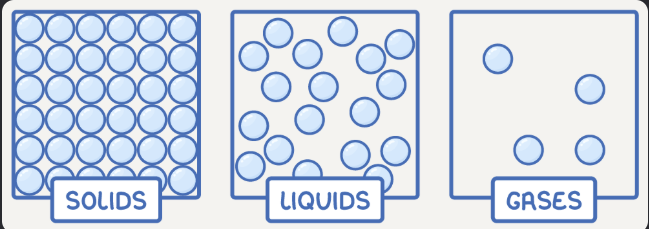
Solids have particles that are tightly packed into a regular 3-dimensional lattice structure, vibrating around fixed positions and they cannot move out of their positions in the structure
In liquids, particles are closer together but are not in an organised structure and are free to move around as they have weaker intermolecular forces or attraction than solids.
In a gas, the particles are far apart with no structure and are free to move around at high speed since they have almost no intermolecular forces of attraction between them
Brownian Motion
Brownian motion is the random irregular movement of microscopic particles suspended in a fluid (liquid or gas) due to continuous collisions with the fast moving molecules of the fluid
Random means that the motion is unpredictable
the particles can move in any direction at any moment
there is no fixed pattern or preferred direction
we cannot predict where the particles will move next because the molecular collisions are constantly changing
Irregular means that the motion is not smooth or uniform
the speed changes continuously
the direction changes abruptly
the particles doesn’t follow a straight line or regular curve
The motion is random and irregular because the resultant force on the particle is constantly changing
A changing force produces a changing acceleration and therefore;
the particle continually changes speed
the particle continually changes direction
Solids, liquids, gases
in gases there is no structure and the particles are free to move around to fill the volume of the container that they are in
at 5 Celsius, density =
at 20 Celsius, density =
at 40 Celsius, density =
Heat Capacity & Specific Heat Capacity
Heat Capacity - The energy required to heat a substance by 1oC; its dependent on the amount of the substance there is. The bigger the volume, the bigger the heat capacity.
Specific Heat Capacity - The energy required to heat 1kg of a substance by 1oC. A higher specific heat capacity means the substance gets hotter slowly
SHC equation: SI Unit: JkgoC-1 Base Unit: m²s⁻²K⁻¹
Calculate the heat energy required to rase the temperature of a copper can (50g) containing 200cm3 of water from 20 to 100oC
SHC of Copper is 385 Jkg-1K-1
SHC of Water is 4200 Jkg-1K-1
For copper: 1540 J
For water: 67200 J
for the can containing water = 68740 J
Measuring Specific Heat Capacity
variables needed to measure: (dependent) change in temperature, (independent) time, (control) specific heat capacity, mass, current, voltage
energy: or or
mass: kg measured using a balance
initial and final temperature: thermometer
the heater switched on for a known time
Equation becomes
, , so

sources of error: heat loss → minimise it by: using an insulator around the metal block, ensuring that the temperature gradient between the block and its surroundings is small
first heat the heater to a constant stable temperature that will immediately heat the block
cover every surface with an insulating material
strong thermal contact between the thermometer and the block
stop the timer when you take the heater out the block
find the average of the temperature when you take the heater out and its maximum stable value after the heater is removed
to do the experiment again, let the block cool back down to room temperature
Calorimetry
The process:
A heated object is placed into a thermally isolated container containing a known amount of water
Object and liquid reach thermal equilibrium
The final temperature of the object/water is used to determine the specific heat capacity of the object
Must also find the heat absorbed by the liquid’s container (calorimeter)
the heat lost by an object is equal to the heat gained by the water
The energy supplied to the heater coil: . The energy will heat the liquid and also the equipment and surroundings:
plot a graph using
, is the specific heat capacity of the liquid
, is the heat lost to the surroundings and the apparatus and is the y intercept on the graph
Latent Heat
This is the energy required to change the state of a substance without a change in temperature
e.g.

Latent Heat of fusion:
The potential energy of the particles increases during phase change. When there is a change of state, energy must be supplied to overcome molecular forces of attraction → this energy is supplied externally, normally as heat and does not increase the temperature → as the effects are not measurable as a temperature changes, its called latent heat (latent meaning invisible)
Latent Heat of fusion is the amount of heat required to convert a unit mass of solid onto liquid without a change in temperature
Latent Heat of vaporisation:
Energy must also be supplied to overcome molecular attractive forces in a liquid → as for a solid, this energy is supplied externally, normally as heat, and does not increase the temperature → as a fluid changes from liquid to vapor at its boiling point, its temperature will not rise above its boiling point
Latent Heat of vaporisation is the amount of heat required to convert a unit mass of liquid into vapour without a change in temperature
Why do things expand when they get hotter
every microscopic object moves due to thermal excitation - Brownian motion
atoms too vibrate with respect to each other
hotter atoms vibrate more - asymmetric potential means average separation increases
Experiment to determine latent heat of fusion of water

Place equal masses of ice in two funnels above beakers.
Turn on the heater around one funnel only and supply a measured quantity of energy for a known time. ()
Measure the mass of water collected in both beakers.
Find the difference in mass to negate the effect of ambient heat.
Calculate the specific latent heat of fusion by dividing the energy supplied by the mass of ice that melted.
Experiment to determine latent heat of vaporisation of water
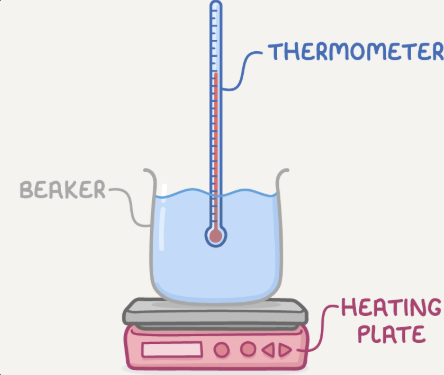
Place a known mass of water in a beaker on a heating plate.
Supply a measured quantity of energy until the water reaches boiling point.
Allow the water to boil for a set period, like 3 minutes.
Measure the remaining water mass.
Calculate the specific latent heat of vaporisation by dividing the energy supplied by the mass of water that vaporised.
220000J to melt 2.5 kg of silver
Specific latent heat of vaporisation is greater than the specific latent heat of fusion because there’s a greater change in internal energy going from liquid to gas than solid to liquid
19900J transferred to the surroundings to turn 50g of aluminium from liquid to solid
of ice melted in 20 minutes using a 24W heater
Experimental Setup
Rigid Flask/Sphere: Traps a fixed volume () of air.
Pressure Sensor or Bourdon Gauge: Measures the internal gas pressure ().
Water Bath & Heater: Changes the gas temperature ().
Thermometer: Measures the water temperature in degrees Celsius ().
Procedure
Seal a fixed volume of air in a flask connected to a pressure gauge.
Submerge the flask completely into a beaker of water.
Heat the water bath to around, then turn off the heat source.
Allow the system to reach thermal equilibrium and record both the temperature () and pressure ().
Add ice or cold water in stages to lower the bath temperature by approximately 10oC increments, taking synchronized and measurements down to around zero degrees.
Data Analysis & Extrapolation
Graphing: Plot a graph with Pressure () on the vertical axis and Temperature () on the horizontal axis.
Line of Best Fit: Draw a straight line of best fit through the plotted data points, which follows the linear equation:
Extrapolation: Extend the best-fit line backward to where the pressure drops to zero ().
Finding Absolute Zero:
Set P0: 0
Solve for T:
The point where the line crosses the horizontal axis represents theoretical absolute zero (approximately ).
Sources of Experimental Error
Unheated Gas Volume: Air in the connective tubing outside the water bath does not reach the bath temperature.
Non-Ideal Gas Behaviour: Real gases deviate from ideal behaviour at lower temperatures or high pressures.
Thermal Lag: Taking readings before the trapped air completely matches the water bath temperature.
Experimental Setup
Known Solid Sample: Metal block of known mass.
Calorimeter & Stirrer: Copper or aluminium cup of known mass with known specific heat capacity.
Water: Known mass of water with known specific heat capacity .
Boiling Water Bath: To heat the sample to a high initial temperature.
Thermometer & Insulation: To measure temperature changes and minimize heat loss.
Procedure
Measure and record the mass of the solid sample (ms), the empty calorimeter (mc), and the calorimeter filled with water (mc+mw to find mw).
Place the solid sample in a boiling water bath and leave it long enough to reach the boiling temperature of water.
Record the initial temperature of the cold water in the calorimeter.
Quickly transfer the hot sample into the calorimeter to minimize heat loss to the surrounding air during transfer.
Stir the water continuously and record the maximum stable temperature reached by the mixture.
Data Analysis & Calculation
Assuming no heat is lost to the surroundings:
Heat lost by hot solid=Heat gained by cold water + Heat gained by calorimeter
ms⋅cs⋅(Thot−Tfinal)=mw⋅cw⋅(Tfinal−Tcold)+mc⋅cc⋅(Tfinal−Tcold)
Rearranging to solve for the specific heat capacity of the solid (cs):
cs=ms(Thot−Tfinal)(mwcw+mccc)(Tfinal−Tcold)
Sources of Experimental Error
Heat Loss During Transfer: Heat is lost to the air as the hot solid is moved from the boiling bath to the calorimeter.
Splashing: Water splashing out during transfer changes the mass of the water (mw).
Thermal Lag: Delay in the thermometer reaching thermal equilibrium with the liquid.
Kinetic Theory of Gases
The kinetic theory of gases is a model that explains the behaviour of gases in terms of the motion of tiny particles (atoms or molecules)
It relates the macroscopic properties of gases, such as pressure, temperature, and volume, to the microscopic motion of molecules
Main assumptions:
Gases consist of a very large number of tiny particles in constant random motion
these particles are molecules or atoms
they are much smaller than the distances between them
they move in all directions with a range of speeds
their motion is continuous and chaotic
The volume of the molecules is negligible compared to the volume occupied by the gas
the actual size of the molecule is extremely small compared to the volume occupied by the gas
Electrostatic forces between molecules are negligible
molecules neither attract nor repel one another except during collisions
this assumption is most accurate for ideal gases
Collisions are perfectly elastic
when molecules collide with each other of with the walls of the container, no kinetic energy is lost
total kinetic energy remains constant
Implications of the Kinetic Theory of Gases
The impact time between the atoms or molecules is negligible compared to the time between impacts.
The average kinetic energy of molecules is proportional to the absolute temperature
higher temperature means greater average molecular speed and kinetic energy
mathematically: average kinetic energy
where: Boltzmann constant
absolute temperature (K)
Explanation of Gas laws
Boyle’s Law
at constant temperature:
constant
reducing the volume causes molecules to hit the walls more frequently, increasing pressure
Charles’ Law
at constant pressure (frequency of collisions must stay the same)
is directly proportional to
Increasing temperature increases molecular speed. The gas expands to maintain constant pressure
Pressure Law
at constant volume
is directly proportional to
a rise in temperature increases the force and frequency of molecular collisions, increasing pressure
Effusion
effusion is the escape of gas molecules through a tiny hole
evidence:
lighter gases escape faster than heavier gases
Expansion and Compressibility of Gases
gases expand to fills any available container and can be compressed easily
evidence:
indicated that molecules are far apart with large empty spaces between them
atoms in 3.0 mol of a substance ( )
The number of atoms in 1 mol of silicon is the same as the number of atoms in 1 mol of aluminium, however the silicon atoms have a greater mass than the aluminium atoms
change in momentum = 2mu
number of atoms in copper of mass 1kg =
6.
Ideal Gases
Macroscopic properties
mass (usually fixed)
density
volume
temperature
pressure
Microscopic properties
motion of molecules/atoms
momentum of molecules/atoms
kinetic energy
force exerted by molecules on collision
Boyle’s Law
The pressure of a fixed mass of gas at constant temperature is inversely proportional to its volume
if is constant
or
in a gas, pressure is caused by collisions between the particles and the walls of the container
to increase pressure only by affecting the particles, you can increase the temperature of the gas which will give the particles more kinetic energy; and you can add more particles which will increase the frequency of the collisions
reducing the volume of the container can increase the frequency of collisions


Charles' Law
the volume of a fixed mass of gas at constant pressure is directly proportional to its absolute temperature
if
or


pressure must remain constant and since the temperature and therefore the average kinetic energy of the particles increases, volume must also increase to keep pressure constant
Gay-Lussac’s (Pressure) Law
the pressure of a fixed mass of gas at constant volume is directly proportional to its absolute temperature
if
or


Equation of state for an ideal gas
an ideal gas is defined as a perfect gas which obeys the three gas laws (Boyle’s, Charles’, Gay-Lussac’s) exactly.
,
Consider 1 mole of gas at standard temperature and pressure
(S.T.P)
1 mole = Avogadro’s constant atoms
molar gas constant
1 mol of oxygen (atom) = 16g of oxygen
1 mol of oxygen (gas) = 32g of oxygen
molar volume =
if you have a gas of volume =
then number of moles
where volume of 1 mole of gas
For mole of an ideal gas, the equation of state is written as
where is the number of moles in the gas
where is the mass and is the molar mass
where is number of molecules and is Avogadro’s constant ()
Boltzmann constant, is defined as:
then the equation of state becomes
so
The Boltzmann constant links temperature to the energy of individual molecules.
The average kinetic energy of a molecules is:
Gas molecules possess a range of speeds described by the Maxwell-Boltzmann distribution

A gas containing billions of molecules:
some move slowly
some at medium speeds
some at high speeds
instead of tracking every molecule individually, we define on effective speed, the RMS (Root Mean Square) speed, such that:
equals the average kinetic energy per molecules
the root mean square speed is the square root of the mean of the squares of the speeds of all the molecules in a gas
mathematically:
the RMS speed is the single speed that would give the same average kinetic energy as the actual collection of gas molecules moving at different speeds
Kinetic energy depends on speed squared:
The RMS speed is therefore the speed that is directly connected to:
average kinetic energy
gas temperature
gas pressure
internal energy
The distribution has a most probable speed, mean speed and RMS speed
Increasing temperature increase average kinetic energy and shifts the distribution to higher speeds
A higher temperature produces a lower, broader curve with a longer high speed tail
The area under the curve remains constant because the number of molecules remains unchanged
mean speed =
mean square speed =

so
so
The magnitude of the velocity is given by:
then
since the velocities of the gas are completely random, there is no preference t one direction or another; hence:
From the definition of pressure, where and
and
, is the mass of the gas as is the number of molecules
Since the density of the gas, is given by
where
: pressure by the gas
: density of the gas
: mean square velocity of the gas molecules
Root mean square velocity is defined as:
from the equation of state in terms of Boltzmann constant, :
by equating the equations, this
PAG 8.2: Boyle’s law experiment
atmospheric pressure =
A parachutist jumping from an aeroplane
The weight of the parachutist downwards will remain constant and the acceleration of the parachutist decreases over time from as the upwards drag force increases with until they are equal and the parachutist reaches terminal velocity. When they open the parachute at the drag force increases dramatically and becomes bigger than the weight causing rapid deceleration and as the speed falls the drag force lowers until the force of drag upwards is equal to the acceleration downwards and the parachutist reaches a new lower terminal velocity.
← ()