MSE 2001 - test 1
Explosion of materials around 1920
Currently in the silicon age - silicon is also a ceramic
Age of Materials today, this leads to better material selection and makes the possibilities much more broad
Also includes challenges such as having difficulty narrowing down options to choose the best material for different applications. Processing of many new materials is also complex
Materials science and engineering studies the inter-relationships between: Processing, Properties, and Structure
Engineers Design while scientists discover
MSE provides the “materials parameters” (material constraints) that are useful for other engineers to design.
___________________________________________________________________________
Mechanical/Structural Properties include:
Density
Elastic Modulus (Stiffness)
Yield Strength
Modulus of Resilience
Fracture Toughness
Hardness
Ductility
Poisson’s Ratio
Coefficient of Friction
Thermal Properties:
Heat Capacity
Thermal Conductivity
Melting Temperature
Chemical
Diffusivity
Corrosion Resistance
Solubility
UV protection rating
Biocompatibility
Price
cost of raw material
cost of processing
Electrical/Magnetic
Electrical conductivity
Magnetic Susceptibility
Magnetization
Magnetic RemanenceDielectric Constant
Polarization
Superconductivity
Optical
Refractive index
absorption coefficient
reflectivity
fluorescence/ emission
Cross-Properties
Thermal expansion
curie temperature
electro-optic coefficient
piezoelectric coefficient
thermoelectric
pyroelectric
emissivity
electrochemical properties
__________________________________________________________________________
Material Property / Material Constant: intrinsic property of material NOT dependent of size or shape
characteristics ending in “ity” are most commonly materials properties, NOT performance parameter
Performance parameter: Property of component the IS dependent on shape, size, and material identity
R=P(L/A) — R is the resistance (the performance parameter), P is the resistivity (the material constant) and L/A is the cross section area (or length/area)
Material properties can ALMOST ALWAYS designed around by making it a different size or shape, aka, if you want to achieve something with a certain material you can probably just change its size and shape, but its inconvenient b/c tradeoffs with other properties.
Why should you choose a different material?
original material may be too expensive, heavy, be impossible to process, etc.
___________________________________________________________________________
1.2 - PRICE OF MATERIALS
importance of price: determines of product is commercially viable
Material driven costs:
Terrestrial abundance - (good first-order estimate for determining material cost
extraction costs
*rare earth metals are rare b/c they are not found in concentrated ores = expensive extraction cost
People-driven costs:
supply/demand
tech drives
speculation
geo politics
___________________________________________________________________________
1.2 - MECHANICAL AND STRUCTURAL PROPERTIES
Stiffness: Amount of force (stress) needed to flex the material [NOT PERMANENTLY DAMAGED]
Strength: Amount of force (stress) needed to deform the material [ PERMANENTLY DAMAGED but NOT BROKEN]
Toughness: Amount of force (stress) needed to break the material [BROKEN]
Measuring Mech Properties:
Performance parameters
Load: Force (N, lb, kg)
Total elongation: ∆L (cm, mm, in)
Material Properties
Stress Θ : Load/ cross - section area = N/m² = Pa (MPa, GPa)
Strain ε : ∆L/L0 = Lf - L0 / L0 = mm/mm = UNITLESS
Tensile tests: provides data for the stress-strain curve
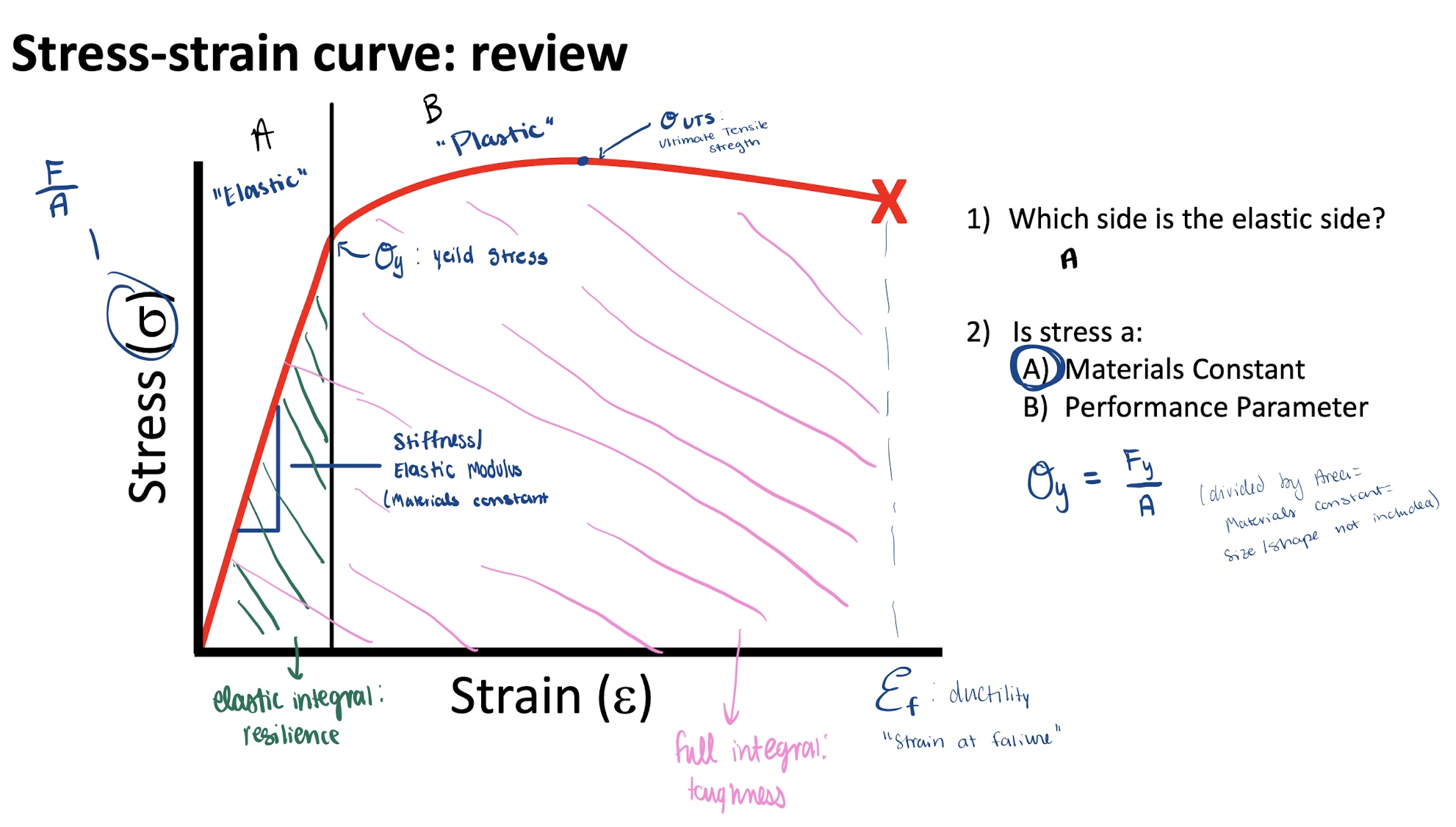
Elastic/linear section: deformation occurs that is reversible - material returns to original shape and has 0 strain when load is removed
Elastic Modulus (stiffness E) : slope of elastic portion
definition: material’s resistance to stretching, bending, and flexing
inc Elastic modulus = inc stiffness = inc E = inc resistance to stretching, bending, and flexing
Hooke’s Law: Θ = Eε = E = Θ/ε = slope
Poisson’s Ratio (v): a measure of how much a material will shrink or expand sideways when stretched/compressed lengthwise
ν=(-ε_trans)/ε_axial
“Perfect isotropic materials: 0.25
Most materials: 0.3
Unusual cases: cork = 0.0, auxetic = - (negative value)
Plastic/non-linear section: deformation occurs that is irreversible/permanent - material does NOT return to original shape when load is removed
Yield Stress, σy, strength: stress required to permanently deform material
located on y axis where elastic and plastic sections meet
Ultimate Tensile Strength σUTS: ultimate strength. stress beyond is when material fails/fractures
located at highest point of plastic section
Ductility εf: maximum amount of strain (% elongation) at failure
located on x axis, parallel to end of curve on graph
Modulus of Resilience
Resilience is a materials property describing the amount of elastic energy per volume that is reversibly absorbed
found w/ integral of elastic region
Coefficient of restitution is a corresponding performance parameter
(round vs cube bouncy ball) SHAPE MATTERS
Toughness measures energy per volume required to BREAK a material
found on stress strain curve as the area under the curve
Hardness: surface property
describes how difficult it is to scratch a material
measured using the Moh’s scale, based on semi quantitatively (not even steps)
Brinell hardness measures hardness more evenly
chemical vapor deposited oxide coating (a ceramic) allows for safety goggles to not be scratched as much
Sound Waves
Sound transmitted through materials in longitudinal strain waves (or aka mechanical waves)
velocity prop to sqrt of (eleastic modulus / density)
Acoustic Impedance: sound travels from a material to a different one, different impedance of sound determines how much is reflected or transmitted.
Z prop to sqrt(density * elastic modulus)
LARGE Z mismatch = mostly reflection of sound
SMALL Z mismatch = mostly transmission of sound
Thermal Properties
Maximum Service Temperature: max “useable” temp of a material, above it will fail
service temperatures are often much much lower than the materials melting point (50 - 80%)
Heat Capacity: materials constant
energy required to raise temp of material by 1 degree C
aka amount of heat energy stored per amount of material
can by J/m³K or J/kg K or J/mole K
Thermal Conductivity (lambda): speed of heat flow
rate of which heat flows through a material at steady state (temp gradient constant with time
follows Fourier’s law: Q = -lambda ∆T/∆x == heat flux = conductivity ( change in temp/m)
Thermal Diffusivity: material property describing transient heat flow (m²/s)
estimates how quickly a material will heat up and reach a certain temp as a source is applied to it
D_th = lambda/Cp = diffusivity = thermal conductivity / heat capacity
Inc of thermal conductivity = faster melting
Inc heat capacity = more heat released
Thermal expansion Coefficient(alpha)
CTE: change in volume of a material with change in temp (expand when heating)
both mechanical and thermal property
∆L = aLi∆T = E = a∆T === mech strain = CTE * temp change
common issue buckling: choose material with low CTE to avoid it
Bimetallic strips: 2 materials with different CTE’s
De-lamination: film on ceramic substrate → glass expands but can’t bend, therefore film flakes
as long as the yield stress’s of the materials to not exceed, the bending is reversible and repeatable for calibration → ex: thermometers
when choosing CTE of 2 materials, chose the closest 2 CTE’s
the higher CTE experiences compression at high temps
materials thermalize best w/ HIGH thermal conductivity and low heat capacity
Electronic Properties
Electrical Conductivity (theta): how quickly electrons/electricity travel through the material (units: S/cm siemens/cm)
Electrical Resistivity (p): material property
OPPOSITE of conductivity, the impediment to electron flow (units: omega * cm)
Relationship: S=1/omega
(conductors, semi conductors, insulators) → increasing resistivity and decreasing conductivity
Electrical Resistance (R): preformance parameter
R = P(L/A) == resistance = resistivity (length/area)
Electrode = electrical conductor
Dielectric = electrical insulator
Capacitor = stores a charge
charging ( a battery placed)
stores charge (charge in the electrode/dielectric)
Discharge (send charge to item - ex light bulb)
Equation for capacitance: C=Eo k (A/t) == vaccum permitivity dielectric constant (area/thickness)
important material properties of capacitor’s dielectric material
k - dielectric constant - amount of charge you can store
p - resistivity - how long(avoid self discharge)
capacitor stores ELECTRICAL energy while battery stores CHEMICAL energy
capacitor is faster
Piezoelectricity: cross-property of electrical and mechanical
electrical insulators bc mush support internal applied voltage to function
Basically: apply mechanical strain to get a voltage is piezoelectricity and applying a voltage to get a mech strain is electrostriction within piezoelectric materials
most common material of piezoelectricity is lead zirconate titanate (PZT)
quartz is also piezoelectric
Semiconducting Materials
semiconducting materials can behave either as insulators OR conductors but neutrally they are insulators (aka off)
become conductive (aka on) w/ energy is applied
Very useful w/ SWITCH applications
have moderate band gap so changes in energy can make semiconductors either a conductor or insulator
Altering semiconductor properties
Doping: intential defects/impurities added to pure semi-conductors
dopants decrease ∆E (band gap energy)
Transistors: use semiconducting materials to act as switches
In enhancement mode MOSFET, a voltage is applied that is above the threshold band energy gap that is applied to the gate, ultimately switching the semiconductor to on and conducting
With no signal or not enough signal applied to the gate, the switch is off and not conducting
Magnetic Properties
Magnetization
material’s response to an applied magnetic field
M=xH == Magnetization = susceptibility * external magnetic field (M and H are vectors)
Magnetic susceptibility (x): materials property
“Magnetic” Materials:
Ferromagnets
Ferrimagnets
“Non-Magnetic” Materials:
Paramagnet
Diamagnets
Antiferromagnets
Superconductors:
ALL superconductors are diamagnets but not all diamagnets are superconductors
All true superconductors exhibit Meissner-effect, which is temp dependent
Below transition temp, electrical resistivity drops sharply and magnetic fields are repelled from material
Behavior of Magnetic Materials
Soft magnetic materials → when apply a magnetic force they magnetize → when magnetic force removed the material demagnetizes
Hard magnetic materials → when apply a magnetic force they magnetize → when magnetic force removed the material STAYS magnetized
MH loops - Hysteresis Curves

Ms: Saturation Magnetization:
max magnetization as loop goes horizontal
Mr: Remanent magnetization:
how much magnetization “remains” at zero H
y-intercepts
Mc: Coercive Field:
how easily switch direction of magnetic field in a material
x-intercepts
(H value where M switches direction)
Curie Temperature:
temp above which a permanently magnetized materal (hard magnet) looses its magnetization
aka the service temp for magnetic materials
curie temp is temp at x-intercept

Optical Properties
When light is incident on material there are 3 results:
reflection, absorption, and transmission
Io = Ir + Ia + It == 1 = R + A + T = 100%
color of material:
reflectivity, absorptivity, and transmissivity all depend on wavelength of incident light and angle of incidence
color of material is the wavelengths that are NOT absorbed
seen by reflection in opaque materials
seen by transmission in transparent materials
UV/Vis Spectroscopy is technique to measure amount of light absorbed by material
materials that reflect most wavelengths appear white
Gold Nanoparticles & Ruby Glass
___________
Reflectivity depends on the Angle of Incidence
A glancing/glazing incident with a small incident angle results in mostly reflection
A near normal incident results in mostly transmission
A “smooth” reflection: specular reflection from a smooth surface and is mirror like
A “blurry” reflection: diffuse reflection from a rough surface due to more scattered light
Polarization of Light
light is an electric field and a magnetic field oscillating perpendicular to each other
the polarization direction of light wave is direction of electric field is oscillating
direction of light wave is axis perpendicular to polarization direction
Most light sources have randomly polarized light (waves w/ electric fields in all directions)
light can be linearly polarized by passing through a polarizer (a material w/ only direction of linearly transmitted polarized light
in randomly polarized light, half of light intensity is found in the 2 vector components
therefore, when linear polarized the 1st time the intensity is cut by 50% and the 2nd time polarized perpendicularly, all light is blocked
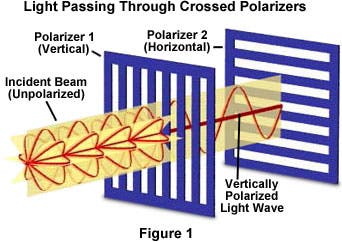
Cross-Polarizers: vertical + horizontal orientations = blocks all light
Light Sources: Randomly polarized: 1 filter block 50% and crossed filter block all
Light reflections: preferential polarization → polarizers in the right direction cut glare down
Refractive Index(n): material property
ration of velocity of light in vacuum to velocity of tight traveling in material
larger n = light is slower
Air, n = 1 → no slowing
performance parameter of interest is ANGLE OF REFRACTION: n1sin(0) = n2sin(02)
as light enters a slower material, it bends toward a surface normal (angel gets smaller)
….
Optical dispersion: material property
describes how much the refractive index of a material varies with the wavelength of incident light
1.5: chem properties
Diffusivity: material property
determining how fast atoms diffuse through a material
xavg = sqrt(Dt)
What effects diffusivity?
temp - higher temp = increase of diffusivity exponentially
type of bonds - stronger bonds = higher Ea = slower diffusion
amount of “open space” between atoms - more space = less resistance = lower Ea = faster diffusion
why polymers diffuse fast
Atomic diffusion in solid state:
Thermally activated atomic process - Arrhenius behavior/process:
begins at rest state, increase in energy needed to squeeze other atoms out of position (transition state) back to rest state
Arrhenius equation: D=Dexp[-Ea/kbT]. ratio of energy requirment to energy available
HIGHER EA = SLOWER DIFFUSION
HIGHER KbT = FASTER DIFFUSION
Durability:
the material and environment determine dominant degradation mechanism
common mechanisms:
solubility
oxidation
corrosion
photodegradation - UV light breaks bonds
Stable State of Elements
Most elements are most stable when formed with oxides, resulting is most materials oxidizing at some rate, which is accelerated within high temperatures
Oxidation:
chemical reaction between a metal and oxygen gas
M+O2 = MOx
if the structure of metal does not equal the structure of MOx, than creaks result in the oxide and lead to fresh metal oxidizing and continued damage
Protective Oxide Layers:
self-terminating oxides form protective coating at a few nanometers thick
protect from further oxidation and can re-form if scratched off
ex. Al → Al2O3, Si→ SiO2, etc.
These elements are mixed with other ones more susceptible to oxidation for protection
Anodization (controlled Oxidation):
through application of a current to the material in an aqueous bath results in a thicker more protective oxide coating
Advantages include:
reduction of harmful oxidation - physical barrier from O2 diffusion
oxide coating has a high hardness → scratch resistence
coloring of material - through dye or voltage
Corrosion (destructive Oxidation):
an electrochemical (redox) reaction, typically with a metal in an aqueous environment
Standard Reduction Potentials (given 3 elements):
what is going to be oxidized? → whatever is lowest on chart.
what is going to be reduced? → next lowest on chart
what is bystander/least reactive → lowest
Galvanic Corrosion:
process when 2 diff metals in electrical contact in water → create galvanic cell
two redox reaction:
oxidation(corrosion) - at the anode [OIL → oxidation is loss)
reduction - at the cathode [RIG → reduction is gain]
rate of corrosion increases with Temp, salt concentration, and PH
elements with smaller standard reduction potentials are more likely to be oxidized - act as anode
elements with larger standard reduction potentials are more likely to be reduced - act as cathode
NOT CORRODED - ONLY REDUCED
PREVENTING galvanic Corrosion
eleminate electrical contact, reduce exposure of metal-metal interface, use CATHODIC PROTECTION: use sacrificial metal (not corroded) (pipe next to pipe ex.)
Galvanizing:
Used to apply to ferrous (iron-based) metal alloys - adds coating of sacraficial metal
most steel dipped in zinc, providing a physical barrier and cathodic protection
1.6 - classifying materials
Major Classes of Materials:
Metals - inorganic, metal alloys, inter-metallics
Ceramics - metal + nonMetal, glass, semiconductor
Polymers - non-metal elements, elastomers
Composites - 2+ material classes or hybrid
Polymer (Plastics):
“Organic solids” - has mostly carbon and hydrogen - may also contain O,N,S,Cl,F and sometimes Si
most identifiable through long carbon chains
solid polymer is entangled “mess of spaghetti” hydrocarbon chains that slide past each other (aka amorphous random arrangment)
most polymers have a amorphous microstructure, some semi-crystalline polymers have a few ordered regions
Mechanical Properties:
LOW elastic modulus (very stretch)
high toughness
may be brittle (depends)
Electrical:
commonly electrically insulating
Thermal:
low thermal conductivity
low service temperature
Optical:
often transparent/translucent
able to be dyed
Chemical:
Corrosion resistant
dissolve/swell in organic solvents
reacts with strong oxidizers and photodegradation
Others:
LOW density → strength per weight ration similar to metals!
easy process into various shapes
low stiffness
low service temp
Elastomers:
have extremely low elastic modulus and very high strain at yield
Ceramics
often composed of oxides and can be other “ides”
Gem stones and most other “rocks” are mostly ceramics
ceramic is referring to the crystalline version of these solids (crystalline = ordered atomic structure)
GLASS: sub class of ceramic w/ amorphous structure
Both crystalline and glass ceramics are brittle and corrosion resistant
differences include crystalline structures (like quartz) being harder, piezoelectric, and have higher melting point
Glass (such as fused silica) is softer, has a lower melting point, is NOT piezoelectric, and is more transparent
Mechanical properties:
stiff but brittle (no plastic deformation, low E at failure, fractures near yield point
Electrical : most ceramics are good insulators
Thermal:
mid thermal conductivity
EXCELLENT temp stability, stable above 1000C -2000C
glass has lower service temp and thermal conductivity
Optical
crystalline is opaque or translucent/transparent, glass is transparent
Chemical:
corrosion resistant
durable against acids/organic solvents
Other:
high hardness
can withstand mech loading in compression, but NOT tension (like bricks)
difficult to machine/shape bc high service temp, stiffness, and hardness
Semi-conductors: sub class of ceramics that are NOT oxides
similar properties except CAN BE conductors
Can be group 4 elements, 3-5 semiconductors, or 2-6 semiconductors
Metals & Metal Alloys
Inorganic solids formed of only metallic elements - can be composed of single element or a mix
almost always crystalline solids
Alloys
A mixture of 2+ elemental metals - crystalline but randomly arranged
Ex. Brass - Cu and Zn - no precise stoichiometry - Zn are randomly placed in Cu lattice
aka solid solution - solute = Zn and solvent = copper
Mechanical properties:
high elastic modulus (stiffness)
pure elemental metals have low yield strength (easy to deform)
alloying improves yield strength
good toughness
Electrical: good conductors
Thermal:
good thermal conductors
intermediate service temps of less than 1000C
exception tungsten which is 3500
Optical:
often opaque in diff ways
relective in UV and visible, absorb longer wavelengths
Chemical: susceptible to corrosion and chemical acid attacks
Other: EASY to machine/deform/shape
Intermetallics:
sub class with PERCISE stoichiometry
crystalline structure w/ repeating pattern - similar to ceramics
compared to other metals and alloys:
less tough, more brittle, higher melting point, higher hardness
Note: nitinol has shape-memory!
Composites
2+ material classes merged to try and obtain both types of properties
Often more expensive than individual classes b/c of manufacturing and processing costs
Ex. Carbon Fiber: ceramic in polymer matrix
2x stiffnes of steel
10x stiffness to weight ratio
creation: take polymer and heat it to get pure C, add stabalizing chemicals, and a polymer matrix
Composite mixing laws:
try to optimize tradeoffs between properties
composites can either show worse or better properties than a simple linear interpolation
properties depend on surface/interface engineering and geometric arangement