Kinematics 1D
#510988
#e4f1f5
#648db4
Introduction
Kinematics is a subfield of physics and a branch of geometry, developed in classical mechanics, that describes the motion of points, bodies (objects), and systems of bodies (groups of objects) without considering the forces that cause them to move. In physics, kinematics studies the geometrical aspects of the motion of physical objects independent of the forces that set them in motion. Constrained motion, such as linked machine parts, is also described as kinematics.
Geometry is a branch of mathematics concerned with the properties of space such as distance, shape, size, and the relative position of figures. It is one of the oldest branches of mathematics, and a mathematician who works in the field of geometry is called a geometer. In geometry, kinematics studies the time dependence of geometrical quantities, such as position, distance, and angular measure, with respect to a frame of reference.
Kinematics differs from dynamics (also known as kinetics), which studies the effect of forces on bodies. The term kinematics comes from cinematique, which is constructed from the Greek word kinema (movement, motion), which is derived from kinein (to move).
It is the study of motion.
Scalars and Vectors
Intro
Scalars and vectors are types of measured quantities. Scalars are magnitude only, like distance; for example, she walked 56 metres. Meanwhile, vectors are quantities with magnitude and direction, like displacement; for example, she walked 56 metres east. Vector quantities have a little arrow pointing to the right on top of their symbol. Since it is a vector, that means that there are two ways that it can change: change in magnitude and change in direction.
Distance is the total length of the path travelled; displacement is the change in an object’s position. Displacements can be either positive or negative depending on the object’s direction of motion from the starting point. The triangle symbol means “change in”
To calculate the average speed, which is specified for an interval of time, you use this equation:

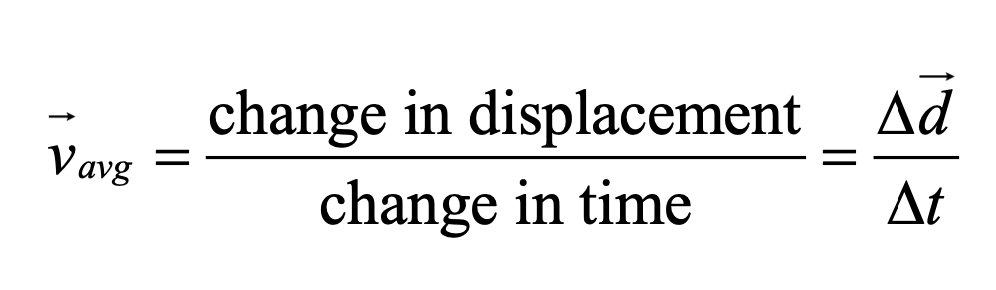
To calculate the average velocity, which is specified for an interval of time, you use this equation:

Instantaneous Motion
Instantenous speed is the speed calculated for a time interval which is very small. Instantaneous speed is a scalar. Instantaneous speed of a car is measured by a speedometer. Instantaneous velocity is the velocity calculated for a time interval which is very small. Instantaneous velocity is a vector.
Uniform Motion
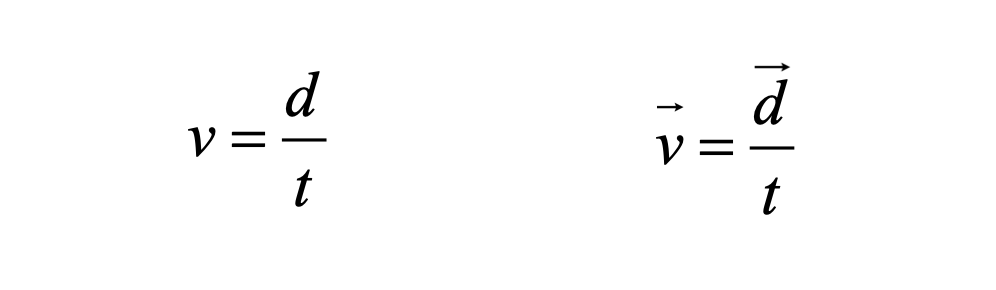
In uniform motion, speed is constant, and velocity is constant as well. In this scenario, the object travels equal distances in equal intervals of time, resulting in no acceleration. The equations for uniform motion are:
Acceleration
Intro
Acceleration is the rate of change of velocity with respect to time. So, an object accelerates when the velocity changes. Acceleration is a vector quantity (must include direction). Positive acceleration means the velocity is increasing, but it does not mean speeding up, and negative acceleration means the velocity is decreasing, but it does not mean slowing down. Whether an object is “speeding up” or “slowing down” is relative to the direction it is headed in, and where it is headed too.To know the change in speed, ou need to know the velocity and the acceleration. If the velocity and acceleration are in the same direction, then the object speeds up. If the velocity and acceleration are in opposite directions, the object slows down.
Slope
Acceleration is the slope of a velocity vs. time graph. The concept of ‘slope’ is typically applied to a straight line (e.g. a linear function). Can we calculate the slope of a curve? We can calculate the slope of a tangent line. A tangent line touches the curve at only one point. Units of acceleration = m/s2.


Acceleration Due to Gravity
A freely falling object will experience acceleration due to gravity. Near the earth’s surface, the acceleration due to gravity is g =9.81 m/s2 down (see formula sheet) We can use any of the equations that describe uniform acceleration. We will usually ignore air friction.