Chapter 7: Motivation Concepts
Motivation Defined
#motivation: The processes that account for an individual’s intensity, direction, and persistence of effort toward attaining a goal.
Intensity of Effort: Intensity refers to how hard a person tries, and it's a central aspect of motivation.
Quality of Effort
Alignment with Organizational Goals: Effort that is directed toward and consistent with the organization's objectives is the kind of effort that should be encouraged and sought after.
Persistence: Motivation also has a persistence dimension, which measures how long a person can maintain effort.
Early Theories of Motivation
1.)hierarchy of needs: Abraham Maslow’s hierarchy of five needs—physiological, safety, social, esteem, and self-actualization—in which, as each need is substantially satisfied, the next need becomes dominant
A sixth need, intrinsic values, has been proposed for the highest level of the hierarchy of needs, but it has not gained widespread acceptance yet.
Original Five Needs by Maslow:
Physiological: Basic bodily needs like hunger, thirst, shelter, and sex.
Safety-Security: Protection from physical and emotional harm.
Social-Belongingness: Affection, acceptance, and friendship.
Esteem: Internal factors like self-respect, and autonomy, and external factors like status and recognition.
Self-Actualization: Drive to fulfill one's potential and achieve self-fulfillment.
Maslow's Hierarchy and Progression: Maslow proposed that as each need is satisfied, the next one in the hierarchy becomes dominant. Understanding an individual's current level in this hierarchy is crucial for effective motivation.
Hierarchy as a Pyramid: The hierarchy is often depicted as a pyramid, although Maslow referred to the needs in terms of levels.
2.) 2 Factor Theory: A theory that relates intrinsic factors to job satisfaction and associates extrinsic factors with dissatisfaction. Also called motivation-hygiene theory.
Herzberg's Dual Continuum: Herzberg proposed a dual continuum where the opposite of job satisfaction is "no satisfaction," and the opposite of job dissatisfaction is "no dissatisfaction."
Two-Factor Theory: Herzberg's theory suggests that factors leading to job satisfaction are distinct from those causing job dissatisfaction. Removing dissatisfaction factors may not necessarily lead to satisfaction.
Hygiene Factors vs. Motivational Factors:
Hygiene factors: Conditions like quality of supervision, pay, company policies, work conditions, relationships, and job security. When adequate, they prevent dissatisfaction but don't necessarily create satisfaction.
Motivational factors: Intrinsic aspects associated with the work or outcomes derived from it, such as growth opportunities, recognition, responsibility, and achievement. These are seen as inherently rewarding.
Criticism of the Two-Factor Theory: mainly concerning Herzberg's methodology and assumptions about participants' bias in recalling job experiences.
#hygiene factors: Factors—such as company policy and administration, supervision, and salary—that, when adequate in a job, placate workers. When these factors are adequate, people will not be dissatisfied
3.) McClelland’s Theory of Needs: A theory that states achievement, power, and affiliation are three important needs that help explain motivation
McClelland's Needs Theory:
Need for Achievement (nAch): Drive to excel and achieve based on a set of standards.
Need for Power (nPow): Desire to influence others to behave in a way they wouldn't have otherwise.
Need for Affiliation (nAff): Desire for friendly and close interpersonal relationships.
Characteristics of High Achievers:
High achievers perform best with a 50–50 chance of success, disliking pure chance or guaranteed success. They prefer goals that require them to stretch themselves.
Research Support and Relationships:
The need for achievement is linked to positive moods, task interest, and performing well under high-stakes conditions.
Need for affiliation and need for power are related to managerial success, with effective managers often having high power needs and low affiliation needs.
Challenges and Practicality:
Measuring the degree of these needs is challenging, and behaviors can be directed at satisfying multiple needs, making it difficult to isolate and examine specific needs.
Managers often label employees based on observations rather than objectively measuring these motivational drivers
Contemporary Theories of Motivation
These are called contemporary because
i.) recent development and relevance
ii.) have a reasonable degree of valid supporting documentation
iii.) The theories are subject to further investigation and potential refinements.
4.) Self-Determination Theory: A theory of motivation that is concerned with the beneficial effects of intrinsic motivation and the harmful effects of extrinsic motivation.
This theory states people prefer to feel they have control over their actions, and anything that
makes a previously enjoyed task feel more like an obligation than a freely chosen activity undermines motivation.
#cognitive evaluation theory: A version of self-determination theory in which allocating extrinsic rewards for behavior that had been previously intrinsically rewarding tends to
decrease the overall level of motivation if the rewards are seen as controlling.
Proposes that, in addition to autonomy, people are driven by the need for competence and positive connections with others.
Autonomy is crucial for attitudinal and affective outcomes, while competence is important for predicting performance.
Effect of Extrinsic Rewards:
Self-Determination Theory and Cognitive Evaluation Theory caution against overreliance on extrinsic rewards to motivate individuals.
Intrinsic motives (strong interest in the work itself) are seen as more sustaining to human motivation than extrinsic rewards.
Extrinsic incentives may undermine intrinsic motivation in many cases.
#Self-Concordance: The degree to which people’s reasons for pursuing goals are consistent with their interests and core values
Self-concordance considers the alignment of reasons for pursuing goals with personal interests and values.
Pursuing work goals for intrinsic reasons leads to higher job satisfaction, organizational fit, and potentially better performance.
Striving Towards Goals and Intrinsic Motivation:
The process of striving toward goals is enjoyable, even if the goal is not achieved, when motivated by intrinsic reasons.
Organizations can increase certain desired behaviors from employees by connecting them with meaningful goals.
5.) Goal-Setting Theory: A theory stating that specific and difficult goals, with feedback, lead to higher performance
Feedback on progress towards goals helps identify discrepancies between actual progress and desired progress, guiding behavior and improving performance.
Goal commitment, task characteristics, and national culture influence the goals-performance relationship.
Goal commitment is likely when employees believe they can achieve the goal and find accomplishing it attractive, especially if they actively participate in goal setting.
Goals affect performance more significantly in simple, independent tasks compared to complex, interdependent ones.
Different cultures may respond differently to specific, difficult goals, and assigned goals may generate greater commitment in high power-distance cultures.
Goal setting is effective but not universally beneficial; inappropriate or excessively challenging goals can undermine adaptation and creativity. e.g. stretch goals
Individuals can be either promotion-focused (striving for advancement) or prevention-focused (fulfilling duties and avoiding distractions) during goal pursuit, affecting their performance and behavior.
Dual Focus Strategies and Outcomes:
Promotion-focused individuals have higher task performance and innovation, while prevention-focused individuals excel in safety performance.
Job Satisfaction and Focus Orientation:
Job satisfaction is more affected by low success for individuals with a prevention-oriented outlook, emphasizing the importance of setting achievable goals and providing structure.
#Management by Objectives (MBO): A program that encompasses specific goals, participatively set, for an explicit time period, with feedback on goal progress.
MBO is a systematic approach to utilizing goal setting, emphasizing participatively set, tangible, verifiable, and measurable goals.
Goals are set at various levels in the organization (divisional, departmental, individual) and form a hierarchy, linking objectives from top to bottom.
Common elements in MBO programs include goal specificity, participation in decision-making (including goal setting), explicit timeframes, and performance feedback.
Commonalities with Goal-Setting Theory:
MBO aligns with the principles of goal-setting theory, emphasizing specific goals, participation in their determination, and providing feedback.
Challenges and Failures of MBO:
MBO programs may fail due to unrealistic expectations, lack of commitment from top management, or issues with rewards tied to goal accomplishment.
Ethical Considerations with Goal Setting:
The relationship between goal setting and ethics is complex.
Tying financial rewards to goal attainment can lead individuals to compromise ethical standards.
Ethical behavior may be influenced by how individuals perceive their use of time and the pressure they experience near goal deadlines. Time pressure may increase the likelihood of unethical actions to achieve goals.
Other Contemporary Theories of Motivation
6.) Self-Efficacy Theory: An individual’s belief that he or she is capable of performing a task.
The higher your self-efficacy, the more confidence you have in your ability to succeed.
High self-efficacy can create a positive spiral where individuals become more engaged in tasks, leading to increased performance, and further boosting self-efficacy.
Self-efficacy is associated with focused attention, which can lead to enhanced task performance.
Feedback influences self-efficacy; individuals with high self-efficacy respond to negative feedback with increased effort and motivation, while those with low self-efficacy may decrease effort.
Changes in self-efficacy over time are related to changes in creative performance.
Integration of Goal-Setting and Self-Efficacy Theories:
Goal-setting theory and self-efficacy theory complement each other.
Managers can enhance employees' self-efficacy by setting challenging goals for them, aligning with the principles of goal-setting theory.
__________________________________________________________________________________________________________
#enactive mastery—that is, gaining relevant experience with the task or job. If you’ve been able to do the job successfully in the past, you’re more confident that you can do it in the future
Sources of Self-Efficacy:
Direct Experience
Vicarious Modeling: Gaining confidence by observing someone else perform a task, especially if you see yourself as similar to that person.
Verbal Persuasion: Gaining confidence through encouragement and persuasion from others who believe in your abilities.
Arousal: Feeling energized and confident, which can enhance performance but might not be suitable for all tasks.
Factors Enhancing Self-Efficacy are Intelligence and Personality
Influencing Self-Efficacy in Others:
Pygmalion Effect: Believing in someone's potential can influence their self-efficacy and lead to a self-fulfilling prophecy.
Enhancing Self-Efficacy in Workplace:
Managers can boost self-efficacy by providing challenging assignments and expectations to employees, enhancing their belief in their abilities.
Training programs that offer interactive practice and feedback can significantly increase self-efficacy, leading to improved performance and skill utilization on the job.
7.) Reinforcement Theory: A theory suggesting that behavior is a function of its consequences
Goal Setting vs. Reinforcement Theory:
Goal setting is a cognitive approach, focusing on individual purposes directing actions.
Reinforcement theory takes a behavioristic view, emphasizing that reinforcement conditions behavior and ignores internal cognitive events.
Reinforcement theory is not strictly a theory of motivation but provides a means to analyze what controls behavior.
Operant Conditioning and Reinforcement:
Operant conditioning theory, a part of reinforcement theory, suggests that people learn to behave in ways to obtain what they desire or avoid what they dislike.
Behavior is influenced by reinforcement or lack of reinforcement based on consequences.
Reinforcement strengthens a behavior and increases the likelihood of its repetition.
B.F. Skinner and Radical Behaviorism:
B.F. Skinner, a key proponent of operant conditioning, demonstrated that people are likely to engage in desired behaviors if positively reinforced.
Skinner's form of radical behaviorism rejects feelings, thoughts, and other mental states as causes of behavior.
Operant conditioning is based on the association of stimulus and response, with conscious awareness of the association being irrelevant.
Social-Learning Theory and Reinforcement
The view that we can learn through both observation and direct experience
Four processes determine their influence on an individuals
Attentional Processes:
Learning from a model occurs when individuals recognize and pay attention to critical features of the model.
People are more influenced by models that are attractive, repeatedly available, important to them, or similar to them.
Retention Processes
Motor Reproduction Processes (convert watching to doing)
Reinforcement Processes:
Individuals are motivated to exhibit the modeled behavior when positive incentives or rewards are provided.
Expectancy Theory
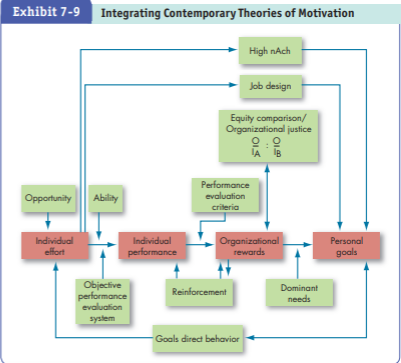
Expectancy theory argues that the strength of our tendency to act a certain way depends on the strength of our expectation of a given outcome and its attractiveness
The theory therefore focuses on three relationships
Expectancy: the effort–performance relationship: The individual's perceived likelihood that exerting effort will result in performance.
Instrumentality: the performance–reward relationship: The extent to which an individual believes that achieving a certain performance level will lead to desired outcomes or rewards.
Valence: the rewards–personal goals relationship: The degree to which organizational rewards align with an individual's personal goals or needs and how appealing these potential rewards are to the individual.
Equity Theory/Organizational Justice
A theory stating that individuals compare their job inputs and outcomes with those of others and then respond to eliminate any inequities
Based on their analysis, they would take one of the 6 decisions
Change inputs (exert less effort if underpaid or more if overpaid).
Change outcomes (individuals paid on a piece-rate basis can increase their
pay by producing a higher quantity of units of lower quality).
Distort perceptions of self (“I used to think I worked at a moderate pace,
but now I realize I work a lot harder than everyone else”).
Distort perceptions of others (“Mike’s job isn’t as desirable as I thought”).
Choose a different referent (“I may not make as much as my brother-in-law, but I’m doing a lot better than my Dad did when he was my age”).
Leave the field (quit the job)
Problems with the concept
Overpayment does not usually significantly impact employee behavior in work settings.
Employees who feel overpaid typically do not compensate by giving back salary or working extra hours
Not everyone is equally sensitive to equity; some individuals may have varying perceptions due to entitlement feelings or preference for lower outcome-input ratios
organizational justice: An overall perception of what is fair in the workplace, composed of distributive, procedural, informational, and interpersonal justice.
Distributive justice is concerned with the fairness of the outcomes, such as pay and recognition, that employees receive
Procedural justice is perceived fairness of the process used to determine the distribution of rewards
If outcomes are favorable and individuals get what they want, they care less about the process
It’s when outcomes are unfavorable that people pay close attention to the process. If the process is judged to be fair, then employees are more accepting of unfavorable outcomes.
Interactional Justice
informational justice: The degree to which employees are provided truthful explanations for decisions
Interpersonal justice: The degree to which employees are treated with dignity and respect
Distributive and procedural justice are more strongly associated with task performance, while informational and interpersonal justice are more strongly associated with citizenship behavior.
Fair treatment elicits positive emotions, which in turn prompts behaviors like citizenship
Fairness is often subjective; what one person sees as unfair, another may see as perfectly appropriate
Research is beginning to suggest that third-party, or observer, reactions to injustice can have a substantial effect.
Job Engagement: the investment of an employee’s physical, cognitive, and emotional energies into job performance.