Was Hitler's Foreign Policy to blame for the Second World War?
Context of the Second World War
The Second World War officially began on September , , following Germany's invasion of Poland. This global conflict erupted only years after the conclusion of the First World War, emerging from the long-standing historical instability and tensions rooted in the aftermath of that earlier struggle.
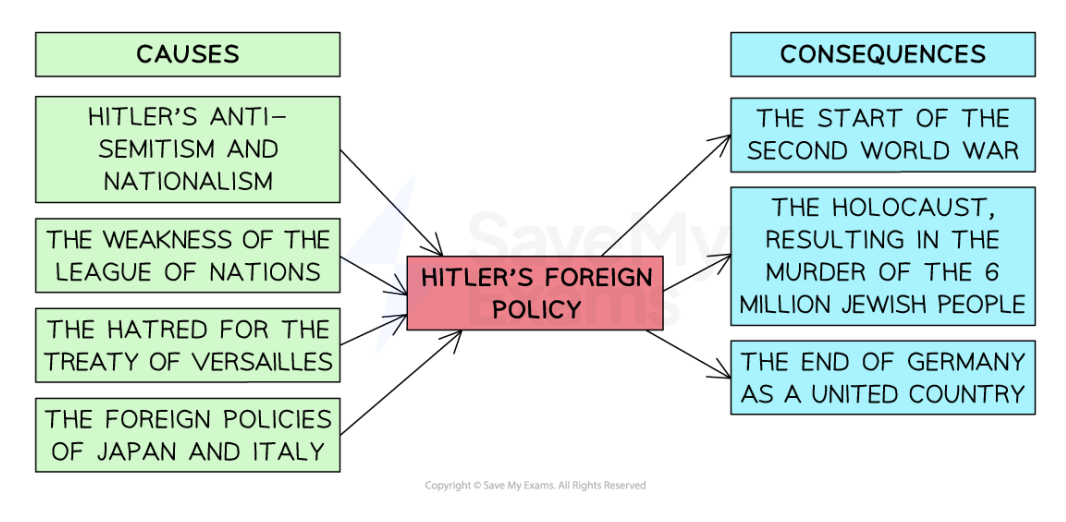
Timeline of Key Events Leading Up to the War
1931: Manchurian Crisis
– Japan invaded Manchuria, showcasing the League of Nations’ weakness.1933: Adolf Hitler became Chancellor of Germany.
1933: Germany left the League of Nations and the World Disarmament Conference.
1934: Non-Aggression Pact signed between Germany and Poland; attempted Nazi coup in Austria.
1935: The Saar plebiscite indicated Germany’s desire to reunite with previously lost territories; Hitler announced Germany's rearmament publicly.
1936: Remilitarisation of the Rhineland occurred, defying the Treaty of Versailles.
1938: Anschluss: Germany’s annexation of Austria; the Sudeten Crisis led to the Munich Conference; Germany invaded significant parts of Czechoslovakia.
1939: Complete occupation of Czechoslovakia and the signing of the Nazi-Soviet Pact paved the way for the invasion of Poland.
Alliances and Major Powers
At the start of the Second World War, the Axis Powers consisted of Germany, Italy, and Japan. In contrast, Britain and France united as the Allied Powers.
The USSR: Initially signed the Nazi-Soviet Pact with Germany in August . However, the USSR joined the Allies in after Germany broke the pact and invaded Russia.
The USA: Did not enter the war until December following the Japanese attack on Pearl Harbor, at which point they joined the Allied forces.
Historical Perspectives on the Causes of the War
Orthodox View
Claims that Adolf Hitler's aggressive foreign policy was the primary cause. Historians argue Hitler followed a meticulous, intentional plan for expansion, as evidenced by:
The remilitarisation of the Rhineland () and the Anschluss ().
A robust rearmament program suggesting he was actively preparing for conflict.
Revisionist View
Argues Hitler was not primarily responsible or that he did not intend to start a global war. These historians contend that:
Hitler was an opportunist and a "normal German leader" in his foreign policy aims.
The Great Depression of the increased support for the Nazi Party while leaving Britain and France without the money or desire to oppose aggressive nations.
The Treaty of Versailles was a primary cause; it was harsh enough to foster German hatred but weakly enforced, allowing Germany to rebuild its power.
Combination of Views
Some historians believe Hitler was a strategist with clear foreign policy aims, but acknowledge he would not have achieved them without the weakness of European leaders and the failure of the League of Nations.
The Long-Term Consequences of the Treaty of Versailles
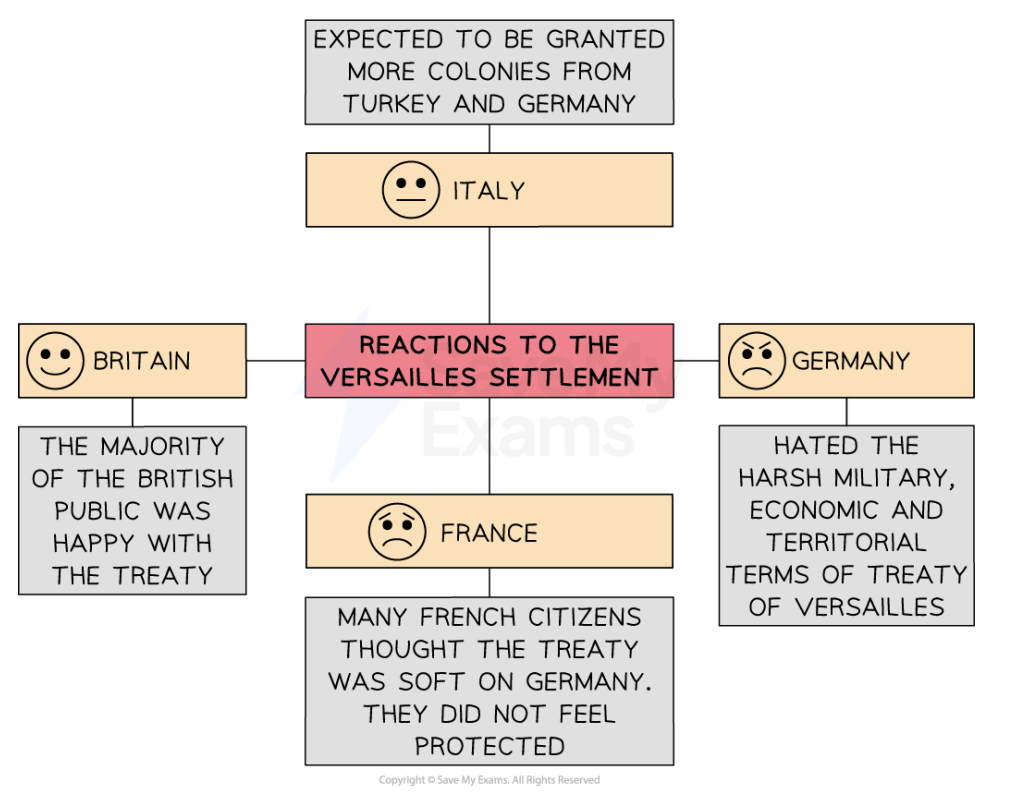
After the TOV was signed more people fear of the USSR than Germany
Britain wanted Germany to be stronger to protect Europe from communism
Long-Term Consequences of the Treaty of Versailles
The ‘Dolchstoss’ Myth: Many Germans felt betrayed by the "November Criminals" who signed the treaty. Because most Germans now felt humiliated and weak than the rest of Europe. The TOV raised nationalism into Germany.
Economic Turmoil: Post-treaty instability and reparations led to the rise of extremist parties.
Rise of Hitler
The reparations caused 2 economic depression within 10 years. Extremist parties like the KPD and the NSDAP gained support. And Hitler wrote a book called “Mein Kampf” after he was arrested from the Munich putsch.
Key Concepts in Mein Kampf
Aryan Superiority: Advocated for racial purity and against intermarriage with Jews.
Lebensraum: The requirement for additional territory in Eastern Europe for German expansion.
Revocation of Versailles: Called for the reclamation of lost territories and a powerful military.
Grossdeutschland: The vision of a united Greater Germany for all ethnic Germans.
Hitler knew when he gained enough support he is going to break the terms of the TOV:
However, he did gain public support in July 1932 the Nazi party received 38% of the votes
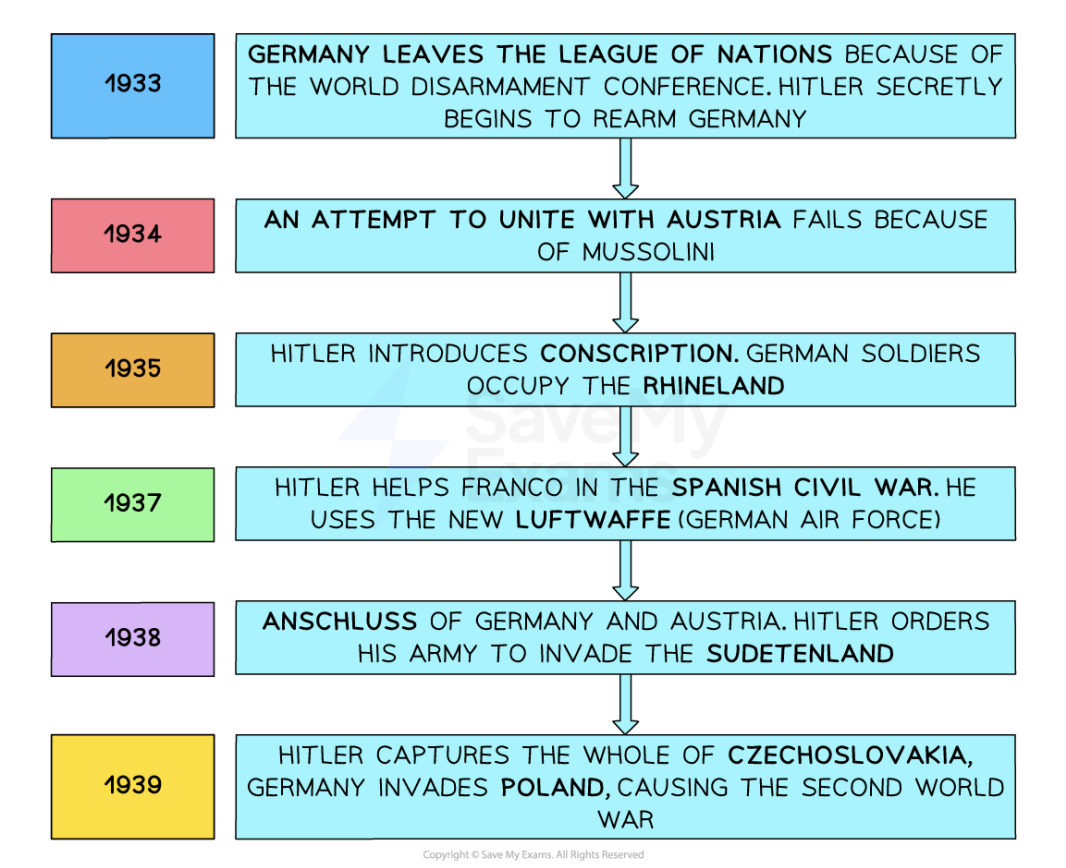
The consequences of the failures of the league of nations in the 1930s
The Impact of Manchuria and Abyssinia
Germany Leaves the League
The Saar, 1935
Remilitarisation Of the Rhineland, 1936
The Spanish Civil War
The Impact of the League of Nations' Failures
The Manchurian Crisis () and Abyssinian Crisis () highlighted the League's inability to manage international conflict.
Strategic players like Britain and France were weakened by the Great Depression, leading to a political environment of militarism and nationalism where Hitler's actions mirrored other autocratic leaders.
Was the policy of Appeasement justified?
Appeasement: Under Neville Chamberlain, Britain and France made concessions to avoid a devastating war. Winston Churchill and others criticized this as failing to recognise Hitler's true ambitions.
How Important was the Nazi-Soviet Pact?
The Nazi-Soviet Pact: Signed August , , providing Hitler the security to invade Poland without fear of Soviet intervention while Stalin gained time for rearmament.
Why did Britain and France declare war on Germany in September 1939?
Outbreak: The war officially began when Britain and France abandoned appeasement and declared war on September , , following the invasion of Poland.