Lecture 13: DNA and RNA Purification, Agarose Gel Electrophoresis, and DNA Visualization
Genetic Information and the Genetic Code
The genetic information of every living organism is stored within the sequence of nucleic acids.
In most organisms, this information resides in deoxyribonucleic acid (DNA). However, some viruses utilize ribonucleic acid (RNA) as their primary genetic material.
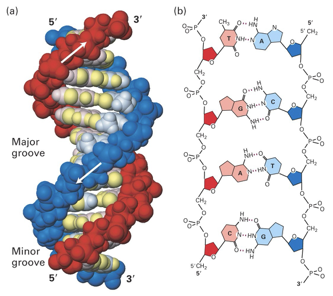
Base Pairing Rules: The fundamental building blocks are purines and pyrimidines, specifically involving Adenine:Thymine and Guanine:Cytosine pairs.
Genomes and Plasmids in Molecular Biology
A genome comprises the full set of nucleic acids that contains all the genes of an organism:
E. coli Genome: Approximately base pairs (bp), containing around genes.
Human Genome: Approximately bp, containing around genes.
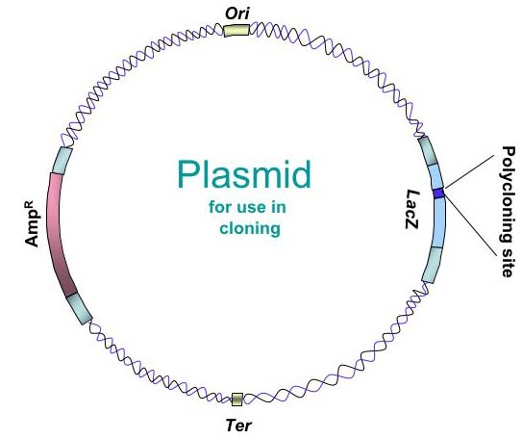
Because a single gene represents an extremely small fraction of the total genome, researchers often use recombinant DNA technology to clone a gene from its source into a plasmid.
Plasmids are defined as pieces of extrachromosomal circular DNA typically found in bacteria.
Fundamentals of DNA Purification
Purposes: Purification of genomic DNA is a prerequisite for gene cloning, gene libraries, PCR (Polymerase Chain Reaction), hybridizations (such as dot blots and Southern blots), RFLP (Restriction Fragment Length Polymorphism), VNTR (Variable Number Tandem Repeats), and sequencing.
Modern Shifts: Historically, purifying genomic DNA was a common first step. However, the rise of PCR and the complete sequencing of the human genome frequently allows scientists to target specific genes directly without prior genomic DNA purification.
Standard Practice: Most contemporary laboratory methods focus on the purification of plasmid DNA via a process known as a "miniprep."
Comparison with Proteins: Unlike proteins, DNA can be purified using organic solvents. It is highly stable at room temperature, and experiments typically require only small quantities of the material.
DNA Extraction and Purification Methodologies
Basic Protocol: Most procedures follow a sequence of cell lysis, removal of contaminants, and purification of DNA using a column.
Key Reagents:
Proteinase K: An enzyme that degrades most proteins, including nucleases that might damage DNA. It remains active in the presence of SDS, EDTA, urea, and across a wide range of pH levels.
Additional Reagents: , Ethanol, Phenol, Chloroform, and Centrifugation.
Common Techniques:
Crude Lysate: Cells are heated and treated with Proteinase K; this is quick but results in a relatively "dirty" sample.
Salting-out/Precipitation: Uses potassium acetate (), centrifugation, and alcohol to precipitate DNA.
Anion Exchange: The negatively charged DNA backbone binds to positively charged beads, followed by alcohol precipitation.
Cesium Chloride () Gradient: Provides very high purity through density gradient centrifugation but is exceptionally time-consuming.
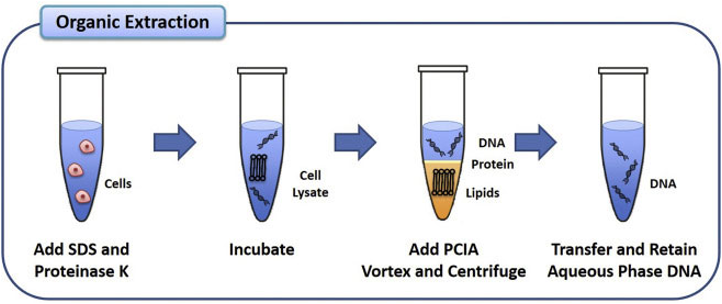
Organic Solvents (Phenol-Chloroform Extraction): Uses a mixture of phenol, chloroform, and isoamyl alcohol, or PCIA. Phenol holds the aqueous phase (DNA/RNA), while chloroform holds the organic phase (proteins/debris). It is tedious and carries risks of residual organics and hazardous waste.
Silica-based Methods: These rely on the selective adsorption of DNA to silica-based gel/columns when chaotropic salts are present.
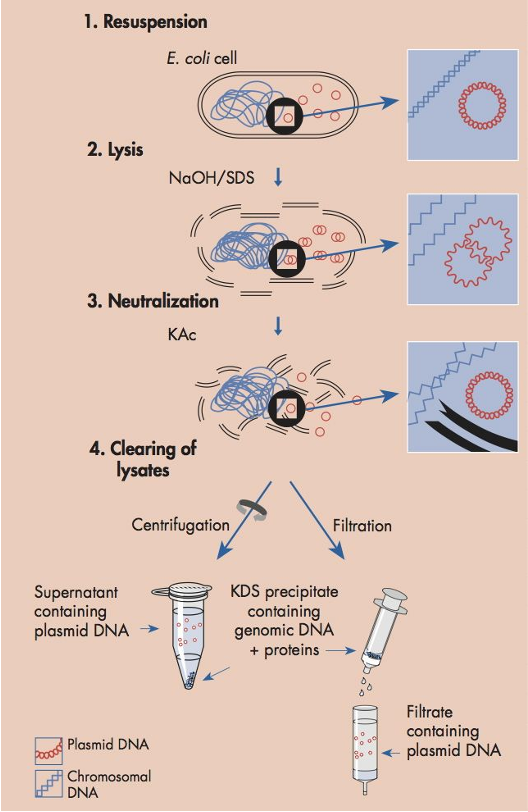
Alkaline Lysis: Gentler and cleaner involving several specific steps:
Resuspension of cell
Lysis where SDS breaks up phospholipid bilayer and NaOH dissolves structural proteins
Neutralization
Agitation, precipitation, and centrifugation
Plasmid Purification and Scaling
Cloned genes are generally stored within plasmids rather than as free-floating DNA.
Post-growth in E. coli, plasmids must be purified for downstream applications like PCR, sequencing, or long-term storage.
Many methods are based on alkaline lysis and silica-based beads
Miniprep: Yields to of DNA.
Midiprep, Maxiprep, Megaprep, Gigaprep: Can yield up to of DNA.
Commercial kits exist for specific needs, such as isolating very large plasmids or ensuring samples are endotoxin-free.
Practical Tip: Growing bacteria overnight in of media from a single white colony can pellet of pure plasmid in a volume.
Select a white colony, grow bacteria overnight in 2 ml media, pellet
Resuspend cells
Lyse cells with different chemicals
Neutralize lysate
Spin it down and bind to column
Wash the column multiple times and elute DNA
DNA and RNA Quantification
Quantification is essential for determining yield for subsequent assays, typically performed via a spectrophotometer or Nanodrop ( or smaller samples).
Absorptivity Standards (A260):
An of equals for double-stranded DNA (dsDNA).
An of equals for single-stranded DNA (ssDNA)
Purity Ratios:
A_{260}/A_{280} > 1.5 indicates pure DNA.
measurements are used to detect organic contaminants.
Proteins absorb at 280 nm.
RNA Purification: Challenges and RNase Management
RNA isolation is critical for cDNA generation, Northern blots, RT-PCR, and in vitro translation.
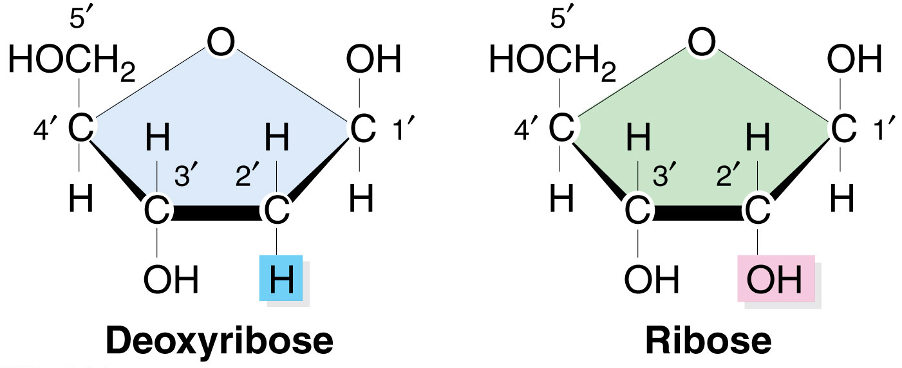
Stability Issues: RNA is vastly more susceptible to degradation than DNA because of the hydroxyl group () which acts as a nucleophile adjacent to the phosphodiester linkages, where it attacks its own backbone and breaks down
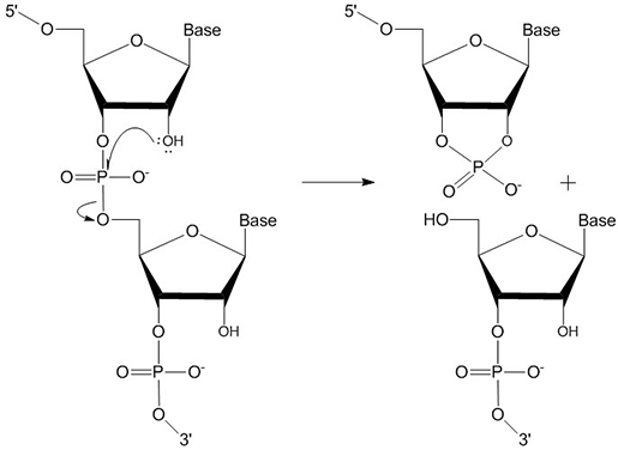
mRNA Features: The cap and polyA tail offer limited protection against degradation.
RNase vs. DNase:
DNases require metal ions for activity and can be easily inactivated with EDTA.
RNases (specifically RNase A) do not require metal ions, are ubiquitous (found in high concentrations in cells, tissues, and on human hands to combat pathogens), and are extremely resilient.
RNase A (a single strand specific endoribonuclease)
Found in cells and tissues in high amounts
Also on hands to fight pathogens and in miniprep reagents, thus contamination is possible
Resistant to metal chelating agents
Can survive prolonged boiling or autoclavfing
Handling RNase Contamination:
Use molecular biology grade chemicals and sterile techniques.
Wear gloves at all times.
Bake glassware at overnight to denature enzymes.
Use inhibitors: -mercaptoethanol (-ME), diethyl pyrocarbonate (DEPC), guanidium isothiocyanate, or recombinant ribonuclease inhibitors.
Advanced RNA Isolation Techniques
Cell type and target RNA is relevant
Different cell types can contain different RNA amounts
mRNA may make up only 1-5% of total RNA, polyA tail binds to oligo-dT (Alanine binding to Thymine) on beads or columns
RNA purification is similar to DNA purification: solubilize cellular components, denature proteins, remove lipids, inactivate RNases
Various protocols: cesium chloride gradient, organic solvents and chaotropic salts, detergents like SDS, spin columns, magnetic beads
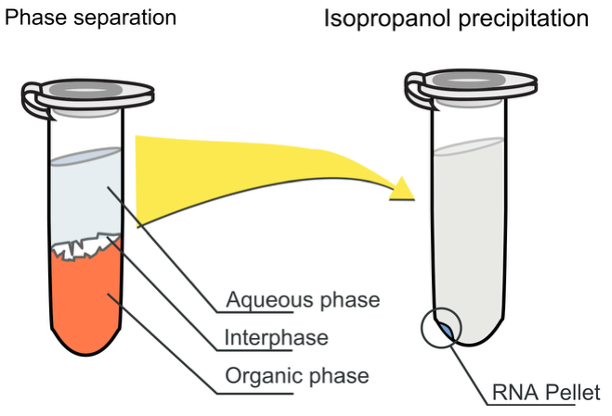
Chomczynski and Sacchi Method (): A landmark protocol utilizing "TRIzol," which contains phenol, chloroform, and guanidinium isothiocyanate. Used to denature proteins and inactivate intracellular RNases.
At , RNA stays in the aqueous phase while DNA remains in the organic phase.
At , DNA is isolated.
Protocol for mRNA:
Harvest cells
Add TRIzol
Centrifuge RNA ends up in aqueous phase
Transfer to new tube and add isopropanol
Precipitate the RNA out of solution in pellet
Add RNA to oligo dT column (binds to the Alanine (A) in mRNA)
Contaminants should flow through (especially ribosomal components)
mRNA will elute last
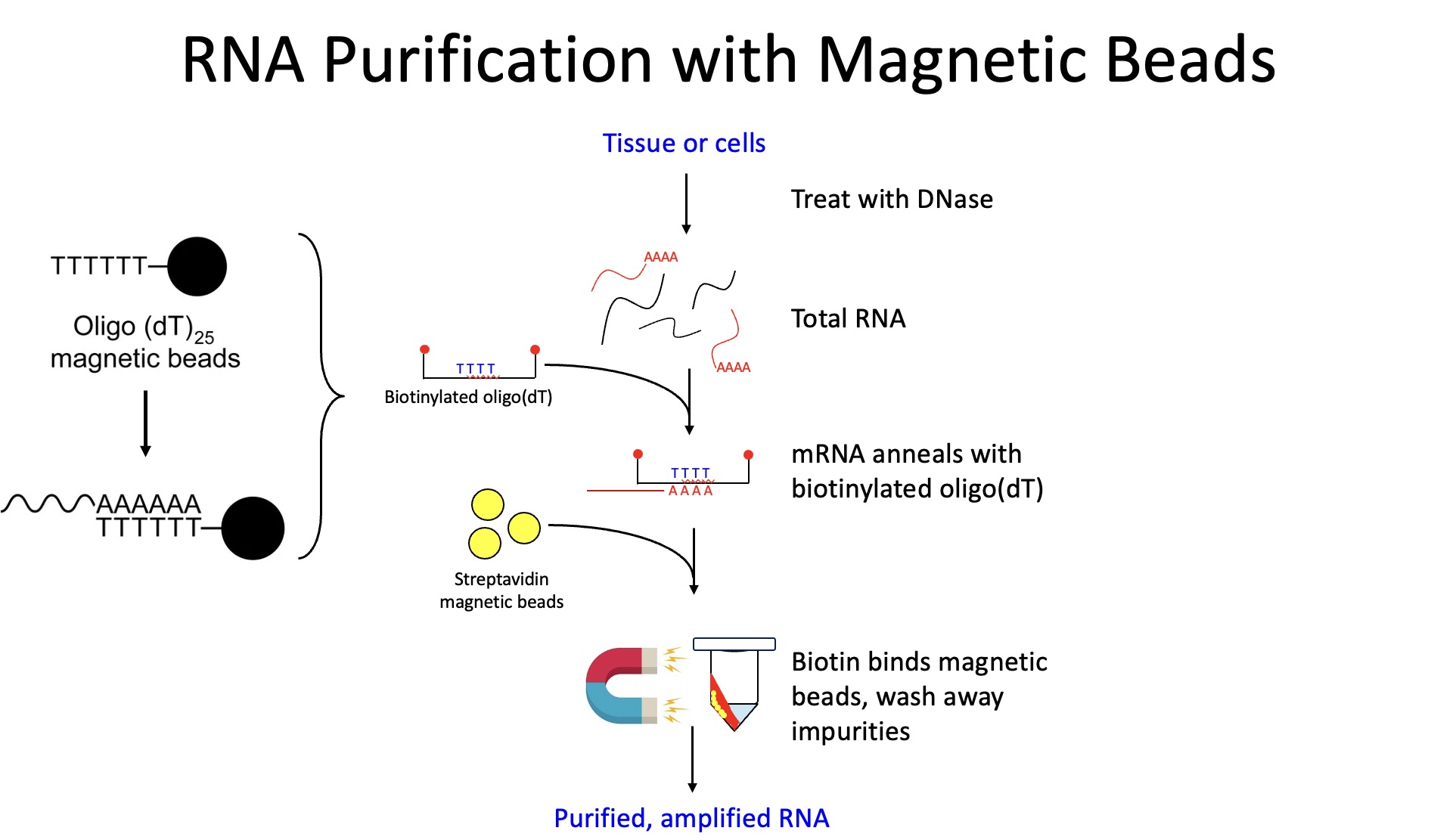
Oligo dT: A bunch of Ts (thymines) that help you purify mRNA
Can be done on a column or magnetic beads
PolyA tail of mRNA binds to Ts
Streptavidin binds to biotin on magnetic beads
RNA Quantification
RNA quantification is nearly identical to DNA quantification, in the spectrophotometer or nanodrop
A of 1.0 = 40 μg/ml
A :A > 1.8 = pure
Cellular RNA can be quantified through other techniques:
Gel electrophoresis
Northern blotting
RT-qPCR
Gel Electrophoresis Principles
Concept: Electrophoresis is used to monitor PCR progress, digestions, and minipreps. At alkaline , nucleic acids are negatively charged and migrate toward the positive electrode (anode) in an electric field.
Charge-to-Mass Ratio: DNA has a uniform charge-to-mass ratio; everytime a base pair is added two phosphates are also added; separation is based strictly on size and friction
Gel Types:
Polyacrylamide Gel Electrophoresis (PAGE): Used for small DNA fragments (< 200 \, bp).
Agarose Gel Electrophoresis: Preferred for larger molecules (> 200 \, bp).
Agarose Mechanics: Agarose is a polysaccharide (galactose and galactopyranose) derived from red seaweed. Typically, a gel ( per buffer) is used.
Buffers:
TAE (Tris-Acetate-EDTA): Faster run times.
TBE (Tris-Borate-EDTA): Provides better resolution of bands.
Agarose is added to the buffer and microwaved
Loading: DNA is loaded into wells perpendicular to the current. Unlike protein gels, agarose gels do not require a stacking gel because they are significantly thicker.
Sample Loading and Migration Variables
Sample Loading Buffer: Added to DNA in concentrations ranging from to . Includes Tris, EDTA, glycerol/Ficoll (for density), and tracking dyes like Xylene cyanol.
Dye Migration: The migration of tracking dyes depends on the gel percentage. For instance, Xylene cyanol runs at roughly in a gel but at only in a gel.
Physical Properties: The isoelectric point of DNA is approximately . Electrophoresis occurs at to ensure a strong negative charge.
Smallest fragments run fastest and farthest; larger fragments slower and less
Markers
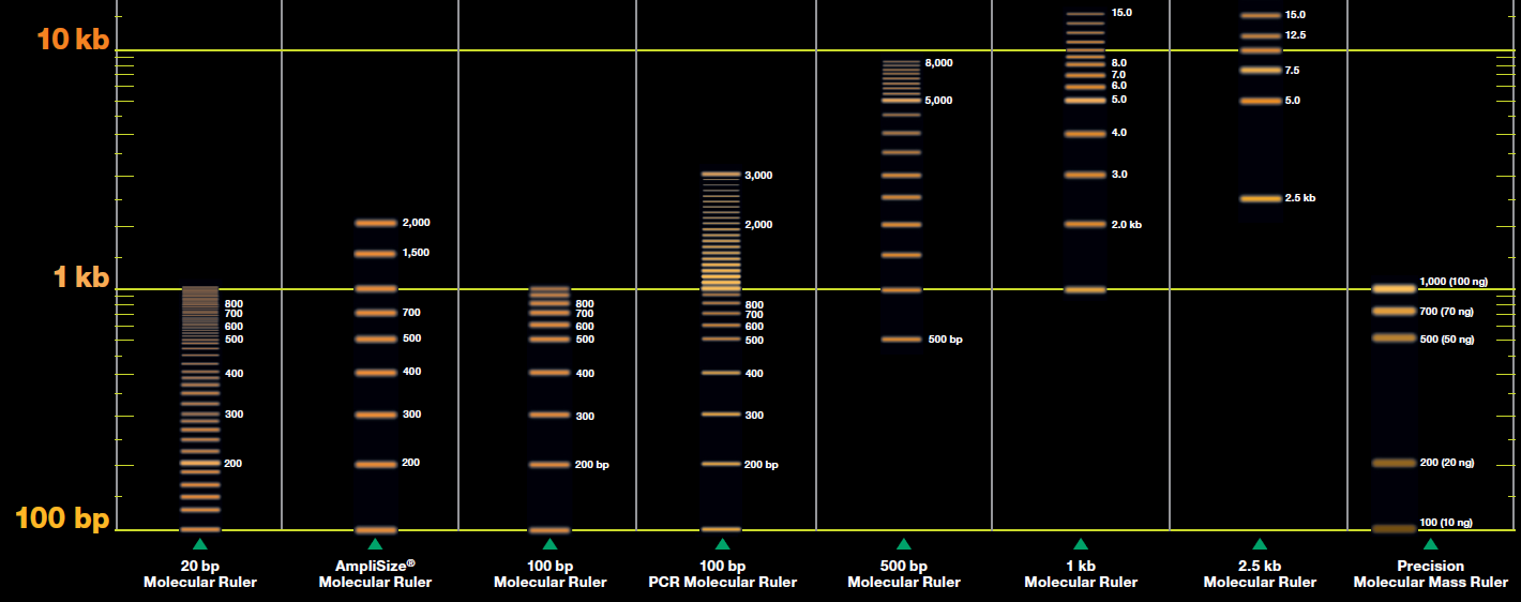
Gels contain markers of known molecular mass for comparison
The migration distance of fragments in the gel will be inversely proportional to the log of the number of base pairs
There are markers for both linear and supercoiled DNA
Intensities can be compared to estimate a band’s concentration (quantification)
DNA Conformations and Migration Patterns
DNA exists in several shapes which greatly affect its speed through the gel:
Linear DNA.
Supercoiled DNA (various degrees).
Circular DNA (single-stranded, double-stranded, or nicked).
Nicked = two layered circular DNA cut only on the outer strand
Catenated = linked up DNA
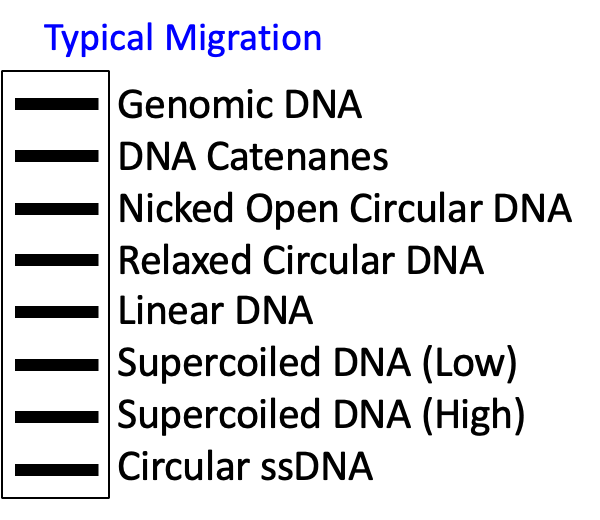
Nicked open circular and relaxed circular DNA typically move the slowest.
Supercoiled DNA (High density) moves the fastest due to its compact shape.
Analysis Strategy: Since different conformations make size identification difficult, it is easiest to digest DNA with restriction enzymes to ensure it is all linear before running the gel.
If run without digestion:
Slowest (Top):
Genomic DNA
DNA Catenanes
Nicked Open Circular DNA
Relaxed Circular DNA
Linera DNA
Supercoiled DNA
Circulas ssDNA
Fastest (Bottom)
Pulsed-Field Gel Electrophoresis
Pulsed-field gel electrophoresis: Large DNA fragments (up to 1 mbp) can be separated in an agarose gel by using multiple electrodes to vary the current direction
Standard electrophoresis is limited to ~50 kb
Can be used for genotyping
RNA Gel Electrophoresis
RNA can be run on an agarose gel to check the sample’s purity, analyze ribosomal components, verify RT-PCR products, or as a first step to northern blotting
High purity is important (A260:A280 > 1.8)
Typically an RNA formaldehyde gel is used
DNA and RNA Visualization
UV Shadowing
Nucleic acids absorb UV light at .
Passing UV light through a gel creates shadows over the bands on a surface.
This requires high concentrations of DNA to be visible.
Ethidium Bromide (EtBr):
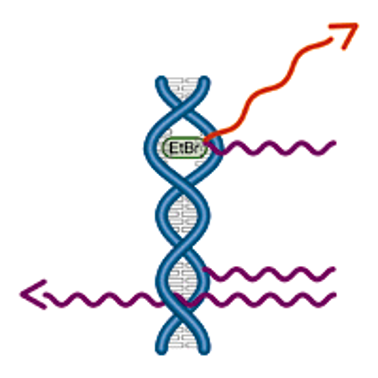
A common intercalating agent that becomes highly fluorescent under UV light when intercalates to nucleic acids.
Detects nanogram quantities of DNA and dsRNA.
Can be added to gel or soaked afterwards
Has a + charge so runs opposite to DNA (runs up the gel)
Nanogram detection of DNA; visulizes as pink bands
Must be handled as hazardous waste; can cause a lot of mutations
Alternative Dyes:
SYBR Green/SYBR Gold: More sensitive than EtBr (detects as low as ). Binds via electrostatic interaction with phosphate and minor groove interaction. Classified as SYBR Safe stain after Ames test done on bacteria.
Methylene Blue and Crystal Violet: Allow real-time visualization without UV, but are not sensitive (detect only microgram quantities).
Autoradiography: DNA is labeled with radioactive and exposed to X-ray film. This is the most sensitive method but is less common today due to safety concerns.
Safety and Toxicity Discussion
EtBr Controversies: EtBr is a mutagen in the Ames test on bacteria (after liver homogenate treatment), leading to concerns about carcinogenicity. However, it is also used as a treatment for African Sleeping Sickness in cattle. To reach a toxic dose, a researcher would need to consume of staining solution.
SYBR Safe: Some data suggests cells may be more permeable to SYBR Safe than EtBr, making it potentially more toxic in specific cellular contexts.
Gel Electrophoresis Applications
Applications of gel electrophoresis include…
DNA analysis, quantification, and purification
RNA analysis
Plasmid insert verification
PCR product verification
Restriction enzyme digestion fragment analysis
Southern blotting (DNA analysis via RFLP, VNTR)
Northern blotting (RNA)
DNA Sequencing
Gel Extraction: Unlike protein gels, DNA can be easily recovered from agarose gels.
Cutting the band out and purifying it via silica columns
"freeze squeeze" in parafilm
automated systems like CloneWell (E-Gel) where DNA is pipetted directly out of the well as the band enters it.