Final Practice Exam (M1 + M2)
Midterm 1:
The black-footed ferret was declared extirpated from the Canadian prairies in the 1980s. What is the significance of its successful reintroduction to the Canadian prairies?
A. The reintroduction effort demonstrates that extinction is always reversible through conservation initiatives.
B. It suggests that species extirpation in one region does not impact their global extinction risk.
C. It shows that extirpated species can recover if their ecological niches and habitats are restored.
D. The success indicates that genetic diversity in captive populations is enough to prevent extinction in the wild.
E. The reintroduction does not contribute to species recovery because extirpation is a natural ecological process.
A testable explanation for a set of observations is called __________________?
A. a quantitative question.
B. an induction.
C. an experiment.
D. a mechanistic approach.
E. a hypothesis.
Which of the following represents an example of deductive reasoning in biology?
A. Observing multiple plants in sunlight and concluding that all plants require sunlight.
B. Based on the premise that plants perform photosynthesis, we predict that leaves exposed to light will produce more oxygen.
C. Generalizing that aquatic plants photosynthesize after observing algal oxygen production.
D. Measuring leaf chlorophyll levels and forming a hypothesis about photosynthesis rates.
E. Noticing that plants wilt in the absence of water and assuming all plant processes stop without water.
Which of the following accurately describes the scientific process based on repeatable observations of the natural world?
A. Scientists exclusively rely on deductive reasoning to formulate hypotheses.
B. Generalizations in science are derived from one-time, unrepeatable observations.
C. Scientists do not make predictions when formulating hypotheses.
D. Scientists use inductive reasoning to make generalizations and generate hypotheses.
E. Hypotheses can be conclusively proven true through experimentation.
In taxonomy, what is a taxon?
A. A scientific name for a species.
B. The highest rank in the hierarchy.
C. A category at any rank in the classification hierarchy.
D. A unique identifier for a subspecies.
E. A specific trait used in classification.
In what way does the hierarchical nature of Linnaean taxonomy support the binomial nomenclature system?
A. It avoids redundancy by limiting the use of specific epithets.
B. It organizes species within progressively broader categories, ensuring clarity.
C. It ensures that species names reflect exact evolutionary relationships.
D. It allows the reuse of genus names within unrelated taxa.
E. It provides a complete description of an organism's morphology.
If someone writes the scientific name of the sunflower as “Helianthus Annuus,” how many of the following errors did they make according to binomial nomenclature rules?
1. The genus name must not be capitalized
2. The genus and specific epithet must be italicized
3. The genus name must be abbreviated as “H.”
4. The specific epithet must not be capitalized
5. The entire name must be written in all caps
6. Both names must be in lowercase letters
7. The genus name must come second, not firstA. 3.
B. 6.
C. 4.
D. 2.
E. 5.
What is a valid way to write the scientific binomial name of tomato?
A. S. lycopersicum.
B. Solanum lycopersicum.
C. Solanum l.
D. Solanum Lycopersicum.
E. solanum lycopersicum.
F. Two of the above answers are correct.
The most recent common ancestor of birds and mammals was a very early reptile, which almost certainly possessed three-chambered hearts (two atria, one ventricle). Birds and mammals, however, are alike in having four-chambered hearts (two atria, two ventricles). The four-chambered hearts of birds and mammals _______________.
1.are analogous.
2. are vestigial structures.
3. are the result of shared ancestry.
4. are homologous.
5. evolved independently.A. 1 and 3.
B. 3 and 5.
C. 2 and 3.
D. 1, 4, and 5.
E. 1 and 5.
Which of the following types of evidence is not useful for distinguishing between homologous and analogous traits?
A. Trait complexity
B. The number of taxa in a clade
C. Anatomical similarities
D. Genetic similarities
E. Developmental similarities
Consider a phylogenetic tree with branch lengths proportional to evolutionary change. Which conclusion can be drawn about two taxa with longer branches leading to their tips compared to their sister taxa?
A. They are more closely related to each other than to their sister taxa.
B. They diverged more recently from their common ancestor than their sister taxa.
C. They are positioned higher in the evolutionary hierarchy.
D. They represent basal taxa.
E. They have undergone more evolutionary change since diverging from their common ancestor.
A phylogenetic tree shows taxa A, B, and C. Taxa A and B are sister taxa, while taxon C is basal. Which statement about taxa A and B is accurate?
A. They share more derived characters with taxon C than with each other.
B. Their shared traits are more likely to be ancestral than derived.
C. Taxon C is more closely related to taxon A than to taxon B.
D. They share a more recent common ancestor with each other than with taxon C.
E. Taxon C shares more morphological similarities with taxon B than taxon A.
A biologist examines a phylogenetic tree and notices a polytomy, where a single branch splits into three or more lineages. What is the most likely explanation for this pattern?
A. The taxa in the polytomy are distantly related.
B. The evolutionary relationships among the taxa are unresolved.
C. The taxa in the polytomy share a recent common ancestor with fully known relationships.
D. The common ancestor of the taxa underwent extensive evolutionary divergence.
E. The polytomy indicates a more complex evolutionary history than simple two-way (dichotomous) branching.
The figure below shows the best-supported hypothesis for the phylogeny of flowering plants (Angiosperms). Which of the following statements accurately describes the relationships shown?
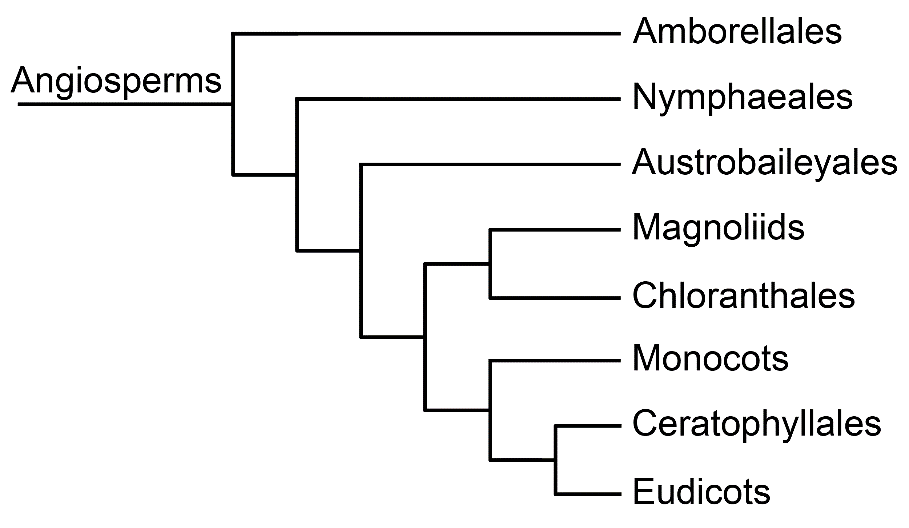
A. Eudicots is equally closely related to Monocots and Magnoliids.
B. Nymphaeales is more closely related to Amborellales than it is to Austrobaileyales.
C.Chloranthales is more closely related to Monocots than it is to Ceratophyllales.
D. Austrobaileyales is more closely related to Chloranthales than it is to Eudicots.
E. Magnoliids is more closely related to Monocots than it is to Austrobaileyales.
In a phylogeny of vertebrates, mammals and birds are shown as separate clades, but both have warm-bloodedness. How should this trait be interpreted in the context of the tree?
A. Warm-bloodedness evolved independently in mammals and birds.
B. Warm-bloodedness is a shared derived character uniting mammals and birds.
C. Warm-bloodedness is an ancestral trait inherited from the common ancestor of all vertebrates.
D. Warm-bloodedness is a homologous trait supporting a close relationship between mammals and birds.
E. Warm-bloodedness is an artifact of incomplete data
An example of a postzygotic barrier to sexual reproduction is:
A. Two orchid species belong to different genera.
B. Polyploid hybrid offspring of two plant species can fertilize other such polyploids, but not interbreed with either parent species.
C. Canada lynx and bobcats produce fertile hybrid offspring.
D. The blue-footed booby and the red-footed booby are not attracted to each other's mating dance.
E. The sperm of a coral species fertilizes the eggs of a different coral species, producing embryos that die within a day.
If two populations of plants flower at different times of the year, preventing cross-pollination, this would be an example of:
A. Gametic isolation
B. Temporal isolation
C. Habitat isolation
D. Mechanical isolation
E. Hybrid infertility
Elk (Cervus elaphus), the most common large grazing mammal found in Banff National Park, is parasitized by the winter tick (Dermancentor albipictus). The winter tick larvae feed on the blood of their elk hosts, maturing over winter, before mating in the spring. The fertilized females then drop off their host elk to lay their eggs on the ground. Another grazing mammal, the plains bison (Bison bison bison) was extirpated from Banff National Park around 140 years ago before being reintroduced in 2018. If some of the female winter ticks develop a strong preference for feeding on bison blood and mate only with male winter ticks that prefer bison blood, then over time how many of the following events should occur in the winter tick population, if the host mammal can be considered as the winter ticks’ habitat?
1. Reproductive isolation; 2. Sympatric speciation; 3. Allopatric speciation; 4. Habitat isolation; 5. Prezygotic barriers.A. 4 events
B. 1 event
C. 2 events
D. 3 events
E. 5 events
Sympatric speciation might be driven by sexual selection when:
A. A population becomes separated into distinct habitats by a natural disaster.
B. Gene flow increases between two previously separated populations.
C. Physical barriers prevent individuals from different populations from mating.
D. Individuals develop preferences for certain mates based on traits like coloration, even without geographic isolation.
E. The population experiences a mutation that leads to complete reproductive isolation.
What is a major challenge to the process of sympatric speciation?
A. The need for a physical barrier to separate populations.
B. Lack of genetic variation in the population.
C. High potential for gene flow between diverging groups.
D. The requirement for hybrid sterility to drive speciation.
E. The inability of natural selection to act in sympatric populations.
How might hybrid speciation lead to the formation of a new species rather than reinforcing or weakening reproductive barriers?
A. Hybrids are always at a disadvantage, preventing speciation.
B. Hybrids can inherit unique combinations of traits that allow them to exploit a new ecological niche.
C. Hybridization always weakens reproductive barriers, leading to fusion.
D. Hybrid species result only from autopolyploidy in plants.
Hybridization is only a temporary process that does not affect long-term evolution. A newly discovered insect species has two populations that emit different mating pheromones. When placed together, they ignore each other as potential mates. What type of reproductive barrier is this?
A. Temporal isolation
B. Hybrid sterility
C. Gametic isolation
D. Behavioural isolation
E. Reduced hybrid viability
A species of marine invertebrate feeds on two different types of seaweed, red and green, in the same habitat. A subgroup begins to specialize on red seaweed and only mates with others that do the same, while another subgroup prefers green seaweed. Over generations, these subgroups stop interbreeding. What type of speciation is likely occurring?
A. Allopatric
B. Sympatric
C. Hybridization
D. Temporal
E. Spontaneous
Two species of European fire-bellied toads (Bombina bombina and Bombina variegata) form a hybrid zone where their ranges overlap. Hybrids exhibit lower fitness than either parent species, yet they continue to be produced each generation. What evolutionary outcome does this scenario illustrate?
A. Reinforcement
B. Fusion
C. Stability
D. Hybrid speciation
E. Genetic drift
What is the most likely long-term evolutionary outcome in a hybrid zone where hybrids have lower fitness than the parent species?
A. The hybrid zone will expand, leading to the merger of the two species.
B. The emergence of a third species that outcompete both parent species.
C. Continuous hybridization without significant effects on parent species.
D. Extinction of both parent species due to the fitness cost of hybrids.
E. Reinforcement of reproductive barriers, reducing hybrid formation over time.
Midterm 2:
Approximately how far back in time does the fossil record extend?
A. 3.5 million years.
B. 5.0 million years.
C. 3.5 billion years.
D. 5.0 billion years.
Scientists identified a layer of fossils that represents a major decline in biodiversity followed by a period of low diversity. Which explanation best fits this pattern?
A. Fossilization only occurred in one region, skewing biodiversity data.
B. An adaptive radiation event led to a burst of new species.
C. A mass extinction event caused a loss of biodiversity, followed by gradual recovery.
D. Organisms evolved larger sizes over time, limiting biodiversity in the record.
E. Fossils in this layer only represent a single type of organism, suggesting no biodiversity changes.
Following a volcanic eruption that creates isolated habitats, a group of small mammals is found to diversify into several species, each with unique adaptations to the island's niches. What process best explains this diversification?
A. Coevolution with local flora
B. Adaptive radiation due to new ecological opportunities
C. Convergent evolution with unrelated species
D. Environmental resistance to genetic drift
E. Gradual replacement of previous mammals through gene flow
The Great Oxygenation Event from 2.7 to 2.3 billion years ago __________________.
A. Increased prokaryote diversity.
B. Was caused by phototrophic eukaryotes.
C. Was caused by ancient colonial prokaryotes known as stromatolites.
D. Was attributable to cyanobacteria.
E. Was advantageous for early prokaryotes.
The Miller-Urey experiment demonstrated the synthesis of amino acids under conditions similar to early Earth. What important concept did this experiment support in the context of life's origins?
A. The first cells formed directly from amino acid clusters.
B. Early Earth conditions favoured complex molecules rather than simple ones.
C. Life began with DNA formation under simple environmental conditions.
D. Organic molecules could form abiotically, providing building blocks for life.
E. Amino acids only form under controlled laboratory conditions.
Match the numbered terms to the description that follows. Choose all the appropriate terms. Description: a prokaryote that obtains both energy and carbon as it decomposes dead organisms.
1. Autotroph; 2. Heterotroph; 3. Phototroph; 4. ChemotrophA. 1, 3, and 4
B. 1 only
C. 4 only
D. 2 and 4
E.1 and 3
A bacterial strain isolated from an industrial waste site is capable of breaking down complex organic compounds and exhibits a thick layer of peptidoglycan in its cell wall, which stains purple in a Gram test. To which group of bacteria does this strain likely belong?
A. Proteobacteria
B. Cyanobacteria
C. Gram-positive bacteria
D. Archaea
E. Spirochetes
Bacterial transduction is ________________.
A. Transfer of genetic material between prokaryotic cells via a pilus.
B. Incorporation of foreign DNA from the surrounding environment.
C. Transfer of genetic material between prokaryotic cells via bacteriophage.
D. A mode of unidirectional horizontal gene transfer that can lead to the rapid spread of antibiotic resistance.
E. Genetic recombination during sexual reproduction between two bacteria.
Which of the following nutritional modes are only found in prokaryotes?
A. Photoautotrophs.
B. Photoheterotrophs.
C. Chemoautotrophs.
D. Chemoheterotrophs.
E. Two of the above are correct.
Which of the following groups is known for living in extreme environments, such as salt lakes and hot springs?
A. Cyanobacteria
B. Gram-positive bacteria
C. Archaea
D. Proteobacteria
E. Spirochetes
Given the wide range of habitats inhabited by prokaryotes, how does their diversity in nutritional modes contribute to their ecological success?
A. Their ability to use various energy sources and carbon substrates allows them to thrive in many environments, including extreme ones.
B. They rely solely on photosynthesis for energy, dominating well-lit environments.
C. They have specialized nutritional modes that limit them to specific niches.
D. They rely on animal hosts for nutrition, limiting their ecological success to symbiotic relationships.
E. They only utilize organic compounds for energy and carbon, restricting them to nutrient-rich environments.
Rhizobium species are ___________________.
A. Common pathogens in soils.
B. Chemoheterotrophic decomposers in soils.
C. Phototrophic mutualists of lichens.
E. Endosymbiotic mutualists of leguminous plant roots.
D. Phototrophic, nitrogen-fixing soil bacteria.
Which of the following is characteristic of the Chlamydias clade of bacteria?
A. Free-living, heterotrophs.
B. Peptidoglycan is absent from the cell wall.
C. Mutualists in the intestines of many mammals.
D. Chemoheterotrophic decomposers.
E. Gram-positive cell walls.
Which term describes an interaction where one organism benefits at the expense of another?
A. Commensalism
B. Mutualism
C. Competition
D. Symbiosis
E. Parasitism
18. Which of the following statements best distinguishes eukaryotic cells from prokaryotic cells?
A. Eukaryotes contain membrane-bound organelles, including a nucleus, while prokaryotes do not.
B. Eukaryotic cells are exclusively multicellular, whereas prokaryotic cells are always unicellular.
C. Eukaryotes have circular DNA stored in the nucleus, whereas prokaryotes have linear DNA in the cytoplasm.
D. Eukaryotic cells lack ribosomes, while prokaryotic cells possess ribosomes for protein synthesis.
E. Eukaryotic cells perform photosynthesis, while prokaryotic cells do not.
Green algae differ from plants in that many green algae ___________________.
A. Are heterotrophs.
B. Have plastids.
C. Are unicellular.
D. Have cell walls containing cellulose.
E. Have alternation of generations.
What event marked the end of the Archean Eon and resulted in the extinction of many prokaryotic groups?
A. The Permian mass extinction
B. The formation of stromatolites
C. The Cambrian explosion
D. The Great Oxygenation Event
E. The Cretaceous mass extinction
Which statement best describes the process of serial endosymbiosis in the evolution of eukaryotic cells?
A. Plastids evolved before mitochondria through endosymbiosis with aerobic prokaryotes.
B. Ancestral prokaryotes gradually developed endomembranes that evolved to become mitochondria and plastids.
C. The sequential incorporation of prokaryotic endosymbiont cells led to the formation of mitochondria and plastids.
D. Mitochondria evolved from plastids through a series of endosymbiotic events.
E. Cyanobacteria evolved from archaeal ancestors through endosymbiosis with eukaryotic cells.
Which of the following correctly describes the difference between primary and secondary endosymbiosis?
A. Primary endosymbiosis involved the engulfment of a prokaryote, while secondary endosymbiosis involved an early eukaryote engulfing another eukaryote that had already undergone endosymbiosis.
B. Primary endosymbiosis leads to three membranes around the engulfed organelle, whereas secondary endosymbiosis results in two membranes.
C. Primary endosymbiosis occurred in plants, while secondary endosymbiosis occurred in animals only.
D. Secondary endosymbiosis led to the evolution of mitochondria, while primary endosymbiosis led to chloroplasts.
E. Secondary endosymbiosis happens exclusively in prokaryotic cells.
The role of secondary (2°) endosymbiosis in the diversification of protists involves:
A. Prokaryotic cells engulfing eukaryotic cells
B. Eukaryotic cells engulfing prokaryotic cells
C. Eukaryotic cells engulfing other eukaryotic cell
D. Prokaryotic cells dividing by binary fission
E. Eukaryotic cells undergoing mitosis
Which of the following scenarios best explains how secondary endosymbiosis has affected protist diversity?
A. Protists that have undergone secondary endosymbiosis are less metabolically flexible, limiting their ability to adapt to changing environments.
B. Secondary endosymbiosis allowed for the acquisition of plastids, enabling protists to adapt to both autotrophic and heterotrophic lifestyles.
C. Secondary endosymbiosis prevents protists from obtaining energy independently, limiting diversity.
D. Secondary endosymbiosis forced all protists to rely solely on photosynthesis.
E. Secondary endosymbiosis only allowed protists to thrive in nutrient-poor environments.