Impression Evidence: Fingermarks
Impression Evidence
Overview
Definition: Impression Evidence is a general term describing markings created when two surfaces come into contact, leaving distinct markings on one or both surfaces.
Categories:
Indentations: Three-dimensional contact patterns where the contact pattern IS the evidence.
Bullet land and groove indentation
Imprints: Two-dimensional contact patterns.
Finger prints
type writers , printers
Fingerprints
Fingerprints are a commonly encountered form of physical evidence.
Definition: Fingerprints are the chance reproduction of friction ridges left on a conducive surface, developed through chemical or physical means.
The term "chance impression" is used because not every contact with a surface results in the transfer of fingermarks.
Fingerprints have been recognized as a form of individualization by nearly every ancient culture.
Stone engraving
Seals in the form of a contract signing by using their fingerprints
Fingerprints are 3-d sphereical circle there not flat
Fingerprint Types
The residues of friction ridges left on a surface are referred to as “fingerprints.”
There are three basic categories of fingerprints:
Latent Prints: Not readily visible to the naked eye.
ex: powder etc
Patent Prints: Readily visible to the naked eye.
ex: blood photograph was then lifted afterward
Plastic Prints: Impressed into a soft surface.
ex: clay impression was created by pressing a finger into the material, capturing a unique pattern that can be analyzed for identification.
Friction Ridges
Friction ridges are the surfaces on the inner portions of hands and feet, also referred to as papillary surfaces.
These ridges form in definite formations that can be observed and classified.
Purpose: Friction ridges enable the ability to subtly grip objects, a mechanism learned over years of development.
Palm Prints
Palm prints can also provide individualizing data.
The ridges on palms form in a manner very similar to those on fingertips.
Three regions:
Interdigital: upwards where the 4 Fingers reside
Thenar: left side where the thumbs reside
Hypothenar: right side of the palm, specifically involving the area related to the pinky finger.
Development
Each person has a unique set of fingerprints.
Fingerprint ridge lines begin to develop 100-120 days after conception (approximately 10 weeks).
Friction ridges are thought to develop due to pressure under the skin interacting with surface tension as the fetus grows.
Different types and locations of pressure result in different friction ridge patterns.
Friction ridges are formed through pressure and surface tension.
Skin Structure
Layers of Skin:
Epidermis.
Dermis.
Hypodermis.
Other Components:
Veins, arteries, hair follicles, fat cells, pores, stratum corneum, arrector pili muscle, hair shaft, oil gland, nerve ending, hair matrix, dermal papilla, and sweat gland.
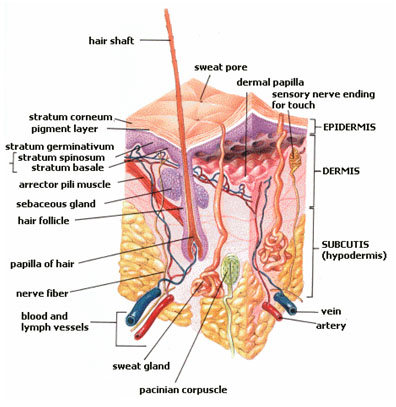
Dermal and Epidermal Interaction
Dermal papillae pegs connect with primary and secondary ridges of the epidermis.
Layers of Epidermis:
Horny.
Hyalin.
Granular.
Spinous.
Basal.
Finger Pad Development
Development of fetal finger pads occurs from 6 weeks to 17 weeks.
Computer models show stress fields across a three-dimensional spherical surface area, resulting in patterns like friction ridges.
Axis of Digit and Pad
Axis of digit Long side: thumbs up
Axis pad: curvature should be analyzed for clarity, as it can greatly impact the accuracy of fingerprint identification.
11 weeks. Lesser developed pads may exhibit simpler ridge patterns, which become more complex as gestational age increases.
14 weeks. More developed pads will display distinct and intricate ridge formations, demonstrating the advancement of dermatoglyphic features that can be identified in later stages.
Each print growth doesn’t radiate out there at random
Fingerprint Patterns
Arches
Loops
Whorls
Pad Types and Corresponding Patterns
High Pad = Whorl
Low Pad = Arch
Mid Pad = Loop
No two fingers are the same, you are not born with all arches,whorls, loops
It’s a mix of all three or between mixes
Permanence and Alteration
Friction ridges are "born" in the dermal layer.
The patterns that develop in the dermal layer are permanent for a person's lifetime, with a few exceptions due to aging or injury.
It is virtually impossible to change fingerprint patterns.
The pattern exists below the epidermis, so damage to the epidermis will not alter the pattern; pattern-altering damage must occur in the dermal layer.
Can you burn your fingerprints off? Yes, with acid or through extreme heat, but these methods do not guarantee complete removal, and the patterns will typically reemerge as the skin heals.
Key Components for Classification
Core: The approximate center of the pattern.
Delta: A point on a ridge at or near the point of divergence or convergence of at least two line types.
The delta can develop in different ways, and at the same time
Having both is very useful, but having none or few would be less useful in a case
Arch Patterns
Arches are the simplest fingerprint patterns.
They enter one side of the print, rise smoothly like a wave, and exit on the opposite side.
Arches make up about 5% of the fingerprint population.
in up,down,out so they tend to not have a delta
Loop Patterns
Loops are friction ridge patterns that can form in either direction.
Ulnar Loop: Exists facing the ulna bone. Face pinky
Radial Loop: Exits facing the radius bone. face thump
Loops are the most common pattern, encountered in approximately 65% of fingerprints.
Loops are characterized by an abundance of friction ridges on one side. The pattern curves around and exits on the SAME SIDE.
By looking at a fingerprint pattern, can you tell which is radial and which is ulnar? No, you need context to determine the specific type of loop, especially in crime, as knowing what direction the fingerprint was made is hard from a single print. If you have more prints or hand print its strong evidence but without context there no way.
Loop patterns enter on one side then flip and exit out on the same side

Whorl Patterns
Whorl patterns are characterized by one or more friction ridges forming full revolutions around the central core.
Whorl patterns often feature two or more deltas.
Whorls are encountered in approximately 30% of fingerprints.
Fingerprint Residue Composition
The fingerprint residues discovered at crime scenes are composed mostly of:
Water (~98.5%)
Oil/Fat/Amino Acids (~1%)
Foreign Substances (0.5%)
Oil is secreted from the sebaceous glands found all over the body except the palms and soles of the feet; these are found around hair follicles.
We touch ourselves, so that’s why we have oils all over our hands/feet. This transfer of oils can create a fingerprint pattern on surfaces, which is critical in forensic investigations.
Sweat is secreted from sweat glands (eccrine glands) found all over the body, including the palms and soles of the feet.
Minutiae
There are approximately 150 different friction ridge formations on the most distal phalanx (uppermost joint) alone.
No such thing is partial print; rather, any print that is captured must contain sufficient minutiae to be considered a full fingerprint suitable for analysis.
These ridge formations are called "minutiae."
Minutiae are used to determine if there is enough information in the fingerprint for individualization.
Types of Minutiae
Bifurcation
Bridge
Double Bifurcation
Dot (Island)
Trifurcation
Island (Eye)
Crossing
Ridge Ending
Spur
Ridge Break
Ridge Characteristics
Ridge characteristics are known as bifurcations, ridge endings, islands, short ridges and fragments.
No two fingers ever have these characteristics similarly grouped.
Bifurcation: A ridge that divides to form two ridges.
Ridge Ending: The termination of a ridge.
Island: A ridge that divides to form two ridges which then rejoin again to form a single ridge.
Short Ridge: A ridge of limited length.
Fragment: A ridge of extremely short length.
Not all fingerprint have all minutiae
Fingerprint Development
Fingerprints can be developed using two different categories of developing reagents:
Physical: Powders dusted onto the print directly; adhere to water and oils within the print to visualize them.
Chemical: Reagents that react with a chemical component of the print, such as oils, fats, and amino acids.
Before processing a surface for latent print development, the technician must carefully consider the nature of the surface.
Smooth, non-porous surfaces are best suited for physical development.
Flexible, porous materials are best suited for chemical development.
Chemical Development Reagents
Reagent Name | Chemical Action |
|---|---|
Cyanoacrylate (Super Glue) | Polymerizes |
Ninhydrin (Nin-Dry) | Amino Acids |
1,2 Indanedione | Amino Acids |
1,8-Diazafluoron-9-one (DFO) | Amino Acids |
Silver Nitrate | Salt Ions |
Multimetal Deposition (Gun Blue) | Sebum |
Iodine Fuming (Iodine) | Fat |
Leuco-Crystal Violet (LVC) | Heme |
Crystal Violet (Wet Powder) | Fat |
Documentation Examples
1,2 Indanedione on paper (505nm)
Iodine on cardboard
Wet Powder on adhesive tape
Fluorescent powder on a bottle label (450nm)
Fingerprint Comparison
Once an examiner has indicated all the unique points of comparison for the questioned fingerprint, it can be compared to a database of known fingerprints.
Fingerprints MUST be compared to a known exemplar.
CSTs will frequently collect finger and palm prints from persons who are not suspects but have legitimate access to items; these are commonly called “Elimination Prints.”
I.A.F.I.S. (Integrated Automated Fingerprint Identification System):
Established in 1999 to allow a smooth and effective database for all law enforcement agencies to share data.
The capabilities of the database were expanded after Sept 11, 2001, to include terrorist suspects.
Entry of a questioned fingerprint into a database will produce 10 closely matching known fingerprints based on the computer algorithm.
The analyst must then manually compare the resulting print to certify which of them is a positive correlation with “100% confidence.”
Current population:
70 million in the criminal master file
31 million civilian prints
73,000 known or suspected terrorists.
ACE-V Methodology
Method of confirming the accuracy of a fingerprint “hit.”
A.C.E. V:
Analysis: Analyst determines if the print is suitable for comparison.
Comparison: Analyst identifies the class characteristics and compares the questioned print to known references.
Evaluation: Are there enough minutiae similarities to confirm individualization?
Verification: An additional analyst repeats this process; both analysts MUST agree on the identification.
Fingerprint Evidence
Fingerprints are more unique for individualizing a person than DNA
(Identical twins share the same DNA profile) however not fingerprints
There are currently more than 70 million fingerprints in AFIS.
NO two sets of prints have a positive correlation.
Fingerprints are transferred to a surface by physical contact only.
DNA is highly probative, but in some cases can be introduced to a location by means of secondary transfer.
Fingerprint Limitations
Friction ridge impressions are the most probative individualizing evidence currently investigated.
Fingerprints are very fragile and can be easily smudged or lost; overlapping prints cannot currently be deduced.
Crime Scene Technicians and Latent print examiners rely on a subjective set of criteria to perform their examinations.
Varying the minimum number of minutiae to declare a positive correlation.
Case Study: Madrid Bombing
On March 11, 2004, terrorist bombs concealed in a backpack detonated in commuter trains in Madrid, Spain.
191 people were killed; Basque Separatists claimed responsibility for the event.
Much of the forensic evidence was processed by the FBI in Quantico, VA.
Forensic analysts determined the backpack contained the dynamite used in the event.
A single fingerprint was discovered on the strap of the recovered backpack.
The developed print was damaged, but some minutiae were visible.
The FBI certified the print to belong to Brandon Mayfield, a lawyer in Oregon, who was subsequently arrested.
It soon became clear that he was NOT responsible for the bombing.
The latent print was also analyzed by the Spanish government.