INTRO TO MACROECON
INTRO TO MACROECONOMICS
Macroeconomists generally conclude that markets work well. Macroeconomists, however, observe that some important prices often seem “sticky.”
“Sticky prices” are prices that do not always adjust rapidly to maintain the equality between quantity supplied and quantity demanded.
| Macroeconomic Concerns |
|---|
Three of the major concerns of macroeconomics are:
- Inflation
- Output Growth
- Unemployment
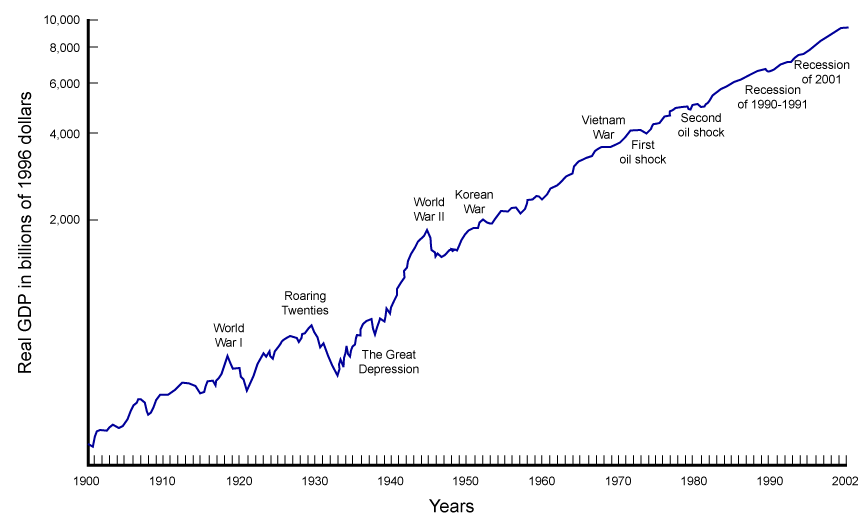
Real GDP, 1900-2002
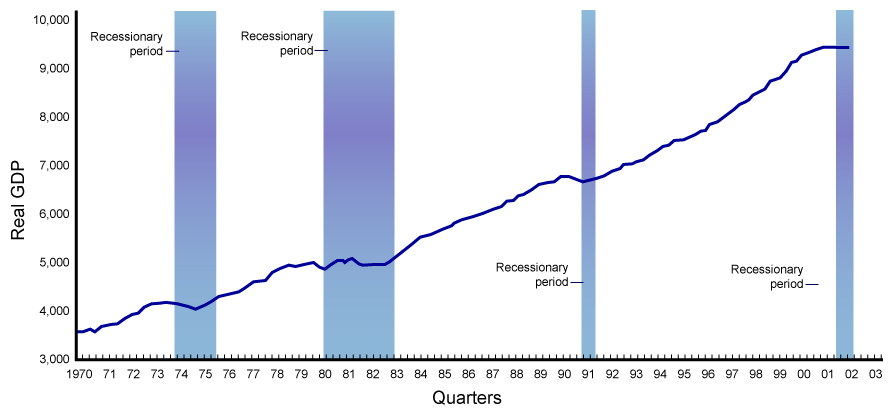
Real GDP, 1970 I-2003 II
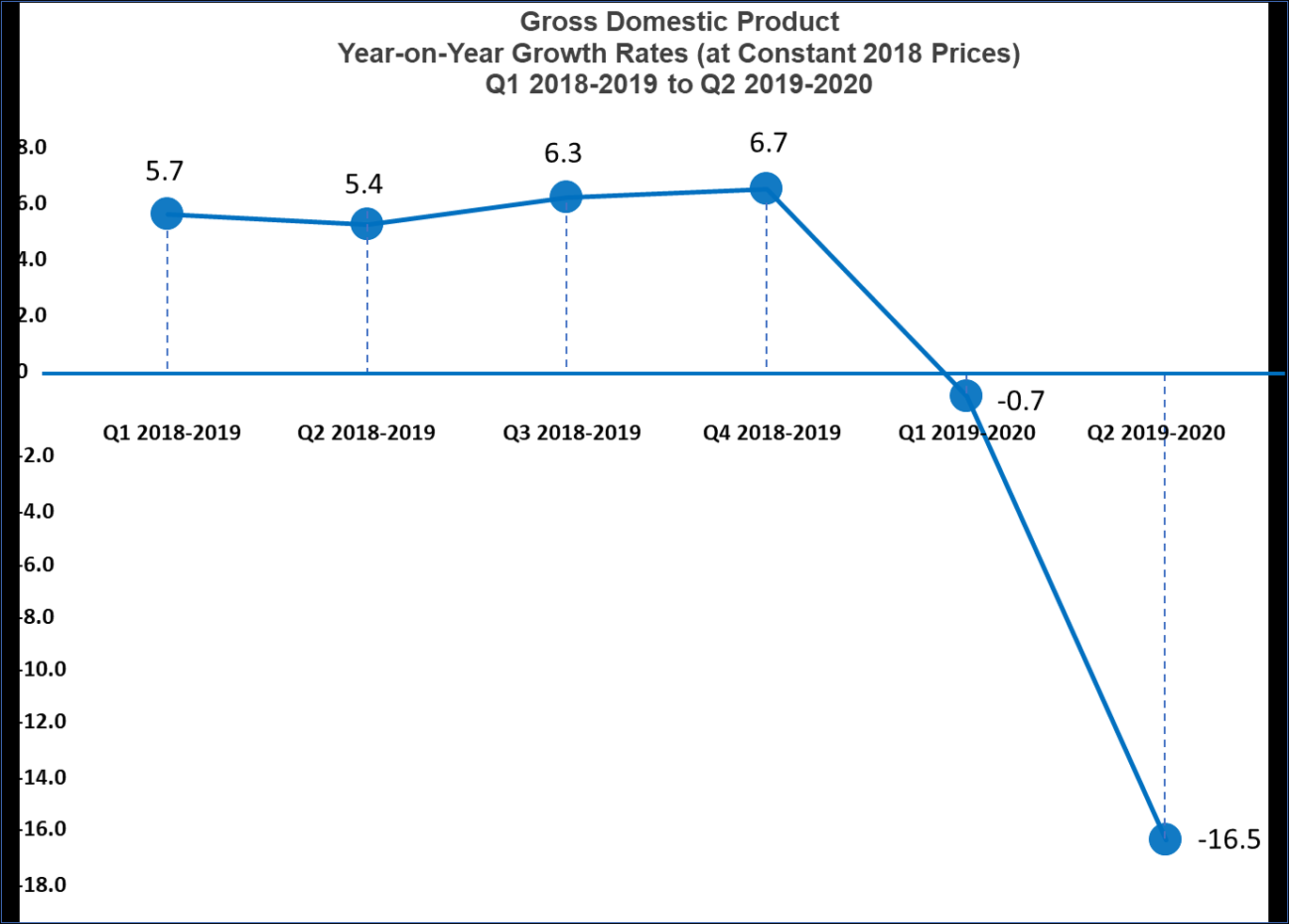
Philippine Growth Rate (RGDP)
| The Roots of Macroeconomics |
|---|
In 1936, John Maynard Keynes published The General Theory of Employment, Interest, and Money.
Keynes believed governments could intervene in the economy and affect the level of output and employment.
During periods of low private demand, the government can stimulate aggregate demand to lift the economy out of recession.
Keynes is the founding father of Macroeconomics.
Keynes believed that the government can do something to solve economic problems and that it should intervene in the economy. (KEYNESIAN SCHOOL OF THOUGHT)
MACROECONOMICS - is the study of the entire economy as a whole rather than individual markets only.
The decision of the country/ Behavior of the country
- It focuses on the:
- whole economy (GDP)
- Inflation (general price level)
- employment/unemployment
- aggregate demand (AD)
- Productive capacity of economy
- It makes predictions based on
- DATA
- THEORETICAL MODELS
- HISTORICAL MODELS
| Government in the Macroeconomy |
|---|
There are three kinds of policy that the government has used to influence the macroeconomy:
- Fiscal Policy - refers to government policies concerning taxes and spending.
- Monetary Policy - consists of tools used by the Federal Reserve to control the quantity of money in the economy.
- Growth or Supply-Side Policies - are government policies that focus on stimulating aggregate supply instead of aggregate demand.
| Macroeconomic Concerns |
|---|
➤ Unemployment
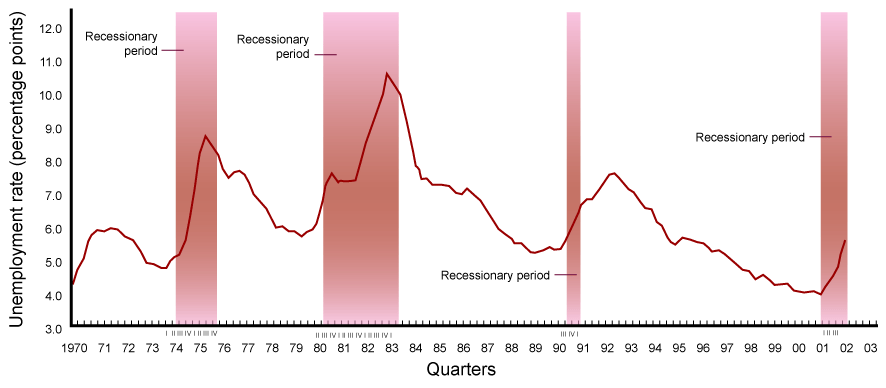
- The unemployment rate is the percentage of the labor force that is unemployed.
- The unemployment rate is a key indicator of the economy’s health.
- The existence of unemployment seems to imply that the aggregate labor market is not in equilibrium. Why do labor markets not clear when other markets do?
Unemployment Rate, 1970 I-2003 II
➤ Inflation and Deflation
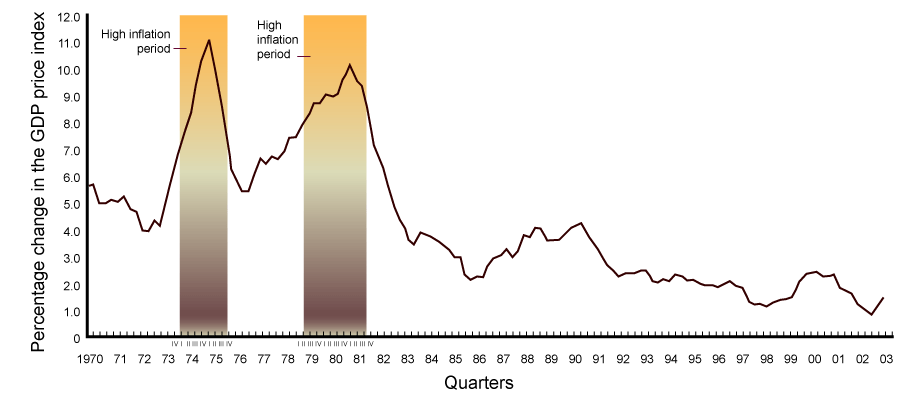
↳INFLATION is an increase in the overall price level.
↳HYPERINFLATION is a period of very rapid increases in the overall price level.
- used to study the costs and consequences of even moderate inflation.
↳DEFLATION is a decrease in the overall price level.
-prolonged periods of deflation can be just as damaging for the economy as sustained inflation.
Philippine inflation remained above target for a fourth month in April with headline inflation staying at 4.5%, unchanged from March. Inflationary pressures emanated from the index-heavy food component and transport costs.5 May 2021
Percentage Change in the GDP Deflator (Four-Quarter Average), 1970 I-2003 II
Venezuela
“In the 1970s world energy crisis, Venezuela was a highly profitable oil producer. After oil prices dropped once the energy crisis ended in the 1980s, Venezuela’s chief export greatly declined in revenue and its economy began to suffer. Despite the decline in exports, Venezuela still needed to spend large sums of funding on the importation of basic goods for its people. This led to inflation, as the country dug itself into deficit spending. To pay for imported goods, Venezuelan banks then printed out paper notes not backed by actual wealth.
Now, inflation in Venezuela has reached monumental levels of devastation. Venezuela has been in hyperinflation since November 2016, when the inflation rate exceeded 50 percent. The International Monetary Fund estimates that inflation in Venezuela will exceed ten million percent by the end of 2019.
Because of this economic crisis, poverty is widespread. In 2017, the poverty rate across Venezuelan households reached 87 percent. On top of widespread poverty, food and medical supply shortages are rampant across Venezuela. The health of its people has deteriorated as weight loss and the spread of disease inflict the nation.
Currently, the Venezuelan government rejects the International Monetary Fund’s option to default on its debt. Venezuelan U.N. representatives have commented that in order for the nation to progress, it needs internal structural changes, not foreign aid.”
◼RECESSION◼
A recession is a macroeconomic term that refers to a significant decline in general economic activity in a designated region. It had been typically recognized as two consecutive quarters of economic decline, as reflected by GDP in conjunction with monthly indicators such as a rise in unemployment.
◼DEPRESSION◼
An economic depression is an occurrence wherein an economy is in a state of financial turmoil, often the result of a period of negative activity based on the country's Gross Domestic Product (GDP). It is a lot worse than a recession, with GDP falling significantly, and usually lasts for many years.
A lot worse than a recession, with GDP falling significantly and usually lasting for many years.
◼STAGNATION◼
Stagnation is a prolonged period of little or no growth in an economy. Real economic growth of less than 2% annually is considered stagnation, and it is highlighted by periods of high unemployment and involuntary part-time employment. Stagnation can occur on a macroeconomic scale or a smaller scale in specific industries or companies. Stagnation can occur as a temporary condition, such as a growth recession or temporary economic shock, or as part of a long-term structural condition of the economy.
◼STAGFLATION◼
Stagflation is characterized by slow economic growth and relatively high unemployment—or economic stagnation—which is at the same time accompanied by rising prices (i.e. inflation).
Stagflation can also be alternatively defined as a period of inflation combined with a decline in the gross domestic product (GDP).
It is a combination of stagnation and inflation.
📍Four Resources that we need to properly allocate to avoid scarcity.
- LAND
- LABOR
- CAPITAL
- ENTREPRENEURSHIP
➤ Gross Domestic Product (GDP) is the value of all final goods and services produced within a country’s border in a specific period of time usually in a year.
• It is measured in DOLLARS
• If the GDP is low or declining, unemployment is rising.
GDP per capita - shows a country’s GDP divided by it’s total population.
➤ Growth Rate is the percentage change in the value of produced goods and services produced in a nation during a specific period of time, as compared to an earlier period.
• It is used to measure the comparative health of an economy over time.
➤ School of Thought is the belief on how you understand situations
➤ Classical School of Thought is a belief that if there is an economic problem, the government should not interfere.
➤ Keynesian School of Thought is a belief that the government should be involved in helping the economy grow.
➤ Invisible Hand Theory is a metaphor for how, in a free market economy, self-interested individuals operate through a system of mutual interdependence
• A belief that the market will be guided.