subject guide notes
A2.2.1—Cells as the basic structural unit of all living organisms
Cell theory has 3 basic principles:
all living things are made of cells
cells are the basic unit of life & are the smallest unit of life
cells come only from other cells
before cell theory, it was believed that life could appear only from non-living matter (called the spontaneous generation theory)
supported by the Rotting Meat experiment (check handouts for info on that)
A2.2.2—Microscopy skills *check kognity for practice questions
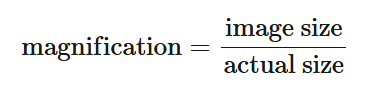
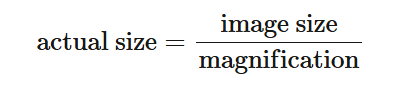
note that image size is AKA as measured length, meaning u acc measure the image, and whatever u get is the image size. the actual size is whatever number is given as the measurement

A2.2.3—Developments in microscopy
Electron microscopes hv a shorter wavelength than light, meaning they hv a higher resolution than light microscopes
can identify small objects very well
Light microscopes are useful for studying tissues & living cells in color, cuz they don’t damage the specimen
following techniques allow scientists to study biological samples at greater resolution
Freeze fracture microscopy - good for examining structures that normally aren’t visible, such as internal plasma membrane
Cryogenic electron microscopy - improves image’s resolution & limits damage done to sample
Immunofluorescence - allows for identification of target molecules as the structure emits a light of different wavelength
Fluorescent dyes - will attach to certain structures, & these areas will appear brighter, which can be detected
can also be used to monitor drug delivery
A2.2.4—Structures common to cells in all living organisms
DNA is the genetic material
Cytoplasm primarily composed of water
plasma membrane composed of lipids, that encapsulates the cell contents
i think these are all common cuz they’re the basic components needed to support an independent unit of life
A2.2.5—Prokaryote cell structure
prokaryotes are also unicellular
Cell wall - protects cell against toxins, resists high osmotic pressure & maintains cell’s shape
Plasma membrane - separates cell’s interior from exterior & controls the entry & exit of substances
Cytoplasm - a water-based fluid that fills the cell
it suspends ions, organic molecules, DNA & ribosomes
is where metabolic reactions occur
DNA - DNA is naked (isn’t associated with histone proteins), & found in region called nucleoid
70S ribosomes - are where translation (protein synthesis) occurs
are smaller & hv a lower mass than eukaryotic ribosomes
Plasmid - small, circular pieces of DNA that can be transferred from one cell to another
many contain a capsule - an outer layer of polysaccharides that protects cell
some also hv a flagellum - moves the organism by propelling
some hv pili (singular: pilus) - protein filaments on cell wall that help in cell adhesion & in transferring DNA between 2 cells
A2.2.6—Eukaryote cell structure
eukaryotes are multicellular
large diversity within eukaryotes
leaf cells, motor neuron
plasma membrane - separates cell’s interior from exterior & controls entry & exit of substances
cytoplasm - a jelly-like substance inside the cell
contains organelles
is where metabolic reactions occur
80S ribosomes - bigger & hv larger mass than 70S ribosomes
is where protein synthesis (translation occurs)
hv be attached or free-floating
Mitochondria - convert glucose into ATP during respiration
Nucleus - contains DNA (that’s associated with histone proteins & sorted into chromosomes)
contains nucleolus (location of protein synthesis)
has double membrane with pores, allowing certain molecules to pass through
Organelles: hv specific functions
smooth endoplasmic reticulum - produces & stores lipids (ex: steroids)
rough endoplasmic reticulum - has ribosomes on its surface, which produce proteins that are sent outside the cell
golgi apparatus - processes & packages proteins
vesicle - transports & releases substances produced within cell by fusing with cell membrane
vacuole - helps maintain osmotic balance
may also store substances
cytoskeleton - is a system of microtubules & microfilaments
helps hold organelles in place
maintains structure of cell
A2.2.7—Processes of life in unicellular organisms
unicellular organisms can perform all these functions
multicellular organisms hv specialised cells to carry out some of these functions
but as a whole, the organism will perform all these functions
metabolism - chemical reactions that take place within the cell(s) of an organism
response to stimuli - reacting to changes in the external environment
homeostasis - the maintenance of constant internal conditions, despite changes in their external environments
movement - living things have some control over their place and position
growth - cells can increase in size over a period of time. In multicellular organisms, growth can also refer to an increase in the number of cells that make up an organism
reproduction - the production of offspring. Reproduction can be sexual or asexual
excretion - the removal of metabolic waste products
nutrition - the intake or production of nutrients. Heterotrophic organisms obtain their nutrients from the external environment, whereas autotrophic organisms are able to produce nutrients from inorganic material
A2.2.8—Differences in eukaryotic cell structure between animals, fungi and plants
presence & composition of cell walls:
animal cells - no cell wall
plant cell - hv cell wall made of cellulose
protects cell & helps it resist osmotic pressure, maintaining shape of cell
fungi - hv cell wall made of chitin
differences in sizes & functions of vacuoles:
animal cell - some hv vacuoles
are smaller
store water, nutrients & waste products
plant cell - hv vacuole
larger than in animal cells
important for regulating osmotic potential of cell
fungi - contain large vacuoles
break down molecules in cell
store smaller molecules (such as ions)
presence of chloroplasts & other plastids
animal cell - hv none of that
plant cell - hv both
chloroplast - converts light energy into chemical energy
fungi - hv none of that
presence of centrioles, cilia, and flagella
animal cell - hv first 2
centrioles help establish & organise microtubules, playing important role in cell division
some hv cilia - important for moving substances past cell
ex: many cilia on epithelial cells of bronchi, which move debris up & out of respiratory tract
plant cell - hv none of the 3
fungi - hv first 2
centrioles produce & organise cytoskeleton, playing important role in cell division
but aren’t present in most fungi, except for male gametes of some fungi
main function is to produce cilia
A2.2.9—Atypical cell structure in eukaryotes
means they don’t contain any organelles typically found in eukaryotic cells, or they contain an abnormal amount of organelles
skeletal muscle - is multinucleated (one cell contains multiple nuclei)
this is cuz the muscle cell formed from multiple smaller myocytes that fused together
RBC’s - anucleate (don’t hv nucleus)
allows cell to hv higher haemoglobin capacity (meaning there’s more space for haemoglobin) & oxygen
aseptate hyphae - multinucleated
don’t hv cellular partitions, meaning there’s multiple nuclei in a single cellular unit
sieve tube elements - anucleate
contain little cytoplasm & organelles
means there’s little resistance for substances moving through a sieve tube element
(not on subject guide but just a note)
advantages of compartmentalisation
ability to establish higher concentrations of certain substances within organelles
ability to separate toxins from rest of cell
ex: hydrolytic enzymes are stored in lysosomes
control over conditions in organelles (such as pH) in order to maintain the optimal conditions for efficient enzyme function
A2.2.10—Cell types and cell structures viewed in light and electron micrographs
NEED TO LEARN
A2.2.11—Drawing and annotation based on electron micrographs
remember to include function of organelles in drawings
A2.2.12—Origin of eukaryotic cells by endosymbiosis
evidence suggests that eukaryotic organisms evolved from a common unicellular ancestor
this common ancestor endocytosed a prokaryotic cell, which generated energy from oxygen
instead of being digested, these cells remained in the host cell, and performed aerobic respiration, providing energy to their host cell, eventually evolving into mitochondria
chloroplast likely evolved when eukaryotes endocytosed a prokaryotic cell that could convert light energy into chemical energy
evidence
both mitochondria & chloroplasts:
measure around 8 μm in length, the same size as many prokaryotic organisms
hv double membranes
hv circular naked DNA, as found in prokaryotes
hv 70S ribosomes, the same size as ribosomes in prokaryotes
divide by binary fission (as do prokaryotes)
susceptible to some antibiotics
A2.2.13—Cell differentiation as the process for developing specialized tissues in multicellular organisms
involves the turning on of certain genes that are responsible for the function of a specialised cell & the turning off of genes that aren’t needed for the function of a specialised cell
these differences in gene expression are typically triggered by the environment
A2.2.14—Evolution of multicellularity
multicellularity evolved repeatedly through cell aggregation
is when individual cells cluster together, meaning they can efficiently obtain & share nutrients
over time, some cells within cluster were thought to hv differentiate to play for specialised roles
multicellularity also has the advantage of hv a larger body size & being able to adapt to their environment