1.1- Intro to Microbiology
Overview of Microbiology
Microbiology: The study of microbes.
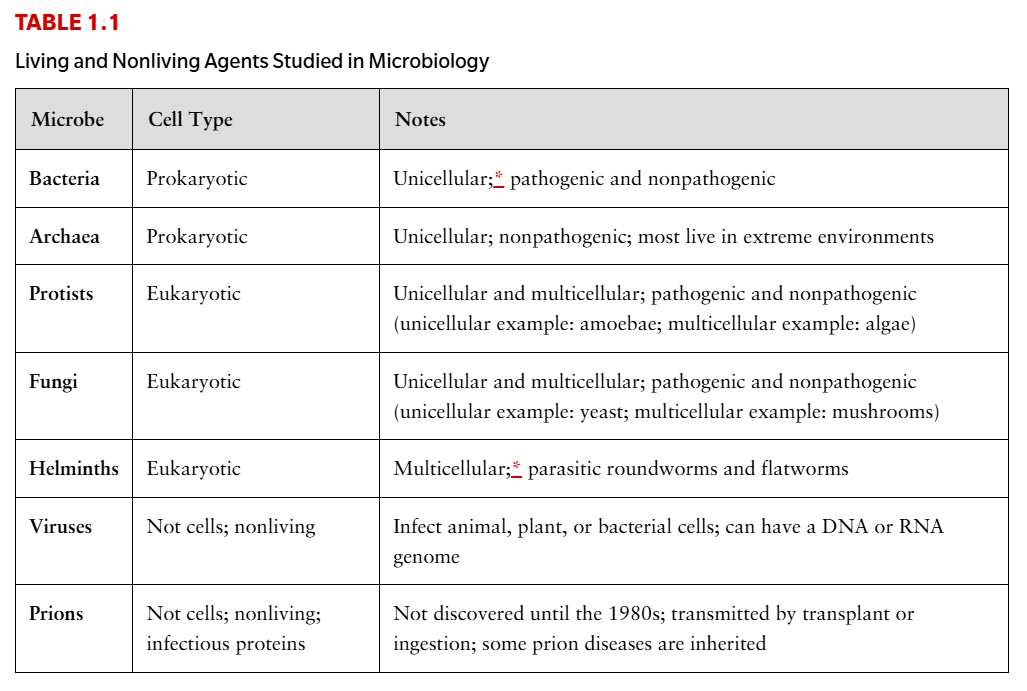
Microbes: Encompass cellular, living microorganisms (bacteria, archaea, fungi, protists, and helminths) and nonliving/noncellular entities (viruses and prions).
Cell Characteristics and Origins
Prokaryotic Cells
Single-celled organisms that lack a true nucleus and membrane-bound organelles.
Typically categorized into two domains: Bacteria and Archaea.
Eukaryotic Cells
Complex cells contain a true nucleus and various membrane-bound organelles.
It can be unicellular or multicellular.
Kingdoms include: Animalia, Plantae, Fungi, and Protista.
Endosymbiotic Theory: A theory stating that eukaryotic cells evolved from prokaryotic cells.
Pathogens and Disease
Pathogens: Microbes that cause disease.
True Pathogens: Pathogens that can cause disease in healthy individuals.
Opportunistic Pathogens: Generally do not cause disease in healthy hosts but lead to infections in individuals with weakened immune systems.
Germ Theory of Disease: States that microbes cause infectious diseases.
Etiological Agent: The causative agent of a disease.
Historical Development
Robert Hooke: Used crude microscopes to publish early descriptions of cells.
Antonie van Leeuwenhoek: He refined microscope designs and was the first to observe bacteria.
Debate on Life's Origin
Spontaneous Generation: The idea that life comes from nonliving items.
Biogenesis: The idea that life emerges from existing life.
Francesco Redi: Performed experiments to test the hypothesis of spontaneous generation.
Louis Pasteur: Proved biogenesis is responsible for the propagation of life.
Proved yeast performs fermentation.
Developed vaccines for anthrax and rabies.
Demonstrated that airborne microbes cause spoilage and disease, leading to the development of aseptic techniques.
Validating Germ Theory
Robert Koch: Reinforced the germ theory and developed techniques to isolate bacteria. He discovered that anthrax is caused by a bacterium.
Koch’s Postulates: principles used to identify the causative agent of a disease:
The same organism must be present in every case of the disease.
The organism must be isolated from the diseased host and grown as a pure culture.
The isolated organism should cause the disease when introduced into a susceptible host.
The organism must be re-isolated from the inoculated, diseased animal.
Aseptic Techniques in Medicine
Aseptic Techniques: Methods used to maintain sterile environments and prevent Healthcare-Acquired Infections (HAIs), such as nosocomial infections.
Ignaz Semmelweis: First to develop aseptic techniques in the 1840s, recommending handwashing to lower childbed fever rates.
Joseph Lister: Investigated aseptic surgery and used carbolic acid as a cleaning agent.
Florence Nightingale: Established the use of aseptic techniques in nursing practices.
The Scientific Method
Process: Starts with a question, followed by a hypothesis (prediction), then observation, and finally a conclusion derived from data.
Scientific Law: A precise statement of fact.
Scientific Theory: A hypothesis that has been extensively proven and supported.