Bio 110 Exam 2
Chapter 19
What is the number of chromosomes found in a somatic cell? Sex cell?
Somatic cell: 46 chromosomes
Sex cell: 23 chromosomes
What is the difference between a somatic and sex cell?
-somatic cells are all cells except eggs and sperm. (gametes) Each cells contains two chromosomes with genes for the same traits called homologous pairs. (1 from mother 1 from father)
-diploid: a cell with two of each chromosome.
-sex cells are gametes, eggs or sperm.
- haploid: only have one member of each homologous pair of chromosomes.
-formed by meiosis.
Describe the structure of a chromosome.
What is contained within that chromosome?
Each chromosome is a tightly coiled combination of a DNA molecule and specialized proteins called histones.
Chromosomes are located in the nucleus.
Describe the structure of a duplicated chromosome.
A duplicated chromosome has two sister chromatids that are joined together at the centromere.
What are homologous pairs of chromosomes?
Each chromosome in one set has a corresponding chromosome from another.
1 chromosome is from the mother
1 chromosome is from the father
What is a sister chromatid? How are they joined to together?
DNA is replicated during the S phase of the cell cycle and the two copies of the chromosome, called chromatids, remain attached at the centromere.
Two attached chromatids are genetically identical and called sister chromatids.
What is the difference between an autosome and a sex chromosome?
A sex chromosome determines whether a person is male or female and an autosome determines the expression of most of a person’s inherited characteristics.
What is a gene?
A gene is a specific segment of DNA.
Direct synthesis of a protein, which plays a structural or functional role in the cell.
Where are genes located on a chromosome?
The genes are located along the length of chromosomes
What is the difference between chromatin and chromosomes?
Chromosomes are threadlike structures made of DNA and associated proteins. Individual chromosomes are visible with a light microscope during cell division, when they shorten and condense.
Chromatins are extended and not readily visible.
List the steps of the cell cycle. What is the overall result of mitosis?
Two major phases are interphase and cell division.
Interphase: period of growth and preparation for cell division; not a resting period
G1
First “gap”
Time of major growth before DNA synthesis begins.
Chromosomes consist of a strand of DNA and proteins.
Double organelles.
S
DNA is replicated, and the two copies of the chromosomes, called chromatids, remain attached at the centromere.
Growth continues
G2
Cytoskeletal
Second “gap”
Period after DNA is synthesized and before mitosis begins
Growth continues
Cell division: division of the nucleus and cytoplasm
Consists of two processes, mitosis (division of the nucleus) and cytokinesis (division of the cytoplasm)
Developing embryo and fetus.
Body cells divide continually.
The overall result of mitosis is the division of one nucleus into two daughter nuclei with the same number and kinds of chromosomes.
Interphase is split into three separate events. List those three events and give a brief description. Why is the S phase so important?
Refer to 11
The S phase is so important because it is the phase that DNA replication occurs.
During mitosis you have the following events:
Prophase
What is happening to the nucleus during this phase?
Chromatin condenses and forms chromosomes as DNA wraps around histones.
Nuclear membrane begins to break down.
Mitotic spindle forms.
What is the mitotic spindle?
The mitotic spindle is a structure composed of microtubules associated with the centrioles. Plays a role in movement and segregation of chromosomes into daughter cells.
Sprout out and attach at the centromere.
Metaphase
Describe the position of the chromosomes
Chromosomes attach to mitotic spindles and form a line at the center of the cell.
Alignment ensures each daughter cell receives one chromatid from each of the 46 chromosomes.
Anaphase
Describe the position of the chromosomes.
Sister chromatids of each chromosome begin to separate, splitting at the centromere.
Now separate entities, the sister chromatids are considered chromosomes.
Telophase
Describe the position of the chromosomes.
Nuclear envelope forms around each group of chromosomes at each pole.
Mitotic spindle disassembles.
Chromosomes become more threadlike in experience.
Cytokinesis divides cell into two daughter cells.
What is happening to the nuclei?
New nuclei forms, each with two complete sets of chromosomes.
Why is cytokinesis required?
Cytokinesis is required for the formation and separation into daughter cells.
Division of the cytoplasm.
What type of cell uses mitosis rather than meiosis?
Somatic cells use mitosis.
Sex cells use meiosis.
What is the difference between a diploid and haploid cell?
Haploid (n)
One set of chromosomes.
Typically, gametes (sperm and egg cells)
23 chromosomes
Typically produced through meiosis.
Diploid (2n)
Two sets of chromosomes. (two of each chromosome)
Genes occur in pairs in diploid cells
Formed through the fusion of haploid gametes.
Meiosis
What type of cell uses meiosis?
Sex cells use meiosis.
Why are there two phases of meiosis instead of one?
To ensure that each haploid gamete produced contains one member of each homologous pair of chromosomes.
How is meiosis different from mitosis?
Meiosis
Sex cells
Produce haploid gametes for sexual reproduction.
Involves two phases.
Mitosis
Somatic cells.
Produce two genetically identical diploid daughter cells.
Only involves one division, resulting in two diploid daughter cells.
During what phase does crossing over occur?
Meiosis, prophase 1
Why is crossing over required? How does it benefit the human?
Increases genetic diversity by having a mixture of DNA from the two parents.
Increases ability to adapt to changing environments.
When does independent assortment occur (i.e. which phase)? How does it benefit the human?
Occurs during metaphase 1
Random alignment of homologous chromosome pairs.
Random distribution of entire chromosomes.
When does nondisjunction occur? What is the result when it does occur?
The failure of homologous chromosomes to separate during meiosis I or of sister chromatids to separate during meiosis II.
Meiosis I
Failure of homologous chromosomes to separate correctly.
Results in one daughter cell receiving both homologous chromosomes, while the other daughter has none.
Could result in the zygote having an abnormal number of chromosomes.
Ex: trisomy (extra chromosome) or monosomy (missing a chromosome)
Meiosis II
Sister chromatids fail to separate correctly.
Results in one daughter cell receiving both sister chromatids of a chromosome, while the other receives none.
Could lead to aneuploidy
Nondisjunction can result in genetic disorder such as down syndrome (trisomy 21), turner syndrome (monosomy x), and others.
What event in meiosis causes a trisomy?
Three representatives of a chromosome in a cell rather than the usual two.
What is the difference between oogenesis and spermatogenesis?
Oogenesis
Produces up to 3 polar bodies and 1 ovum (egg) packed with nutrients to nourish early embryo.
Occurs in the ovaries of females.
Begins during fetal development.
Spermatogenesis
Produces 4 sperm cells specialized for transporting the male’s genetic information to the egg.
Occurs in the testes of males
Begins at puberty.
What is the result of oogenesis?
The result of oogenesis is the production of one mature ovum (egg)
What is the result of spermatogenesis?
The result of spermatogenesis is the production of four mature sperm cells.
Chapter 20
Define
What is a gene? Where is it located?
Genes are segments of DNA that code for a specific protein that will play a structural or functional role in the cell.
Located on a chromosome within the nucleus.
What is an allele? How is it different from a gene?
An allele produces different versions of the trait they determine
An allele is a specific version of a gene.
Different forms of a gene.
An individual who is homozygous dominant would contain two dominant alleles.
An individual who is heterozygous dominant would contain a dominant allele and a recessive allele.
An individual who is homozygous recessive would contain two recessive alleles.
Black hair is dominant. Using the term genotype and phenotype give an example for each (any letter works).
Genotype: alleles that are present, genetic composition of an individual.
BB (homozygous dominant)
Bb (heterozygous dominant)
bb (homozygous recessive)
Phenotype: Observable physical traits of an individual.
BB and Bb will have black hair.
bb would not have black hair; it would have the corresponding recessive trait. (another hair color)
What is the difference between a male and female set of chromosomes?
Male
XY sex chromosome.
Inherit X from mother and Y from father.
Y carries genes that determine male specific traits.
More prone to disorder such as color blindness because they can only inherit 1 X.
Female
XX sex chromosome.
Inherit X from each parent.
2 X’s leads to female specific traits
What is sex linked traits? Give an example.
Different pattern of inheritance.
Influence likelihood of inheriting certain conditions based on sex chromosome composition.
Example: red-green color blindness
Be able to complete a monohybrid cross.
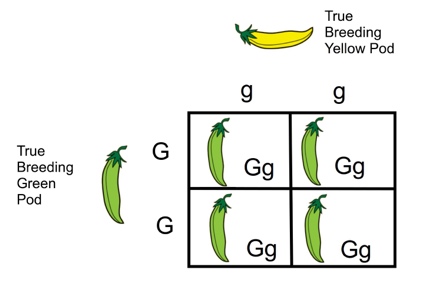
What does a Pedigree display?
Display the genetic connections among individuals in a family.
Define and give an example
Polygenic inheritance
Variation in a trait, such as height, independent of environmental influences.
Involves two or more genes, often on different chromosomes.
Example: skin color, melanin production involved in skin pigmentation.
Pleiotropy
One gene having many effects.
Example: sickle-cell anemia
Sickling of red blood cells caused by abnormal hemoglobin affects many areas of the body. Can break down, clog blood vessels, and accumulate in the spleen.
Can affect the heart, brain, lungs, kidneys, muscles, and joints.
Incomplete dominance
Expression of the trait in an heterozygous individual is in between the way the trait is expressed in a homozygous dominant or homozygous recessive person.
Neither allele is completely dominant over the other.
Example: sickle-cell allele, heterozygote has sickle cell trait.
Codominance
Effects of both dominant alleles are apparent in a heterozygote.
Example: blood type AB
The protein products of both the A and B alleles are expressed on the surface of the red blood cell.
Be able to discern the offspring when given the maternal and paternal genes
Chapter 21
Describe the structure of a DNA double helix
Double-stranded molecule twisted to form a double helix.
Resembles a ladder.
Each side and half of each rung is made from a string of repeating units called nucleotides.
Why is it called a double helix?
Twisted ladder
Has two strands
What are the nitrogenous bases found in DNA?
Adenine (A)
Guanine (G)
Thymine (T)
Cytosine (C)
Which are complementary? (i.e. paired)
Adenine (A) only pairs with thymine (T)
Cytosine (C) only pairs with guanine (G)
T 🡪 A
A🡪 T
C🡪 G
G🡪 C
Where are the hydrogen bonds located?
Located in between the nitrogenous bases, holds each pair of the bases together.
Describe the structure of RNA
Single-stranded
Contains the base uracil (U), and not thymine (T)
Contains the sugar ribose, not deoxyribose.
Are the nitrogenous bases different than in DNA?
Yes, contains uracil (U) instead of thymine (T)
Why do we need protein synthesis?
Essential to form proteins which are needed for structural and functional roles in cells.
What directs protein synthesis or which protein we will make?
Newly formed mRNA carries the genetic message from the nucleus to the cytoplasm, where it is translated into protein at the ribosomes.
During the process of protein synthesis there are two events: transcription and translation.
Where does transcription occur in the cell?
Nucleus
Where does translation occur in the cell?
Cytoplasm
What is the job of mRNA?
mRNA (messenger RNA) carries DNA’s instructions for synthesizing a particular protein from the nucleus to the cytoplasm.
What is the difference between an intron and exon?
Intron🡪non-coding
Exon🡪coding, functional
Where does mRNA meet tRNA?
Within the ribosome.
Who has the codon and an anticodon?
Codon-mRNA
Anticodon-tRNA
What is recombinant DNA?
DNA made from two or more sources.
Created when a gene of interest is put into another piece of DNA.
How do restriction enzymes work?
Used to cut gene of interest out of original DNA and splice it into vector DNA.