Language Development & Language Disorder
Language Development & Language Disorder
Receptive and Expressive language.
Form, content, use- Intentionality model (pragmatics).
Brown’s morphological stages (morphology).
Blank levels.
Key word levels
Look at Language Acquisition lecture in Year 1 (SLT 402).
Play and language development, social interactions. Hanen, MIJY? and it takes 2 to talk.
Key Phases in Language Development
Prelinguistic Phase
Involves multiple domains of language, including:
Babbling
Speech sounds
Grammar
Morphological Development
Understanding Morphemes
Definition of Morpheme: A morpheme is the smallest grammatical unit that conveys meaning.
Examples of morphemes:
un(prefix)happy(root)est(suffix)ily(suffix)
Morpheme Length Examples
Example 1:
Sentence: "He meets the unhappiest boys"
Analysis:
1 sentence, 5 words, 8 syllables, 9 morphemes
Example 2:
Sentence: "The girl's mother slowly filled the bucket with water"
Analysis:
1 sentence, 9 words, 13 syllables, 12 morphemes
Stages of Communication
Perlocution Stage
Age Range: Birth to approx 10 months
Description:
Babies exhibit prelinguistic behaviors such as eye gaze and sound play.
Adults interpret these behaviors as communication.
Illocution Stage
Description:
Gestures and vocalizations become intentional.
This stage marks the use of these actions to communicate.
Locution Stage
Milestone: Occurs between 10-14 months.
This is when the child says their first word (Singleton & Shulman, 2020).
Families of Speech Acts
Categories of Illocutionary Acts:
Assertives: Statements that convey information.
Directives: Requests or commands.
Commissives: Commitments made by the speaker.
Expressives: Expressions of the speaker's emotional state.
Declarations: Acts that change the state of affairs by the mere act of saying.
Source: Muller et al. (2008)
Information Carrying Words (ICWs)
Definition: ICWs or KWLs (Key Words for Learning) are significant in clinical practice.
Emerging Evidence: Suggests that the concept might not universally apply beyond the English language.
Language Disorder Overview
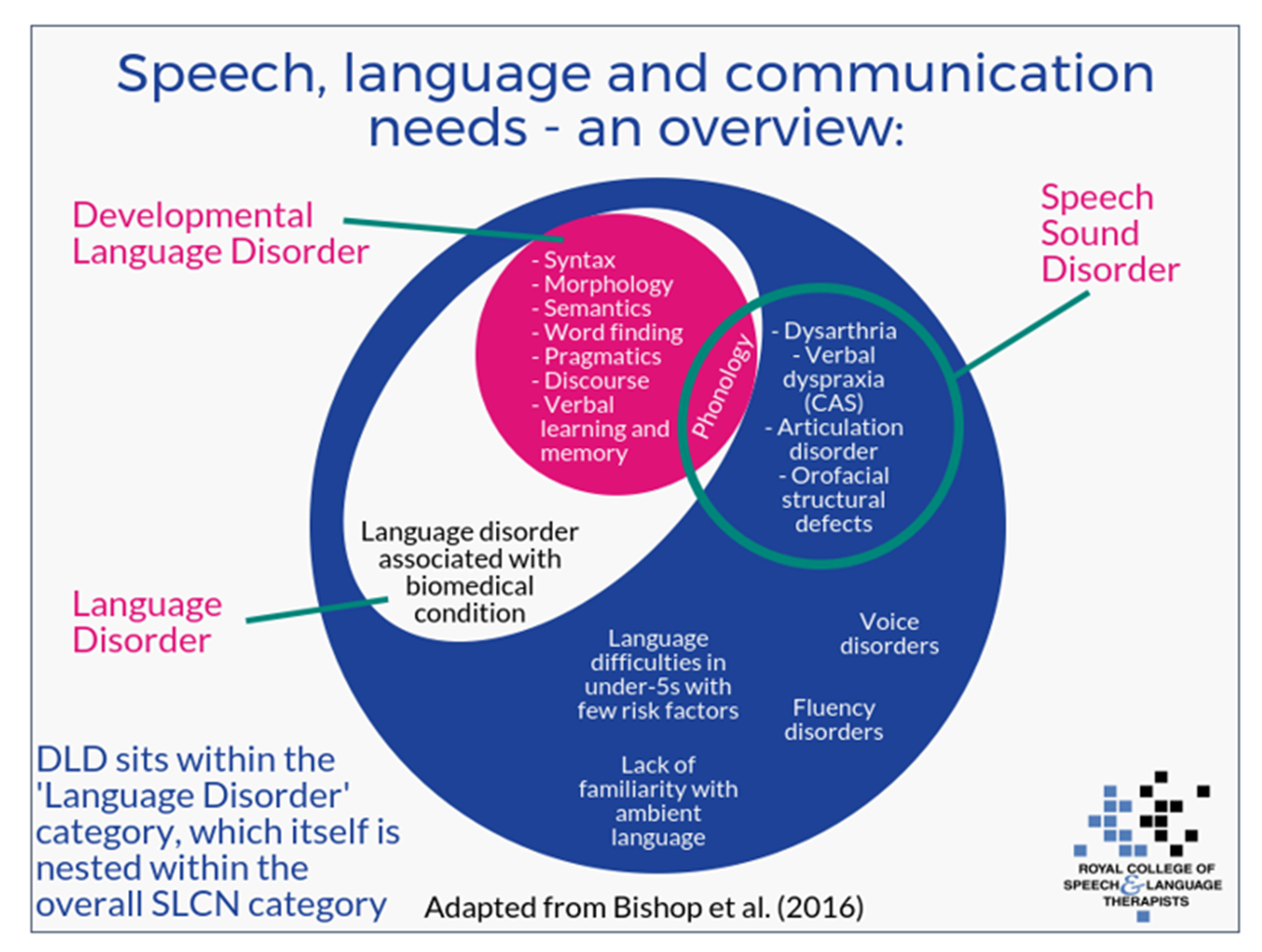
Speech Language and Communication Needs (SLCN):
Overall diagnostic category that encompasses a wide range of conditions.
Recommended particularly for pre-school children where diagnosis may be unclear.
Unlikely to be resolved unless specialist intervention is provided and likely to continue into middle childhood.
Definition of Language Disorder
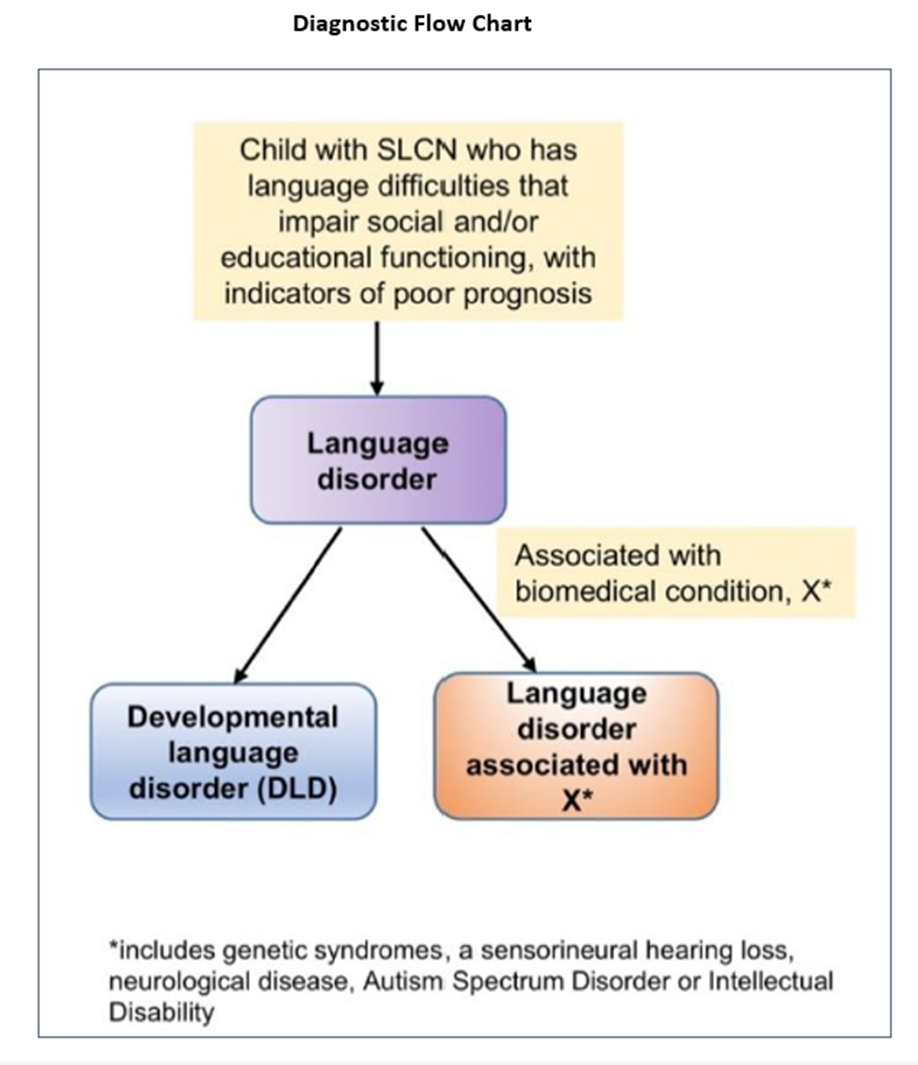
Language disorder refers to children with language difficulties that impair social and educational functioning.
Indicators of poor prognosis include:
Difficulties likely to persist into middle childhood (beyond age 5 - RCSLT, 2017).
Language delay refers to children that may have a difficulty with language but will likely to catch up. This is typical but better to refer to it as a difficulty.
Language Disorder Associated with X (another condition).
Within the language disorder category:
Describes children with language disorders accompanied by a differentiating condition (as defined by CATALISE panel, 2017).
Differentiating Conditions: Biomedical conditions where language disorder forms part of a more complex impairment pattern.
Management of the language disorder is influenced by the biomedical condition context.
Developmental Language Disorder (DLD)
Definition: Refers to children whose language disorder does not occur in the context of a biomedical condition.
Co-occurring Issues: DLD may accompany conditions such as:
Attention Deficit Hyperactivity Disorder (ADHD)
Motor problems (e.g., Developmental Co-ordination Disorder)
Developmental dyslexia
Speech difficulties
Behavioral disorders
Does not have a mis match between verbal and non-verbal ability.
Neurodevelopmental condition. Mix of genetics and the environment. They have the gene but it is switched on by the environment.
Siblings or parents may also have ADHD or dyslexia alongside DLD.
Specific Language Impairment (SLI)
Historical Label: Used for children with atypical language development without an obvious cause (Bishop, 1999).
Criteria: At least 2 standard deviations below age norms on standardized assessments.
SLI and DLD are not interchangeable. They have a different diagnostic criteria and it is a different diagnosis. SLI is still used as a diagnosis, may see it in the literature.
Cause of Developmental Language Disorder (DLD)
Genetics
FOXP2 Gene Disorder: Affects development of speech and language beginning in early childhood.
Importance of FOXP2: Responsible for making a protein essential for normal speech and language development.
Inheritance Patterns
Neurodevelopmental disorders often run in families.
DLD is observed more frequently among relatives of affected children.
Statistics: 50-70% of children with DLD have at least one family member with similar challenges.
Diagnosing DLD
Diagnostic Flow Chart
Presents a pathway for assessing children with SLCN who demonstrate language difficulties impacting their social and educational functionalities.
Risk Factors in DLD Assessment
Assessment Consideration: Therapists must evaluate several risk factors while diagnosing DLD.
Reference: Risk factors checklist is available in the All Wales DLD pathway.
Babbling, perlocutionary stage, non-verbal communications, lack of progress after intervention, family history, male (more prevalent), deprivation (socio-economic), hearing, ALN, functional impacts- parents and school. Can helo to make a clinical decision- outreach provision, sessions with TI or LRP.
Clinical Markers for DLD
Areas of Assessment
Expressive Language:
Vocabulary
Grammar (Morphology, Syntax)
Receptive Language:
Understanding of concepts
Semantic skills
Social Communication:
Conversational skills and social understanding.
Possible Assessments
Expressive Language
Semantics: Understanding relationships between words and vocabulary size/diversity.
Morphology: Correct use of grammatical markers.
Syntax: Mean utterance length and sentence complexity.
Receptive Language
Understanding words and concepts, including abstract language, and idioms.
Social Communication
Conversational initiation, topic maintenance, and acknowledgment of breakdowns.
Non-verbal communication skills and understanding emotions.
Assessment Tools
The Renfrew Language Scales:
Includes various tests like Action Picture, Bus Story, and Word Finding tasks.
CELF 5 - Clinical Evaluation of Language Fundamentals:
A standardized assessment with multiple language domains and standalone subtests.
CELF 5 Subtests Include
Observational Rating Scale
Sentence Comprehension
Linguistic Concepts
Vocabulary, Syntax, Semantic Relationships, and Pragmatics.
Impact of DLD
Risks Associated with DLD
Research indicates various risks, including:
Lower academic performance
Lower post-school employment outcomes
Increased risk of anxiety and depression
Challenges in establishing friendships.
Statistics
Approximately 7% of children have a language disorder, which is significantly higher than the 1% for autism.
Discussions on the implications of these statistics for affected individuals in society.
Interventions for DLD
Language-based Interventions: Found to be effective, though variability exists across language domains.
Specific gaps noted in research regarding bilingual children’s interventions.
Importance of Early Intervention: Enhances communication skills and social participation for better opportunities.
General Intervention Strategies
Get the student’s attention before speaking to them.
Use clear, slow language and provide visual aids.
Use short sentences and allow thinking time.
Summary of DLD
Language disorders can significantly affect educational and social functioning.
DLD is categorized under the broader language disorder category as a neurodevelopmental disorder with undefined aetiology.
SLTs can diagnose DLD through holistic assessments, keeping in mind risk factors and various interventions available.