Refraction
The bending of light when it goes from one medium to another.
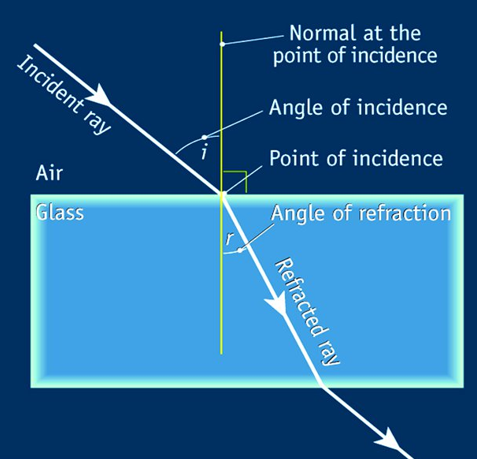
As the angle of incidence increases, so does the angle of refraction. However they do not increase proportionally.
When light travels from a rarer medium to a denser medium, it is refracted towards the normal.
When light travels from a denser medium to a rarer medium, it is refracted away from the normal.
Laws of Refraction
Law 1: The incident ray, the normal at the point of incidence and the refracted ray all lie in the same plane.
Law 2: The ratio of the sine of the angle of incidence to the sine of the angle of refraction is a constant
, where is constant
Snell’s Law
Snell’s Law
Snell’s law states that the ratio of the sine of the angle of incidence to the sine of the angle of refraction is constant.
Refractive Index
The ratio of the sine of the angle of incidence to the sine of the angle of refraction when light travels from air into that material.
Due to refraction an object in liquid appears at a lesser depth than it actually is.
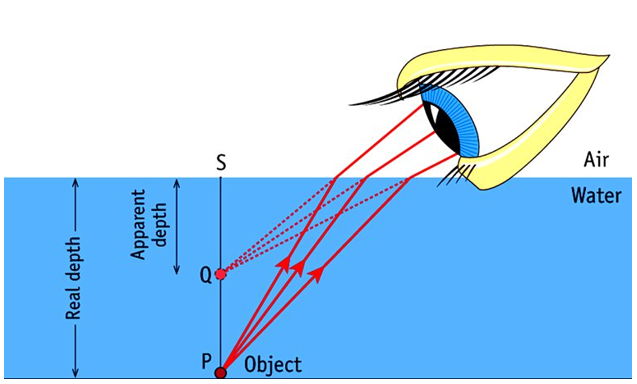
The apparent depth decreases as you view the object more from the side. The apparent depth is greatest when the object is viewed from vertically above it.

Real Depth and Apparent Depth
An object is viewed from air through another medium and the line of view is perpendicular to the surface of the medium.
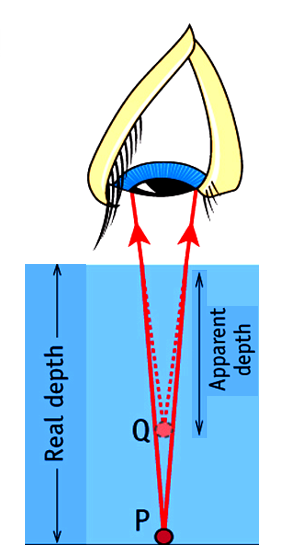
Real Depth and Apparent Depth in relation to refractive index
Refractive Index in Terms of Relative Speeds
Critical Angle
When light travels from a denser to a rarer medium the angle of incidence whose angle of refraction is 90o is called the critical angle.
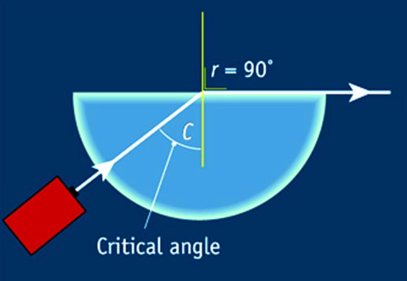
Total Internal Reflection
When light going from a denser to a rarer medium strikes the rarer medium at an angle greater than the critical angle, it does not enter the second medium. It is all reflected back in the denser medium.
When the critical angle is reached, the refracted ray skims along the flat face of the glass.
Increase angle of incidence further and total internal reflection occurs.
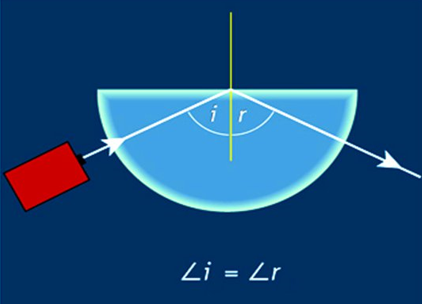
Refractive Index of a Medium
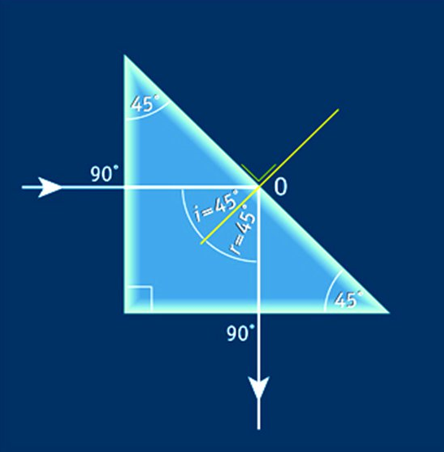
Turning of a Ray of Light Through 90o With a Prism
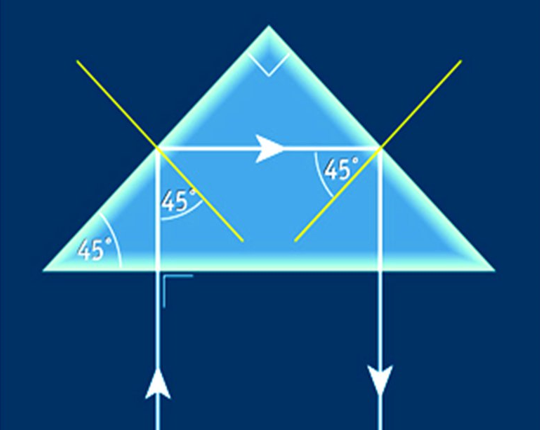
Turning a Ray of Light Through 180o With a Prism
Optical Fibres
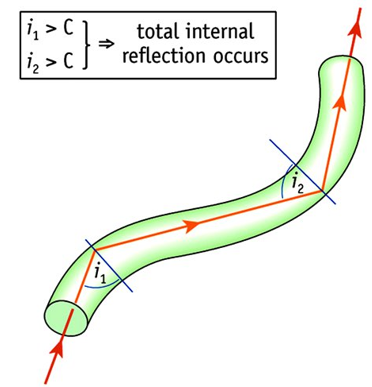
A very thin transparent rod (usually of glass) through which light can travel by total internal reflection is called an optical fibre.
If two optical fibres touch, light may escape from one and pass into the other.
Optical fibres are usually coated with glass of lower refractive index.
This ensures that light always stays in the inner denser glass even if two fibres touch eachother.
It also prevents damage to the surface of the denser inner fibre.