Light Reactions
Photosynthesis
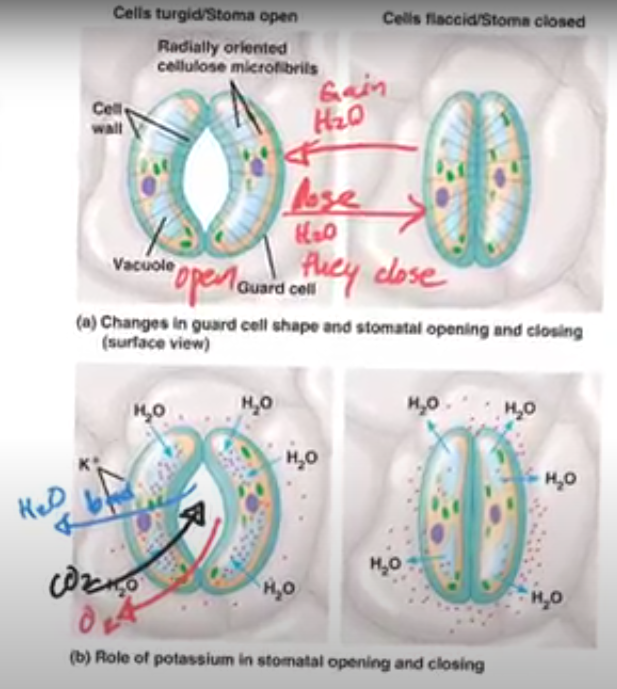 Stomata/Stoma = () ←this thing on the leaf
Guard cell = outermost layer?
Cell wall = All around the stoma
Cells Flaccid [closed] = Low amounts of water <
Cells Turgid Stoma [open] = Large amounts of water >
*based on how much of water they have.
[Open cell] lose H20 -> the stoma close
[Closed cell] Gain H20 -> the stoma open
When open gasses can move in and out, that’s how plants are able to breathe.
In: C02
Out: 02 & H20(bad)
Bad b/c plants Morning (Open) , Noon Hot[Closed] , Evening (Open)
Gas movement occurs when the day isn’t as extremely hot
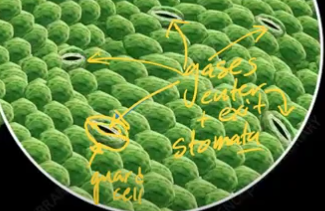 Guard cell on one side like a cotyledon -> like this [ - - ]
Gasses Enter + Exit → Stomata
Multiple Stoma = Stomata
Plant Cell
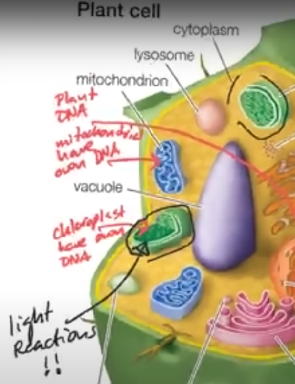 Plant cells have the same organelles as animals besides cell wall, chloroplasts
Plant cell more complex than animal cell
Three Types of DNA: Plant DNA, Mitochondrial DNA, Chloroplast DNA
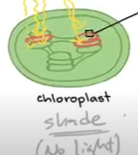
Chloroplast
Chloroplast make sugar for plant / Like the Mitochondria
Phophlibid bylayers []*32w332222222222e
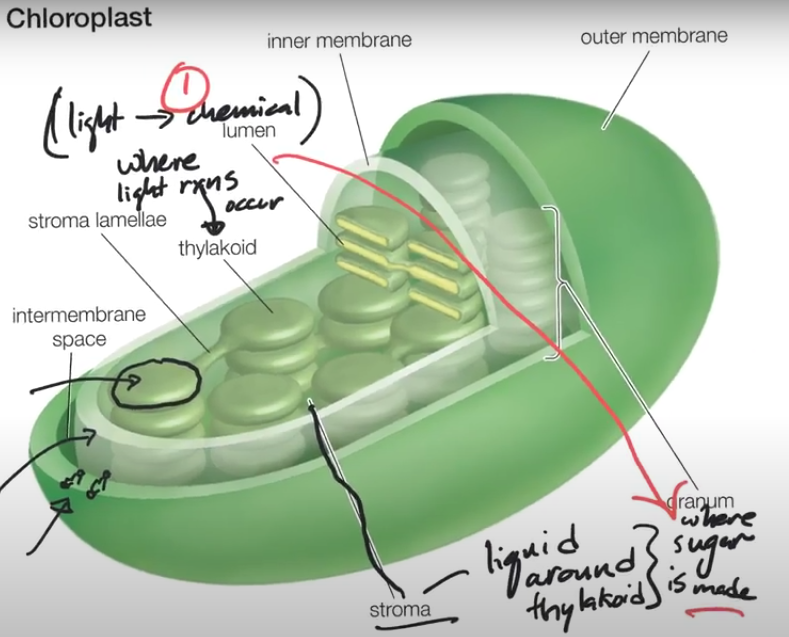
Thylakoid(PSI(1st rxn)): Where light reactions occur.
Stroma(PSII(2nd Rxn)): Liquid around Thylakoid → Sugar is made
Light Reactions
Step 1: Light Energy → Chemical Energy
Step 2: Chemical Energy → Sugar
Light stuck will get to the 1st 3rd 4th -> layer thylakoids on top of each other.?
 The Light Reactions = (Opposite to Electron Transport Chain in Mitochondria)
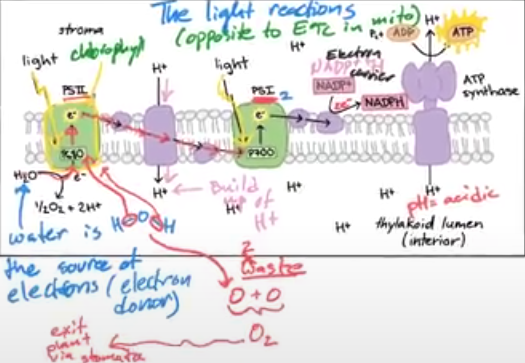
Sunlight strikes PSII (protein structure)
Chlorophyll absorbs sunlight uses it too take Electrons from the water
PSII Take Electrons holding H20 together getting pulled away by PSII (molecule found after PSI)
Water is the Source of Electrons = (Electron Donor)
H (-) O (-) H -> Ions break (- = become Electrons)
Steal one Electron from each side → The Electrons go in to thing called the light reaction
Pass Electrons from Electron Pathway → Energise molecules in pathway to get Hydrogen thru
Build up of H+ in the interior thylakoid lumen
Electrons slowly lose energy then sunlight hits the Second Reaction Center (PSI)
Re energises the Electron, gives it more energy, Higher amount of energy
That electron (H+) can go into NADP+ = TAKES 2 ELECTRONS
(NADP+ + 2H+ = NADPH)
When this happens we get a bunch of O2
Waste: O + O = O2 → exit plant via Stomata
NADP+ / NADPH is an electron carrier ???
Build up of Hydrogens on one side
pH drops → plant becomes acidic
allows H+ to pump back out
If there is no place for the electrons to go then the plant cant make ATP, NADPH
ATP Synthase transfer out as they do we make ATP
Light energy → Chemical energy (ATP)
Quick Review
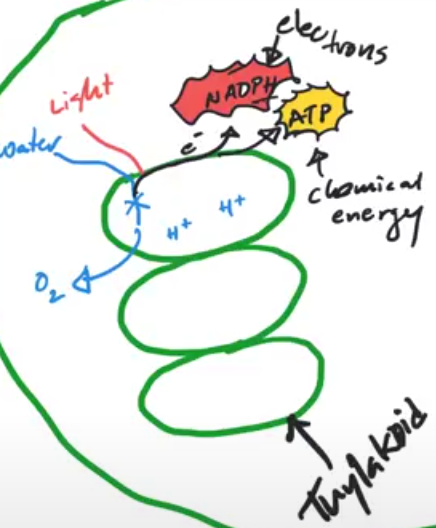 Light + Water = O2
e- stored in NADPH?
What is the electron carrier?
H+ stored in plant
Need → Light + Water + C02
Make → O2 ATP NADPH
Location: Thylakoid
Plants absorb energy from sunlight through a process called photosynthesis
Short wavelengths of light have higher energy, while long wavelengths have lower energy
Photosynthesis primarily uses red and blue wavelengths of light
Photosynthesis occurs in the chloroplasts of plant cells, specifically in the thylakoid membranes
Photosynthesis: Energy + 6CO2 + H2O → C6H12O6 + 6O2

Plants absorb wavelengths primarily in the blue (400-500 nm) and red (600-700 nm) regions of the electromagnetic spectrum for photosynthesis. But green (500-600) is reflected or transmitted.
https://knowt.com/flashcards/ce04c017-592a-4e1f-bbf6-707614a3f9a9 ←My flash cards
FOLLOW ME PLS!
Calvin cycle
The Krebs cycle is the opposite of the Calvin cycle.
CO2 NADPH ATP → C6H12O16 + 02
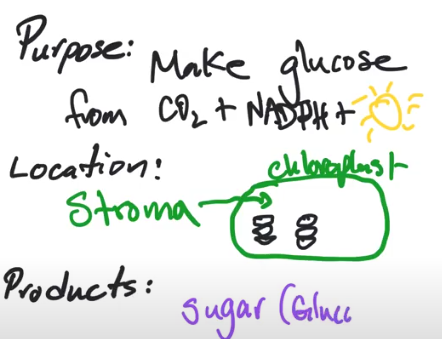
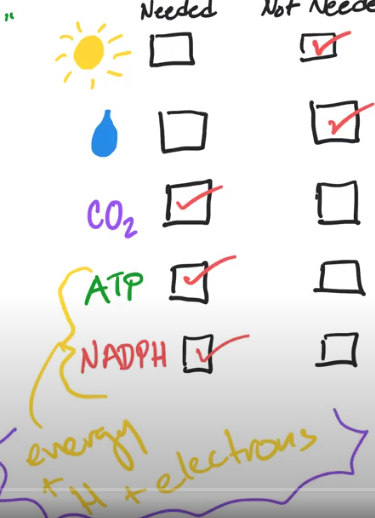 Stroma = Calvin cycle
Needs CO2 ATP NADPH
Thylakoid NEEDS {light + water} light reactions
Stroma = Calvin cycle
light hits the thing ion the chloroplast
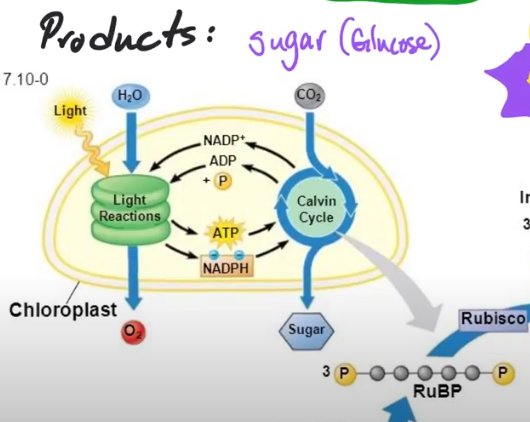 The Calvin Cycle takes place in the stroma of the chloroplasts in plant cells.
Need Make
Make ATP NADPH, CO2 Sugar NADP+ ADP
Kreb Cycle Produces CO2
Plant don’t do Calvin cycle without sttomata
Light Reactions
Thylakoid
Light reaction happen in the thylakoid which happens in the gramnum and a gruop of thylakods are granum. If
Calvin Cycle
Dark = During the night
Light Independans
light water nadph and ATP
NADPH
C6H12O6 the H come from NADPH
plants can recyle carbon
RUBISCO helps put the CO2 and make half a glucose::
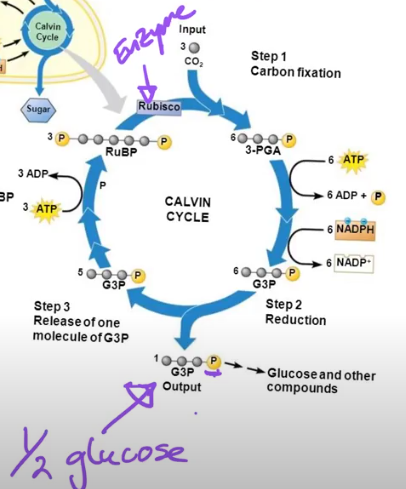
Calvin Cycle
3 RUBISCO( p5Cp )
To Rearrange it take energy
6ATP→6ADP
6NADPH→6NADP+
1 3c falls off do too
spins twice to make glucose
Need 18 ATP per full glucose (2 cycles)
Need 12 NADPH per full glucose (2 cycles)
NADPH drops off Hydrogen it beccome NADP+
True.In the Calvin Cycle, water is oxidized to produce oxygen, and carbon dioxide is reduced to form glucose. This process occurs in the stroma of chloroplasts during photosynthesis.
Step 1 Light hits
Step 2 Steal e- from H20 { O2 stolen from Stoma
Step 3 Elecate e-
Step 4 Pass e- down and pump H into thyakoid
Step 5 PSI - absorbs light - regenerates e- so it can jump to NADP+ + e- -> NADP´ + e- -> NADP-
Step 6 H+ get pumped out of thylocoid and generateds ATPH as a lower En than Oxygen
Plants produce suger goes to the mitochondira that break them down
Creating chemical energy steal energy from water
E- from water make o2
Oxygen come from the light reaction
Need
Make ATP NADH,
Calvin Cycle made G3P makes Half a glucose
Enzyme = rubisco can hold 15 carbons
3 [ 5c + 1C ] = 3 * [ 6c ]
[ 6 ] / 2 Break in half = 6 * [3c]
3 come in 3 go out
NADP_H = Electron carrier for plant
NAD_H = Electrom carrier for animals
Calvin Cycle: 6CO2 + 6H2O + light energy → C6H12O6 + 6O2
What? molecule proton pump
hemoglobin carry oxygens contains iron
light Kinetic energy: concert radiant energy
reverse of kreb cycle called the Call
Plants need Oxygen and water and CO2
CO2 Water used to make glucose.
Plant make their own food