Specialised cells
WHAT ARE SPECIALISED CELLS?
Specialised cells are cells that are adapted to a specific function. They will have at least one difference to their respective original counterparts, which are the typical plant or animal cell. A popular example is how the red blood cell, a specialised animal cell, has no nucleus due to it needing to store more oxygen molecules with the use of haemoglobin to bind each and everyone of them.
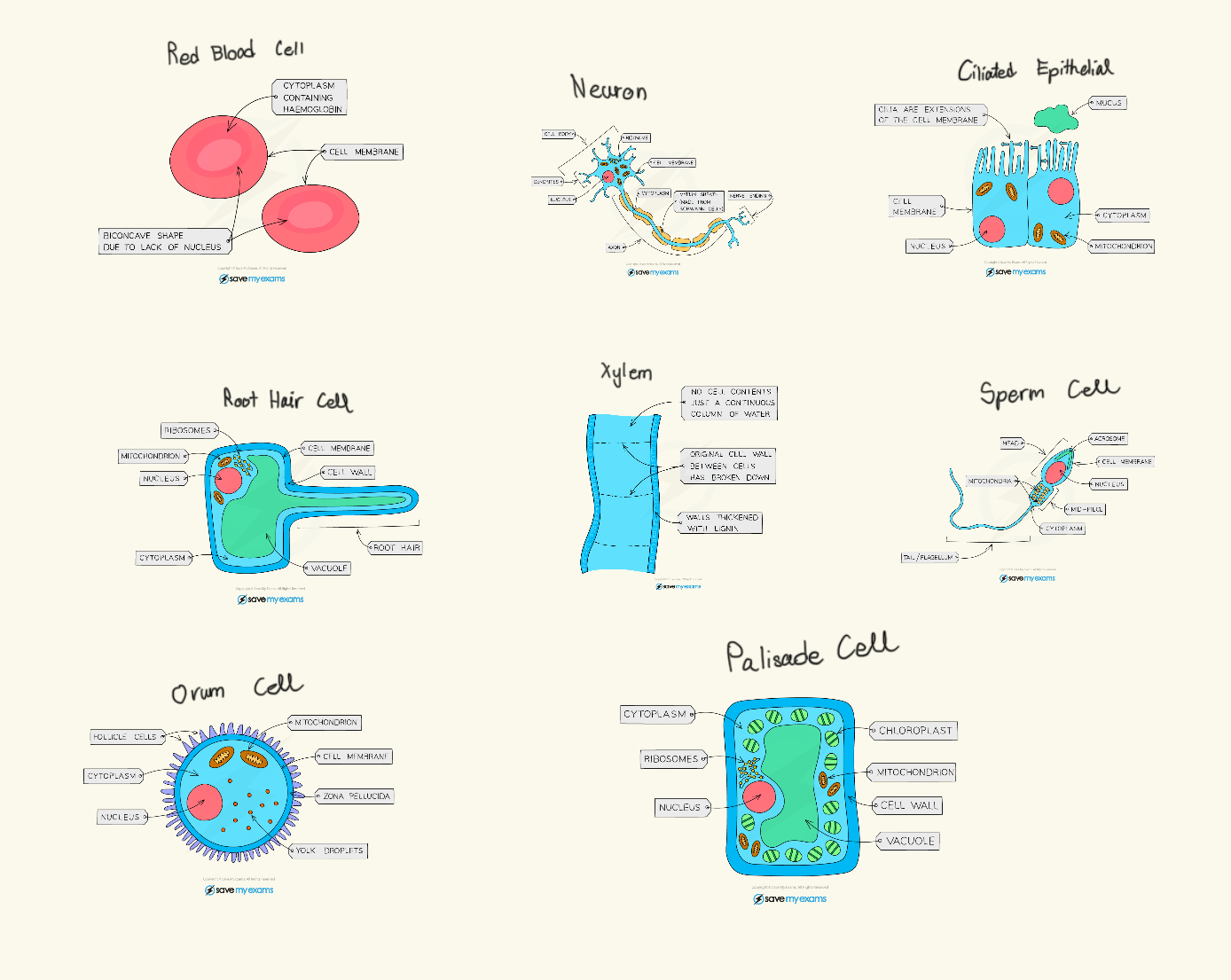
Specialised Cells: Functions and Distinguishing Features
Cell Type | Major Function | Distinguishing Feature from Unspecialised Cells |
|---|---|---|
Red Blood Cell | Oxygen transport | Lacks a nucleus to store more haemoglobin; biconcave shape for increased surface area. |
White Blood Cell | Immune response/Fight infection | Irregular shape allows amoeboid movement; some have granules containing enzymes; many have lobed nuclei. |
Sperm Cell | Male gamete for fertilisation | Has a tail (flagellum) for motility; acrosome contains enzymes to penetrate egg; many mitochondria for energy. |
Ovum (Egg Cell) | Female gamete for fertilisation | Large size due to cytoplasm with nutrient stores; protective layers (zona pellucida). |
Root Hair Cell | Water and mineral absorption | Long, thin extension (root hair) increases surface area for efficient absorption. |
Xylem Cell | Water and mineral transport (plants) | Dead, hollow tubes with lignin thickening for structural support; no end walls for continuous column. |
Phloem Cell | Sugar transport (plants) | Sieve tubes with sieve plates for transport; companion cells provide metabolic support. |
Neuron (Nerve Cell) | Transmit electrical signals | Long axons for long-distance signalling; dendrites to receive signals; myelin sheath for faster impulse. |
Muscle Cell | Contraction for movement | Contains abundant myofibrils with contractile proteins (actin and myosin); many mitochondria for energy. |
Ciliated Epithelial Cell | Move mucus and trapped particles | Possesses cilia (hair-like projections) on its surface that beat in coordinated waves. |
Palisade Cell | Photosynthesis (primary site in plants) | Packed with chloroplasts to absorb sunlight; columnar shape for efficient light absorption. |